


Page 435 - Critical Care Nursing Demystified
P. 435
420        CRITICAL CARE NURSING  DeMYSTIFIED


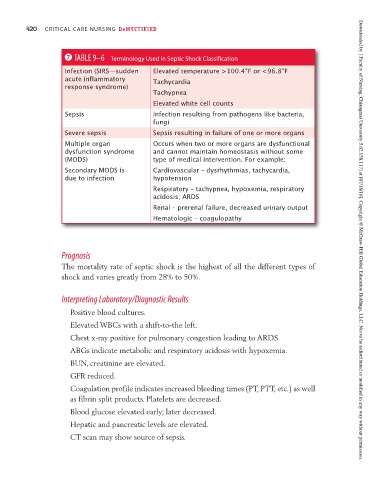
                              7   TABLE 9–6   Terminology Used in Septic Shock Classification
                             Infection (SIRS—sudden   Elevated temperature >100.4°F or < 96.8°F
                             acute inflammatory       Tachycardia
                             response syndrome)
                                                      Tachypnea
                                                      Elevated white cell counts
                             Sepsis                   Infection resulting from pathogens like bacteria,
                                                      fungi
                             Severe sepsis            Sepsis resulting in failure of one or more organs
                             Multiple organ           Occurs when two or more organs are dysfunctional
                             dysfunction syndrome     and cannot maintain homeostasis without some
                             (MODS)                   type of medical intervention. For example:
                             Secondary MODS is        Cardiovascular – dysrhythmias, tachycardia,
                             due to infection         hypotension
                                                      Respiratory – tachypnea, hypoxemia, respiratory
                                                      acidosis; ARDS
                                                      Renal – prerenal failure, decreased urinary output
                                                      Hematologic – coagulopathy


                            Prognosis                                                                           Downloaded by [ Faculty of Nursing, Chiangmai University 5.62.158.117] at [07/18/16]. Copyright © McGraw-Hill Global Education Holdings, LLC. Not to be redistributed or modified in any way without permission.
                            The mortality rate of septic shock is the highest of all the different types of
                            shock and varies greatly from 28% to 50%.


                            Interpreting Laboratory/Diagnostic Results

                               Positive blood cultures.
                               Elevated WBCs with a shift-to-the left.
                               Chest x-ray positive for pulmonary congestion leading to ARDS.
                               ABGs indicate metabolic and respiratory acidosis with hypoxemia.
                               BUN, creatinine are elevated.

                               GFR reduced.
                               Coagulation profile indicates increased bleeding times (PT, PTT, etc.) as well
                               as fibrin split products. Platelets are decreased.
                               Blood glucose elevated early; later decreased.
                               Hepatic and pancreatic levels are elevated.
                               CT scan may show source of sepsis.

