


Page 50 - Critical Care Nursing Demystified
P. 50
Chapter 2  CARE OF THE PATIENT WITH CRITICAL RESPIRATORY NEEDS        35


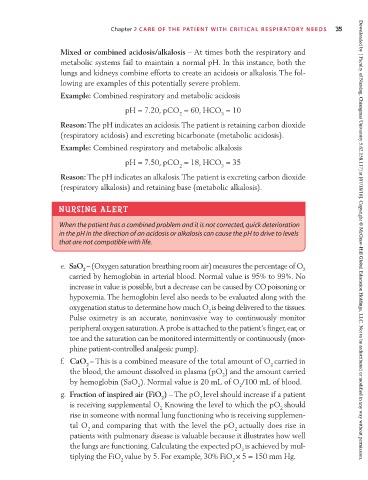
                                 Mixed or combined acidosis/alkalosis – At times both the respiratory and
                                 metabolic systems fail to maintain a normal pH. In this instance, both the
                                 lungs and kidneys combine efforts to create an acidosis or alkalosis. The fol-
                                 lowing are examples of this potentially severe problem.
                                 Example: Combined respiratory and metabolic acidosis
                                                   pH = 7.20, pCO  = 60, HCO  = 10
                                                                  2           3
                                 Reason: The pH indicates an acidosis. The patient is retaining carbon dioxide
                                 (respiratory acidosis) and excreting bicarbonate (metabolic acidosis).
                                 Example: Combined respiratory and metabolic alkalosis
                                                   pH = 7.50, pCO  = 18, HCO  = 35
                                                                  2           3
                                 Reason: The pH indicates an alkalosis. The patient is excreting carbon dioxide
                                 (respiratory alkalosis) and retaining base (metabolic alkalosis).


                                 NURSING ALERT
                                 When the patient has a combined problem and it is not corrected, quick deterioration
                                 in the pH in the direction of an acidosis or alkalosis can cause the pH to drive to levels
                                 that are not compatible with life.                                                 Downloaded by [ Faculty of Nursing, Chiangmai University 5.62.158.117] at [07/18/16]. Copyright © McGraw-Hill Global Education Holdings, LLC. Not to be redistributed or modified in any way without permission.


                                 e.  SaO – (Oxygen saturation breathing room air) measures the percentage of O
                                       2                                                             2
                                   carried by hemoglobin in arterial blood. Normal value is 95% to 99%. No
                                   increase in value is possible, but a decrease can be caused by COpoisoning or

                                   hypoxemia. The hemoglobin level also needs to be evaluated along with the
                                   oxygenation status to determine how much O is being delivered to the tissues.
                                                                          2
                                   Pulse oximetry is an accurate, noninvasive way to continuously monitor
                                   peripheral oxygen saturation. A probe is attached to the patient’s finger, ear, or
                                   toe and the saturation can be monitored intermittently or continuously (mor-
                                   phine patient-controlled analgesic pump).
                                 f.  CaO – This is a combined measure of the total amount of O carried in
                                        2                                                   2
                                    the blood, the amount dissolved in plasma (pO ) and the amount carried
                                                                              2
                                    by hemoglobin (SaO ). Normal value is 20 mL of O /100 mL of blood.
                                                       2                           2
                                 g.  Fraction of inspired air (FiO ) – The pO level should increase if a patient
                                                             2          2
                                    is receiving supplemental O Knowing the level to which the pO should
                                                             2.                               2
                                    rise in someone with normal lung functioning who is receiving supplemen-
                                    tal O and comparing that with the level the pO actually does rise in
                                         2                                        2
                                    patients with pulmonary disease is valuable because it illustrates how well
                                    the lungs are functioning. Calculating the expected pO is achieved by mul-
                                                                                    2
                                    tiplying the FiO value by 5. For example, 30% FiO × 5 = 150 mm Hg.
                                                  2                              2

