


Page 54 - Critical Care Nursing Demystified
P. 54
Chapter 2  CARE OF THE PATIENT WITH CRITICAL RESPIRATORY NEEDS        39


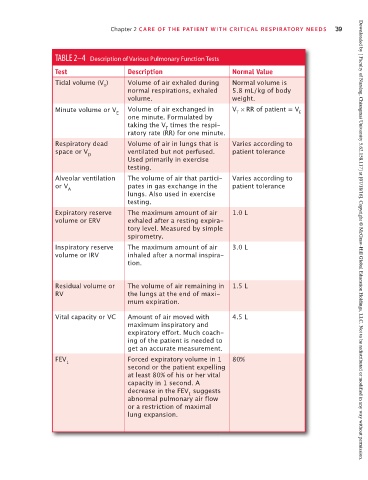
                               TABLE 2–4  Description of Various Pulmonary Function Tests
                               Test                 Description                  Normal Value
                               Tidal volume (V )    Volume of air exhaled during   Normal volume is
                                             T
                                                    normal respirations, exhaled   5.8 mL/kg of body
                                                    volume.                      weight.
                               Minute volume or V   Volume of air exchanged in   V  × RR of patient = V
                                                 E                                T                 E
                                                    one minute. Formulated by
                                                    taking the V  times the respi-
                                                              T
                                                    ratory rate (RR) for one minute.
                               Respiratory dead     Volume of air in lungs that is   Varies according to
                               space or V           ventilated but not perfused.   patient tolerance
                                         D
                                                    Used primarily in exercise
                                                    testing.
                               Alveolar ventilation   The volume of air that partici-  Varies according to
                               or V                 pates in gas exchange in the   patient tolerance
                                   A
                                                    lungs. Also used in exercise
                                                    testing.
                               Expiratory reserve   The maximum amount of air    1.0 L
                               volume or ERV        exhaled after a resting expira-
                                                    tory level. Measured by simple
                                                    spirometry.                                                     Downloaded by [ Faculty of Nursing, Chiangmai University 5.62.158.117] at [07/18/16]. Copyright © McGraw-Hill Global Education Holdings, LLC. Not to be redistributed or modified in any way without permission.
                               Inspiratory reserve   The maximum amount of air   3.0 L
                               volume or IRV        inhaled after a normal inspira-
                                                    tion.


                               Residual volume or   The volume of air remaining in  1.5 L
                               RV                   the lungs at the end of maxi-
                                                    mum expiration.
                               Vital capacity or VC  Amount of air moved with    4.5 L
                                                    maximum inspiratory and
                                                    expiratory effort. Much coach-
                                                    ing of the patient is needed to
                                                    get an accurate measurement.
                               FEV                  Forced expiratory volume in 1   80%
                                   1
                                                    second or the patient expelling
                                                    at least 80% of his or her vital
                                                    capacity in 1 second. A
                                                    decrease in the FEV  suggests
                                                                     1
                                                    abnormal pulmonary air flow
                                                    or a restriction of maximal
                                                    lung expansion.

