


Page 53 - Critical Care Nursing Demystified
P. 53
38        CRITICAL CARE NURSING  DeMYSTIFIED


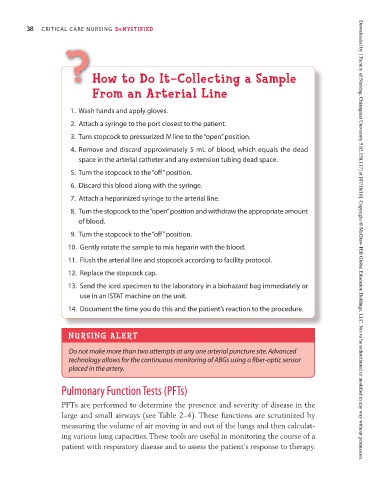
                                     H ?  How to Do It—Collecting a Sample


                                                         t—C
                                                     o I
                                               o D
                                                               o
                                       o
                                                                 l
                                         w t
                                     From an Arterial Line
                                     From an Arterial
                               1.
                                   ash hands and appl
                                                   y
                               1.  Wash hands and apply gloves..

                                 W
                                                        es
                                                       v
                                                     glo
                                  ttach a s
                                 A
                                                               o
                                                       t closest t
                                                                 h
                                                                 t
                                          ringe t
                                         y
                                                  the por
                                                o
                               2.  Attach a syringe to the port closest to the patient.
                               2.

                                            k
                                              to

                                        p
                                         co
                                           c
                                                 essuriz
                                                       ed IV line t
                               3.  Turn stopcock to pressurized IV line to the “open” position.
                                               p
                                                                o t
                                                 r
                               3.
                                  u
                                   rn
                                 T
                                       o
                                     st
                               4.   Remove and discard approximately 5 mL of blood, which equals the dead
                                 space in the arterial catheter and any extension tubing dead space.
                               5.   Turn the stopcock to the “off” position.
                               6.   Discard this blood along with the syringe.
                               7.   Attach a heparinized syringe to the arterial line.
                               8.   Turn the stopcock to the “open” position and withdraw the appropriate amount
                                 of blood.
                               9.   Turn the stopcock to the “off” position.                                    Downloaded by [ Faculty of Nursing, Chiangmai University 5.62.158.117] at [07/18/16]. Copyright © McGraw-Hill Global Education Holdings, LLC. Not to be redistributed or modified in any way without permission.
                              10.   Gently rotate the sample to mix heparin with the blood.
                              11.   Flush the arterial line and stopcock according to facility protocol.
                              12.   Replace the stopcock cap.
                              13.   Send the iced specimen to the laboratory in a biohazard bag immediately or
                                  use in an ISTAT machine on the unit.
                              14.   Document the time you do this and the patient’s reaction to the procedure.
                              NURSING ALERT
                                    Do not make more than two attempts at any one arterial puncture site. Advanced
                              technology allows for the continuous monitoring of ABGs using a fi ber-optic sensor
                              placed in the artery.
                            Pulmonary Function Tests (PFTs)
                            PFTs are performed to determine the presence and severity of disease in the
                            large and small airways (see Table 2–4). These functions are scrutinized by
                            measuring the volume of air moving in and out of the lungs and then calculat-
                            ing various lung capacities. These tools are useful in monitoring the course of a
                            patient with respiratory disease and to assess the patient’s response to therapy.

