


Page 63 - Critical Care Nursing Demystified
P. 63
48        CRITICAL CARE NURSING  DeMYSTIFIED


                               Positive pressure ventilation (PPV) works in reverse of normal breathing. At
                            the end of inspiration during normal ventilation, pressures in the lungs are nega-
                            tive. Using an invasive airway, PPV actively forces air into the lungs during inspi-
                            ration, creating positive pressure at the end of expiration. During exhalation, the
                            air is allowed to passively flow out of the lungs similar to normal breathing.
                            Because of PPV, there are hemodynamic changes in the chest during the initia-
                            tion of MV. PPV can impede blood flow back to the heart in patients who are
                            sensitive to these pressures, dehydrated, or who are hypotensive.


                              NURSING ALERT
                              A patient’s blood pressure (BP) must be frequently monitored after being placed on
                              positive pressure ventilation. Anticipate a drop in BP due to changes in chest pres-
                              sures. NURSING ACTION: Isotonic fluids like normal saline and vasopressors like

                              dopamine may be necessary to maintain a BP greater than 100 systolic.


                            Assessment of the Patient Who Is at High Risk for MV                                Downloaded by [ Faculty of Nursing, Chiangmai University 5.62.158.117] at [07/18/16]. Copyright © McGraw-Hill Global Education Holdings, LLC. Not to be redistributed or modified in any way without permission.
                            Patients at the highest risk for MV are those who cannot maintain a normal
                            blood arterial oxygen level (pO ) or have a high carbon dioxide level (pCO ).
                                                         2                                       2
                            As a rule of thumb, with a decrease in pO  toward 50 and an increase in pCO
                                                                  2                               2
                            greater than 50, aggressive intervention with MV is usually required. There are
                            four broad groups of patients that are at risk for MV. These groups, the prob-
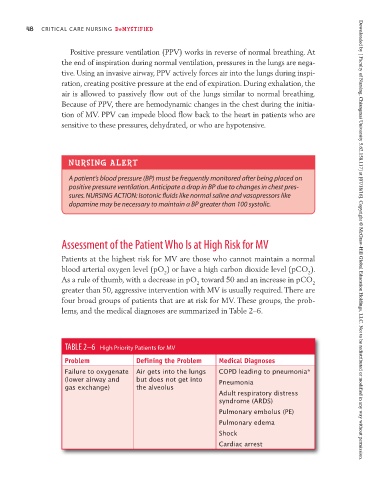
                            lems, and the medical diagnoses are summarized in Table 2–6.


                             TABLE 2–6  High Priority Patients for MV
                             Problem             Defining the Problem   Medical Diagnoses
                             Failure to oxygenate  Air gets into the lungs   COPD leading to pneumonia*
                             (lower airway and   but does not get into   Pneumonia
                             gas exchange)       the alveolus
                                                                        Adult respiratory distress
                                                                        syndrome (ARDS)
                                                                        Pulmonary embolus (PE)
                                                                        Pulmonary edema
                                                                        Shock
                                                                        Cardiac arrest

