


Page 64 - Critical Care Nursing Demystified
P. 64
Chapter 2  CARE OF THE PATIENT WITH CRITICAL RESPIRATORY NEEDS        49


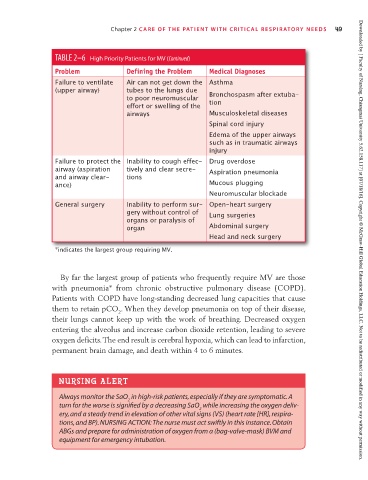
                               TABLE 2–6  High Priority Patients for MV (Continued)
                               Problem             Defining the Problem    Medical Diagnoses
                               Failure to ventilate   Air can not get down the  Asthma
                               (upper airway)      tubes to the lungs due
                                                   to poor neuromuscular   Bronchospasm after extuba-
                                                   effort or swelling of the   tion
                                                   airways                 Musculoskeletal diseases
                                                                           Spinal cord injury
                                                                           Edema of the upper airways
                                                                           such as in traumatic airways
                                                                           injury
                               Failure to protect the  Inability to cough effec-  Drug overdose
                               airway (aspiration   tively and clear secre-  Aspiration pneumonia
                               and airway clear-   tions
                               ance)                                       Mucous plugging
                                                                           Neuromuscular blockade
                               General surgery     Inability to perform sur- Open-heart surgery
                                                   gery without control of   Lung surgeries
                                                   organs or paralysis of
                                                   organ                   Abdominal surgery
                                                                           Head and neck surgery                    Downloaded by [ Faculty of Nursing, Chiangmai University 5.62.158.117] at [07/18/16]. Copyright © McGraw-Hill Global Education Holdings, LLC. Not to be redistributed or modified in any way without permission.
                               ∗ indicates the largest group requiring MV.


                                 By far the largest group of patients who frequently require MV are those
                               with pneumonia* from chronic obstructive pulmonary disease (COPD).
                               Patients with COPD have long-standing decreased lung capacities that cause
                               them to retain pCO . When they develop pneumonia on top of their disease,
                                                 2
                               their lungs cannot keep up with the work of breathing. Decreased oxygen
                               entering the alveolus and increase carbon dioxide retention, leading to severe
                               oxygen deficits. The end result is cerebral hypoxia, which can lead to infarction,
                               permanent brain damage, and death within 4 to 6 minutes.


                                 NURSING ALERT
                                 Always monitor the SaO  in high-risk patients, especially if they are symptomatic. A
                                                    2
                                 turn for the worse is signified by a decreasing SaO  while increasing the oxygen deliv-

                                                                        2
                                 ery, and a steady trend in elevation of other vital signs (VS) (heart rate [HR], respira-
                                 tions, and BP). NURSING ACTION: The nurse must act swiftly in this instance. Obtain
                                 ABGs and prepare for administration of oxygen from a (bag-valve-mask) BVM and
                                 equipment for emergency intubation.

