


Page 66 - Critical Care Nursing Demystified
P. 66
Chapter 2  CARE OF THE PATIENT WITH CRITICAL RESPIRATORY NEEDS        51


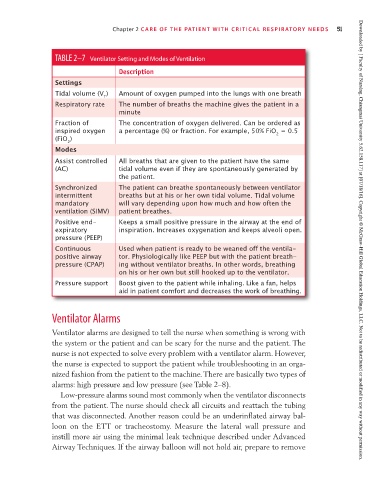
                               TABLE 2–7  Ventilator Setting and Modes of Ventilation
                                                 Description
                               Settings
                               Tidal volume (V )  Amount of oxygen pumped into the lungs with one breath
                                             T
                               Respiratory rate  The number of breaths the machine gives the patient in a
                                                 minute
                               Fraction of       The concentration of oxygen delivered. Can be ordered as
                               inspired oxygen   a percentage (%) or fraction. For example, 50% FiO  = 0.5
                                                                                             2
                               (FiO )
                                   2
                               Modes
                               Assist controlled   All breaths that are given to the patient have the same
                               (AC)              tidal volume even if they are spontaneously generated by
                                                 the patient.
                               Synchronized      The patient can breathe spontaneously between ventilator
                               intermittent      breaths but at his or her own tidal volume. Tidal volume
                               mandatory         will vary depending upon how much and how often the
                               ventilation (SIMV)  patient breathes.
                               Positive end-     Keeps a small positive pressure in the airway at the end of
                               expiratory        inspiration. Increases oxygenation and keeps alveoli open.
                               pressure (PEEP)                                                                      Downloaded by [ Faculty of Nursing, Chiangmai University 5.62.158.117] at [07/18/16]. Copyright © McGraw-Hill Global Education Holdings, LLC. Not to be redistributed or modified in any way without permission.
                               Continuous        Used when patient is ready to be weaned off the ventila-
                               positive airway   tor. Physiologically like PEEP but with the patient breath-
                               pressure (CPAP)   ing without ventilator breaths. In other words, breathing
                                                 on his or her own but still hooked up to the ventilator.
                               Pressure support  Boost given to the patient while inhaling. Like a fan, helps
                                                 aid in patient comfort and decreases the work of breathing.


                               Ventilator Alarms

                               Ventilator alarms are designed to tell the nurse when something is wrong with
                               the system or the patient and can be scary for the nurse and the patient. The
                               nurse is not expected to solve every problem with a ventilator alarm. However,
                               the nurse is expected to support the patient while troubleshooting in an orga-
                               nized fashion from the patient to the machine. There are basically two types of
                               alarms: high pressure and low pressure (see Table 2–8).
                                 Low-pressure alarms sound most commonly when the ventilator disconnects
                               from the patient. The nurse should check all circuits and reattach the tubing
                               that was disconnected. Another reason could be an underinflated airway bal-
                               loon on the ETT or tracheostomy. Measure the lateral wall pressure and
                               instill more air using the minimal leak technique described under Advanced
                               Airway Techniques. If the airway balloon will not hold air, prepare to remove

