


Page 67 - Critical Care Nursing Demystified
P. 67
52        CRITICAL CARE NURSING  DeMYSTIFIED


                             TABLE 2–8  Ventilator Alarms
                             Causes              Nursing Actions
                             Low-pressure alarms
                             Disconnection from  Find the location of the disconnect and reconnect the
                             patient             tubing to the patient
                             Underinflated       Determine the LWP by minimal leak technique and
                             balloon of ETT or   recheck the LWP. If leak continues, notify the person
                             tracheostomy        responsible for reintubating the patient and gather
                                                 supplies to assist with the procedure.
                             High-pressure alarms
                             Tubing is kinked or  Release the kink. Usually this is a situation where the
                             caught  somewhere   patient is lying on the tubing or it is accidentally caught
                                                 in the bedside rail.
                             Patient is biting on   Insert a bite block (oral airway) so the patient can not
                             the ETT             bite on the ETT; patient may need sedation.
                             Patient needs       Auscultate the lung fields; suction the patient and then
                             suctioning          reassess the lung fields. If it is an emergency, suction first!
                                                 Auscultation then can be done after clearing the airway.
                             Patient is anxious   Use therapeutic communications to help relax the
                             and fighting or     patient. Ask yes/no questions, which give the patient a
                             “bucking” the ETT   sense of control. Sedatives and paralytics might be            Downloaded by [ Faculty of Nursing, Chiangmai University 5.62.158.117] at [07/18/16]. Copyright © McGraw-Hill Global Education Holdings, LLC. Not to be redistributed or modified in any way without permission.
                             and ventilator      needed as a last resort.
                             Change in lung      Perform a physical assessment. If the lungs fill with fluid
                             compliance          (heart failure, pulmonary edema), the patient may need
                                                 a chest x-ray (CXR), diuretic, and cardiac medications
                                                 to improve cardiac functioning. If the patient has a
                                                 pneumothorax, it is best to ventilate with a BVM until
                                                 help arrives.


                            and reinsert another invasive airway. This should be done by a respiratory ther-
                            apist or trained health care provider.
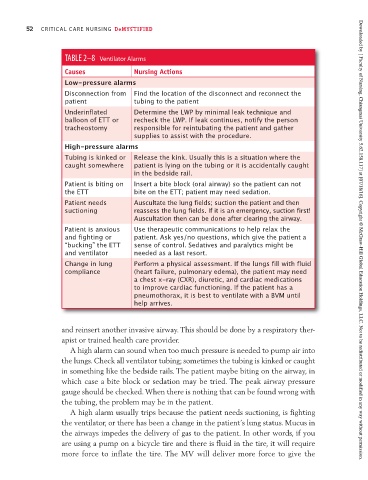
                               A high alarm can sound when too much pressure is needed to pump air into
                            the lungs. Check all ventilator tubing; sometimes the tubing is kinked or caught
                            in something like the bedside rails. The patient maybe biting on the airway, in
                            which case a bite block or sedation may be tried. The peak airway pressure
                            gauge should be checked. When there is nothing that can be found wrong with
                            the tubing, the problem may be in the patient.
                               A high alarm usually trips because the patient needs suctioning, is fighting
                            the ventilator, or there has been a change in the patient’s lung status. Mucus in
                            the airways impedes the delivery of gas to the patient. In other words, if you
                            are using a pump on a bicycle tire and there is fluid in the tire, it will require
                            more force to inflate the tire. The MV will deliver more force to give the

