


Page 307 - Color_Atlas_of_Physiology_5th_Ed._-_A._Despopoulos_2003
P. 307
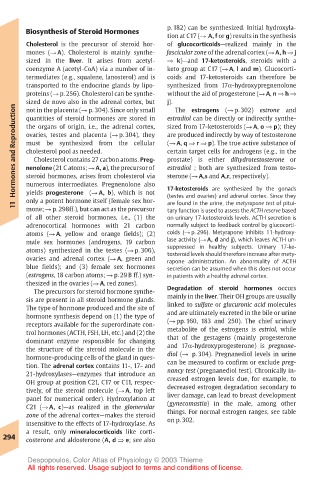
Biosynthesis of Steroid Hormones  p. 182) can be synthesized. Initial hydroxyla-
                                       tion at C17 (! A, f or g) results in the synthesis
       Cholesterol is the precursor of steroid hor-  of glucocorticoids—realized mainly in the
       mones (! A). Cholesterol is mainly synthe-  fascicular zone of the adrenal cortex (! A, h ! j
       sized in the liver. It arises from acetyl-  ! k)—and 17-ketosteroids, steroids with a
       coenzyme A (acetyl-CoA) via a number of in-  keto group at C17 (! A, l and m). Glucocorti-
       termediates (e.g., squalene, lanosterol) and is  coids and 17-ketosteroids can therefore be
       transported to the endocrine glands by lipo-  synthesized from 17α-hydroxypregnenolone
       proteins (! p. 256). Cholesterol can be synthe-  without the aid of progesterone (! A, n ! h !
       sized de novo also in the adrenal cortex, but  j).  The  estrogens  (! p. 302)  estrone  and
    Hormones and Reproduction  ovaries, testes and placenta (! p. 304), they  are produced indirectly by way of testosterone
       not in the placenta (! p. 304). Since only small
                                       estradiol can be directly or indirectly synthe-
       quantities of steroid hormones are stored in
                                       sized from 17-ketosteroids (! A, o ! p); they
       the organs of origin, i.e., the adrenal cortex,
                               cellular
                            the
                                       (! A, q ! r ! p). The true active substance of
       must
           be
              synthesized
                       from
                                       certain target cells for androgens (e.g., in the
       cholesterol pool as needed.
                                       prostate) is either dihydrotestosterone or
         Cholesterol contains 27 carbon atoms. Preg-
                                       estradiol ; both are synthesized from testo-
       nenolone (21 C atoms; ! A, a), the precursor of
                                       sterone (! A,s and A,r, respectively).
       steroid hormones, arises from cholesterol via
       yields progesterone (! A, b), which is not
                                       (testes and ovaries) and adrenal cortex. Since they
       only a potent hormone itself (female sex hor-
                                       are found in the urine, the metyrapone test of pitui-
    11  numerous intermediates. Pregnenolone also  17-ketosteroids are synthesized by the gonads
       mone; ! p. 298ff.), but can act as the precursor
                                       tary function is used to assess the ACTH reserve based
       of all other steroid hormones, i.e., (1) the  on urinary 17-ketosteroids levels. ACTH secretion is
       adrenocortical hormones with 21 carbon  normally subject to feedback control by glucocorti-
       atoms (! A, yellow and orange fields); (2)  coids (! p. 296). Metyrapone inhibits 11-hydroxy-
       male sex hormones (androgens, 19 carbon  lase activity (! A, d and j), which leaves ACTH un-
       atoms) synthesized in the testes (! p. 306),  suppressed in healthy subjects. Urinary 17-ke-
                                       tosteroid levels should therefore increase after mety-
       ovaries and adrenal cortex (! A, green and  rapone administration. An abnormality of ACTH
       blue fields); and (3) female sex hormones  secretion can be assumed when this does not occur
       (estrogens, 18 carbon atoms; ! p. 29 B ff.) syn-  in patients with a healthy adrenal cortex.
       thesized in the ovaries (! A, red zones).
         The precursors for steroid hormone synthe-  Degradation of steroid hormones occurs
       sis are present in all steroid hormone glands.  mainly in the liver. Their OH groups are usually
       The type of hormone produced and the site of  linked to sulfate or glucuronic acid molecules
       hormone synthesis depend on (1) the type of  and are ultimately excreted in the bile or urine
       receptors available for the superordinate con-  (! pp. 160, 183 and 250). The chief urinary
       trol hormones (ACTH, FSH, LH, etc.) and (2) the  metabolite of the estrogens is estriol, while
       dominant enzyme responsible for changing  that of the gestagens (mainly progesterone
       the structure of the steroid molecule in the  and 17α-hydroxyprogesterone) is pregnane-
       hormone-producing cells of the gland in ques-  diol (! p. 304). Pregnanediol levels in urine
       tion. The adrenal cortex contains 11-, 17- and  can be measured to confirm or exclude preg-
       21-hydroxylases—enzymes that introduce an  nancy test (pregnanediol test). Chronically in-
       OH group at position C21, C17 or C11, respec-  creased estrogen levels due, for example, to
       tively, of the steroid molecule (! A, top left  decreased estrogen degradation secondary to
       panel for numerical order). Hydroxylation at  liver damage, can lead to breast development
       C21 (! A, c)—as realized in the glomerular  (gynecomastia) in the male, among other
       zone of the adrenal cortex—makes the steroid  things. For normal estrogen ranges, see table
       insensitive to the effects of 17-hydroxylase. As  on p. 302.
       a result, only mineralocorticoids like corti-
  294  costerone and aldosterone (A, d ! e; see also
       Despopoulos, Color Atlas of Physiology © 2003 Thieme
       All rights reserved. Usage subject to terms and conditions of license.

