


Page 1148 - Hall et al (2015) Principles of Critical Care-McGraw-Hill
P. 1148
CHAPTER 86: Intracranial Pressure: Monitoring and Management  787


                    fixed space of the calvarium must be carefully regulated by many mecha-  The structures between the brain surface and the inner skull,
                    nisms in order to be maintained within a physiologic range. Disruption   the meningeal layers, are important in identifying and maintaining
                    of these mechanisms through trauma, space-occupying lesions, or   normal ICP. The most important of these is the subarachnoid space
                    edema leads to dysregulation of the delicate balance required to main-  where the arachnoid villi conduct cerebrospinal fluid (CSF) from the
                    tain normal pressure that results in significant neurologic and systemic   subarachnoid space to the venous sinuses. If these granulations are
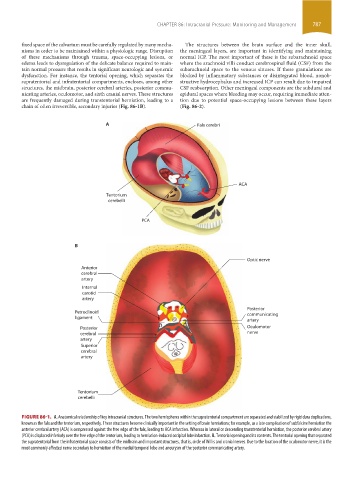
                    dysfunction. For instance, the tentorial opening, which separates the   blocked by inflammatory substances or disintegrated blood, nonob-
                    supratentorial and infratentorial compartments, encloses, among other   structive hydrocephalus and increased ICP can result due to impaired
                    structures, the midbrain, posterior cerebral arteries, posterior commu-  CSF reabsorption. Other meningeal components are the subdural and
                    nicating arteries, oculomotor, and sixth cranial nerves. These structures   epidural spaces where bleeding may occur, requiring immediate atten-
                    are frequently damaged during transtentorial herniation, leading to a   tion due to potential space-occupying lesions between these layers
                    chain of often irreversible, secondary injuries (Fig. 86-1B).  (Fig. 86-2).


                                                A                              Falx cerebri


                                                                                              ACA

                                                Tentorium
                                                 cerebelli


                                                            PCA


                                      B

                                                                                                Optic nerve
                                        Anterior
                                        cerebral
                                        artery
                                        Internal
                                        carotid
                                        artery
                                                                                                Posterior
                                      Petroclinoid                                              communicating
                                      ligament
                                                                                                artery
                                        Posterior                                               Oculomotor
                                        cerebral                                                nerve
                                        artery
                                        Superior
                                        cerebral
                                        artery


                                       Tentorium
                                       cerebelli


                    FIGURE 86-1.  A. Anatomical relationship of key intracranial structures. The two hemispheres within the supratentorial compartment are separated and stabilized by rigid dura duplications,
                    known as the falx and the tentorium, respectively. These structures become clinically important in the setting of brain herniations; for example, as a late complication of subfalcine herniation the
                    anterior cerebral artery (ACA) is compressed against the free edge of the falx, leading to ACA infarction. Whereas in lateral or descending transtentorial herniation, the posterior cerebral artery
                    (PCA) is displaced inferiorly over the free edge of the tentorium, leading to herniation-induced occipital lobe infarction. B. Tentorial opening and its contents. The tentorial opening that separated
                    the supratentorial from the infratentorial space consists of the midbrain and important structures, that is, circle of Willis and cranial nerves. Due to the location of the oculomotor nerve, it is the
                    most commonly affected nerve secondary to herniation of the medial temporal lobe and aneurysm of the posterior communicating artery.


            section06.indd   787                                                                                       1/23/2015   12:55:43 PM

