


Page 1150 - Hall et al (2015) Principles of Critical Care-McGraw-Hill
P. 1150
CHAPTER 86: Intracranial Pressure: Monitoring and Management  789


                      TABLE 86-1    Causes of Elevated Intracranial Pressure                  Simultaneous ECG
                    Primary (Intracranial)    Secondary (Extracranial)
                                                                                200                                   40
                    Nontraumatic              Airway obstruction                              Arterial pressure
                       Intracranial hemorrhages (parenchymal,  Hypoventilation
                       subarachnoid, subdural, epidural)  Hypoxia               150                                   30
                       Ischemic infarction    Hypercarbia
                       Hydrocephalus (communicating and   Head position or posture  Systemic arterial pressure           Intracranial pressure
                         noncommunicating)    Venous outflow obstruction
                       Brain edema            Hyperpyrexia                      100                                   20
                       Brain tumor            Hyponatremia
                       Status epilepticus     Agitation, pain
                       Cerebral venous thrombosis  Diabetic ketoacidosis         50                                   10
                       Cerebral vasospasm     Eclampsia or hypertensive encephalopathy       Intracranial pressure
                       Infection (ie, encephalitis, meningitis,   Convulsive or nonconvulsive seizure
                       abscess, etc)          Increased intrathoracic or intra-abdominal   0                          0
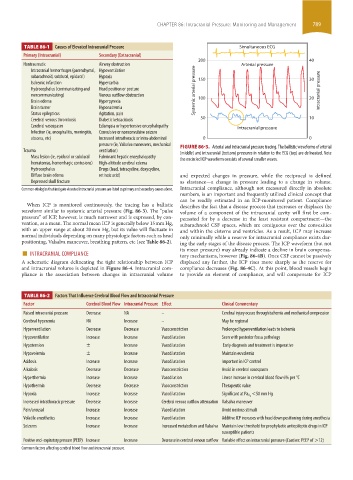
                                                pressure (ie, Valsalva maneuvers,  mechanical   FIGURE 86-3.  Arterial and intracranial pressure tracing. The ballistic waveforms of arterial
                    Trauma                    ventilation)                (middle) and intracranial (bottom) pressures in relation to the ECG (top) are delineated. Note
                       Mass lesion (ie, epidural or subdural   Fulminant hepatic encephalopathy  the encircled ICP waveform consists of several smaller waves.
                         hematomas, hemorrhagic contusions)  High-altitude cerebral edema
                       Hydrocephalus          Drugs (lead, tetracycline, doxycycline,
                       Diffuse brain edema    retinoic acid)              and expected changes in pressure, while the reciprocal is defined
                       Depressed skull fracture                           as   elastance—a change in pressure leading to a change in volume.
                    Common etiologies that instigate elevated intracranial pressure are listed as primary and secondary causes above.  Intracranial compliance, although not measured directly in absolute
                                                                          numbers, is an important and frequently utilized clinical concept that
                                                                          can be readily estimated in an ICP-monitored patient. Compliance
                     When ICP is monitored continuously, the tracing has a ballistic   describes the fact that a disease process that increases or displaces the
                    waveform similar to systemic arterial pressure (Fig. 86-3). The “pulse   volume of a component of the intracranial cavity will first be com-
                    pressure” of ICP, however, is much narrower and is expressed, by con-  pensated for by a decrease in the least resistant compartment—the
                    vention, as a mean. The normal mean ICP is generally below 15 mm Hg,   subarachnoid CSF spaces, which are contiguous over the convexities
                    with an upper range at about 20 mm Hg, but its value will fluctuate in   and within the cisterns and ventricles. As a result, ICP may increase
                    normal individuals depending on many physiologic factors such as head   only minimally while a reserve for intracranial compliance exists dur-
                    positioning, Valsalva maneuver, breathing pattern, etc (see Table 86-2).  ing the early stages of the disease process. The ICP waveform (but not
                        ■  INTRACRANIAL COMPLIANCE                        its mean pressure) may already indicate a decline in brain compensa-
                                                                          tory mechanisms, however (Fig. 86-4B). Once CSF cannot be passively
                    A schematic diagram delineating the tight relationship between ICP   displaced any further, the ICP rises more sharply as the reserve for
                    and intracranial volume is depicted in Figure 86-4. Intracranial com-  compliance decreases (Fig. 86-4C). At this point, blood vessels begin
                    pliance  is  the  association  between changes  in  intracranial volume   to provide an element of compliance, and will compensate for ICP


                      TABLE 86-2    Factors That Influence Cerebral Blood Flow and Intracranial Pressure
                    Factor                Cerebral Blood Flow Intracranial Pressure Effect  Clinical Commentary
                    Raised intracranial pressure  Decrease  NA     –                    Cerebral injury occurs through ischemia and mechanical compression
                    Cerebral hyperemia    NA           Increase    –                    May be regional
                    Hyperventilation      Decrease     Decrease    Vasoconstriction     Prolonged hyperventilation leads to ischemia
                    Hypoventilation       Increase     Increase    Vasodilatation       Seen with posterior fossa pathology
                    Hypotension           ±            Increase    Vasodilatation        Early diagnosis and treatment is imperative
                    Hypovolemia           ±            Increase    Vasodilatation       Maintain euvolemia
                    Acidosis              Increase     Increase    Vasodilatation       Important in ICP control
                    Alkalosis             Decrease     Decrease    Vasoconstriction     Avoid in cerebral vasospasm
                    Hyperthermia          Increase     Increase    Vasodilation         Linear increase in cerebral blood flow 6% per °C
                    Hypothermia           Decrease     Decrease    Vasoconstriction     Therapeutic value
                    Hypoxia               Increase     Increase    Vasodilatation       Significant at Pa O 2  <50 mm Hg
                    Increased intrathoracic pressure  Decrease  Increase  Cerebral venous outflow attenuation Valsalva maneuver
                    Pain/arousal          Increase     Increase    Vasodilatation       Avoid noxious stimuli
                    Volatile anesthetics  Increase     Increase    Vasodilatation       Additive ICP increases with head down positioning during anesthesia
                    Seizures              Increase     Increase    Increased metabolism and Valsalva Maintain low threshold for prophylactic antiepileptic drugs in ICP
                                                                                          susceptible patients
                    Positive end- expiratory pressure (PEEP) Increase  Increase  Decrease in cerebral venous outflow Variable effect on intracranial pressure (Caution: PEEP of >12)
                    Common factors affecting cerebral blood flow and intracranial pressure.


            section06.indd   789                                                                                       1/23/2015   12:55:46 PM

