


Page 1153 - Hall et al (2015) Principles of Critical Care-McGraw-Hill
P. 1153
792     PART 6: Neurologic Disorders


                                                              Autoregulatory curve
                                                 Passive  Maximum  Zone of normal  Maximum
                                                Collapse  Dilatation  Autoregulation  Constriction


                                       Cerebral blood flow (mL/100 g/min)  75                     4.0 Cerebral blood volume (mL/100 g)
                                        100


                                         50


                                         25

                                          0
                                                  25    50    75   100   125   150   175   200
                                                        Cerebral perfusion pressure (mm Hg)
                                            Legend:
                                                  Normal autoregulation
                                                  Cerebrovascular resistance
                                                  Cerebral blood volume
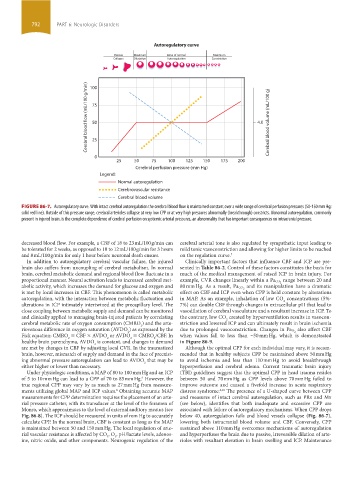
                 FIGURE 86-7.  Autoregulatory curve. With intact cerebral autoregulation the cerebral blood flow is maintained constant over a wide range of cerebral perfusion pressures (50-150 mm Hg;
                 solid red line). Outside of this pressure range, cerebral arterioles collapse at very low CPP or at very high pressures abnormally (breakthrough) constricts. Abnormal autoregulation, commonly
                 present in injured brain, is the complete dependence of cerebral perfusion on systemic arterial pressures, an abnormality that has important consequences on intracranial pressure.


                 decreased blood flow. For example, a CBF of 18 to 23 mL/100 g/min can   cerebral arterial tone is also regulated by sympathetic input leading to
                 be tolerated for 2 weeks, as opposed to 10 to 12 mL/100 g/min for 3 hours   mild tonic vasoconstriction and allowing for higher limits to be reached
                 and 8 mL/100 g/min for only 1 hour before neuronal death ensues.  on the regulation curve. 7
                   In addition to autoregulatory cerebral vascular failure, the injured   Clinically important factors that influence CBF and ICP are pre-
                 brain also suffers from uncoupling of cerebral metabolism. In normal   sented in Table 86-2. Control of these factors constitutes the basis for
                 brain, cerebral metabolic demand and regional blood flow fluctuate in a   much of the medical management of raised ICP in brain injury. For
                 proportional manner. Neural activation leads to increased cerebral met-  example, CVR changes linearly within a Pa CO 2  range between 20 and
                 abolic activity, which increases the demand for glucose and oxygen and   80 mm Hg. As a result, Pa CO 2  and its manipulation have a dramatic
                 is met by local increases in CBF. This phenomenon is called metabolic   effect on CBF and ICP even when CPP is held constant by alterations
                 autoregulation, with the interaction between metabolic fluctuation and   in MAP. As an example, inhalation of low CO  concentrations (5%-
                                                                                                          2
                 alterations in ICP intimately intertwined at the precapillary level. The   7%) can double CBF through changes in extracellular pH that lead to
                 close coupling between metabolic supply and demand can be monitored   vasodilation of cerebral vasculature and a resultant increase in ICP. To
                 and clinically applied to managing brain-injured patients by correlating   the contrary, low CO  created by hyperventilation results in vasocon-
                                                                                       2
                 cerebral metabolic rate of oxygen consumption (CMRO ) and the arte-  striction and lowered ICP and can ultimately result in brain  ischemia
                                                          2
                 riovenous difference in oxygen saturation (AVDO ) as expressed by the   due to prolonged vasoconstriction. Changes in Pa O 2  also affect CBF
                                                     2
                 Fick equation: CMRO  = CBF × AVDO  or AVDO  = CMRO /CBF. In   when  values fall to  less than  ~50 mm Hg,  which is  demonstrated
                                                              2
                                              2
                                                      2
                                 2
                 healthy brain parenchyma, AVDO  is constant, and changes in demand   in Figure 86-9.
                                          2
                 are met by changes in CBF by adjusting local CVR. In the traumatized   Although the optimal CPP for each individual may vary, it is recom-
                 brain, however, mismatch of supply and demand in the face of preexist-  mended that in healthy subjects CPP be maintained above 50 mm Hg
                 ing abnormal pressure autoregulation can lead to AVDO  that may be   to avoid ischemia and less than 110 mm Hg to avoid breakthrough
                                                           2
                 either higher or lower than necessary.                hyperperfusion and cerebral edema. Current traumatic brain injury
                   Under physiologic conditions, a MAP of 80 to 100 mm Hg and an ICP   (TBI) guidelines suggest that the optimal CPP in head trauma resides
                 of 5 to 10 mm Hg can lead to a CPP of 70 to 85 mm Hg.  However, the   between 50 and 70 mm Hg as CPP levels above 70 mm Hg failed to
                                                          9
                 true regional CPP may vary by as much as 27 mm Hg from measure-  improve outcome and caused a fivefold increase in acute respiratory
                 ments utilizing global MAP and ICP values.  Obtaining accurate MAP   distress  syndrome.  The presence of a U-shaped curve between CPP
                                                                                     6,10
                                                 8
                 measurements for CPP determination requires the placement of an arte-  and measures of intact cerebral autoregulation, such as PRx and Mx
                 rial pressure catheter, with its transducer at the level of the foramen of   (see  below),  identifies  that  both  inadequate  and  excessive  CPP  are
                 Monro, which approximates to the level of external auditory meatus (see   associated with failure of autoregulatory mechanisms. When CPP drops
                 Fig. 86-8). The ICP should be measured in units of mm Hg to accurately   below 40, autoregulation fails and blood vessels collapse (Fig. 86-7),
                 calculate CPP. In the normal brain, CBF is constant as long as the MAP   lowering both intracranial blood volume and CBF. Conversely, CPP
                 is maintained between 50 and 150 mm Hg. The local regulation of arte-  sustained above 110 mm Hg overcomes mechanisms of autoregulation
                 rial vascular resistance is affected by CO , O , pH/lactate levels, adenos-  and hyperperfuses the brain due to passive, irreversible dilation of arte-
                                              2
                                                 2
                 ine, nitric oxide, and other components. Neurogenic regulation of the   rioles with resultant elevation in brain swelling and ICP. Maintenance


            section06.indd   792                                                                                       1/23/2015   12:55:49 PM

