


Page 1149 - Hall et al (2015) Principles of Critical Care-McGraw-Hill
P. 1149
788     PART 6: Neurologic Disorders


                                                               Epidural    Arachnoid
                                                                                       Pia mater
                                                          Dura                                Skull
                                                         mater
                                                                                                   Skin
                                                                                                     Subdural


                                                                     Brain


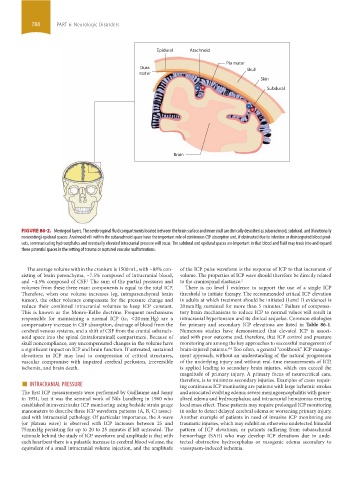
                 FIGURE 86-2.  Meningeal layers. The cerebrospinal fluid compartments located between the brain surface and inner skull are clinically described as subarachnoid, subdural, and (functionally
                 nonexisting) epidural spaces. Arachnoid villi within the subarachnoid space have the important role of continuous CSF absorption and, if obstructed due to infection or disintegrated blood prod-
                 ucts, communicating hydrocephalus and eventually elevated intracranial pressure will occur. The subdural and epidural spaces are important in that blood and fluid may track into and expand
                 these potential spaces in the setting of trauma or ruptured vascular malformations.


                   The average volume within the cranium is 1500 mL, with ~88% con-  of the ICP pulse waveform is the response of ICP to that increment of
                 sisting of brain parenchyma, ~7.5% composed of intracranial blood,   volume. The properties of ICP wave should therefore be directly related
                 and ~4.5% composed of CSF.  The sum of the partial pressures and   to the craniospinal elastance. 2
                                       1
                 volumes from these three main components is equal to the total ICP.   There is no level I evidence to support the use of a single ICP
                 Therefore, when one volume increases (eg, intraparenchymal brain   threshold to initiate therapy. The recommended critical ICP elevation
                 tumor), the other volumes compensate for the pressure change and   in adults at which treatment should be initiated (Level II evidence) is
                 reduce their combined intracranial volumes to keep ICP constant.   20 mm Hg sustained for more than 5 minutes.  Failure of compensa-
                                                                                                          3
                 This is known as the Monro-Kellie doctrine. Frequent mechanisms   tory brain mechanisms to reduce ICP to normal values will result in
                 responsible for maintaining a normal ICP (ie,  <20 mm Hg)  are  a   intracranial hypertension and its clinical sequelae. Common etiologies
                 compensatory increase in CSF absorption, drainage of blood from the   for primary and secondary ICP elevations are listed in  Table 86-1.
                 cerebral venous systems, and a shift of CSF from the cranial subarach-  Numerous studies have demonstrated that elevated ICP is associ-
                 noid space into the spinal (intraforaminal) compartment. Because of   ated with poor outcome and, therefore, that ICP control and pressure
                 skull noncompliance, any uncompensated changes in the volume have   monitoring are among the key approaches to successful management of
                 a significant impact on ICP and brain function. If untreated, sustained   brain-injured patients.  Too often, a general “cookbook” ICP manage-
                                                                                        4-6
                 elevations in ICP may lead to compression of critical structures,   ment approach, without an understanding of the natural progression
                 vascular compromise with impaired cerebral perfusion, irreversible   of the underlying injury and without real-time measurements of ICP,
                 ischemia, and brain death.                            is applied leading to secondary brain injuries, which can exceed the
                                                                       magnitude of primary injury. A primary focus of neurocritical care,
                     ■  INTRACRANIAL PRESSURE                          therefore, is to minimize secondary injuries. Examples of cases requir-
                                                                       ing continuous ICP monitoring are patients with large ischemic strokes
                 The first ICP measurements were performed by Guillaume and Janny   and associated evolving edema; severe meningoencephalitis with gener-
                 in  1951,  but  it  was  the  seminal  work  of  Nils  Lundberg  in  1960  who   alized edema and hydrocephalus; and intracranial hematomas exerting
                 established intraventricular ICP monitoring using bedside strain gauge   local mass effect. These patients may require prolonged ICP monitoring
                 manometers to describe three ICP waveform patterns (A, B, C) associ-  in order to detect delayed cerebral edema or worsening primary injury.
                 ated with intracranial pathology. Of particular importance, the A-wave   Another example of patients in need of invasive ICP monitoring are
                 (or plateau wave) is observed with ICP increases between 25 and   traumatic injuries, which may exhibit an otherwise undetected bimodal
                 75 mm Hg persisting for up to 20 to 25 minutes if left untreated. The   pattern of ICP elevations, or patients suffering from subarachnoid
                 rationale behind the study of ICP waveform and amplitude is that with   hemorrhage (SAH) who may develop ICP elevations due to unde-
                 each heartbeat there is a pulsatile increase in cerebral blood volume, the   tected obstructive hydrocephalus or vasogenic edema secondary to
                 equivalent of a small intracranial volume injection, and the amplitude   vasospasm-induced ischemia.


            section06.indd   788                                                                                       1/23/2015   12:55:45 PM

