


Page 143 - Hall et al (2015) Principles of Critical Care-McGraw-Hill
P. 143
CHAPTER 15: Long-Term Outcomes After Critical Illness  109


                                          Sepsis/SIRS
                                    Microvascular disruption
                                    Endotoxin-induced mitochondrial
                                    dysfunction
                                    Eicosanoids/cytokines/reactive O /NO
                                                          2
                     Hyperglycemia                          Drugs
                      Mitochondrial  ICU-Acquired Weakness  NMB
                      dysfunction                          Aminoglycosides
                      Assymmetric                          Corticosteroids
                      dimethylarginine
                      Proinflammatory
                      transcription       Immobility
                                          IL-1, IL-6, TNF-
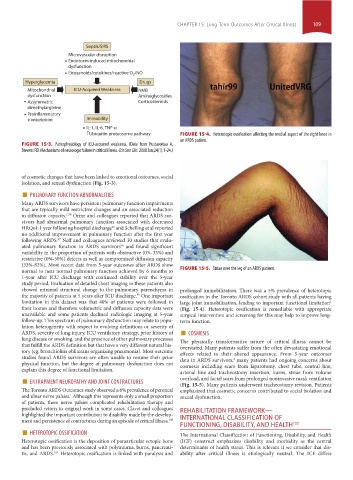
                                           Ubiquitin proteosome pathway   FIGURE 15-4.  Heterotopic ossification affecting the medial aspect of the right knee in
                                                                          an ARDS patient.
                    FIGURE 15-3.  Pathophysiology of ICU-acquired weakness.  (Data  from  Pustavoitau A,
                    Stevens RD. Mechanisms of neurologic failure in critical illness. Crit Care Clin. 2008 Jan;24(1):1-24.)


                    of cosmetic changes that have been linked to emotional outcomes, social
                    isolation, and sexual dysfunction (Fig. 15-3).
                        ■  PULMONARY FUNCTION ABNORMALITIES

                    Many ARDS survivors have persistent pulmonary function impairments
                    that are typically mild restrictive changes and an associated reduction
                    in diffusion capacity.  Orme and colleagues reported that ARDS sur-
                                   1,78
                    vivors  had  abnormal pulmonary function associated with  decreased
                    HRQoL 1 year following hospital discharge  and Schelling et al reported
                                                  26
                    no additional improvement in pulmonary function after the first year
                    following ARDS.  Neff and colleagues reviewed 30 studies that evalu-
                                97
                    ated pulmonary function in ARDS survivors  and found significant
                                                     98
                    variability in the proportion of patients with obstructive (0%-33%) and
                    restrictive (0%-50%) defects as well as compromised diffusion capacity
                    (33%-82%). Most recent data from 5-year outcomes after ARDS show
                    normal to near normal pulmonary function achieved by 6 months to   FIGURE 15-5.  Striae over the leg of an ARDS patient.
                    1-year after ICU discharge with continued stability over the 5-year
                    study period. Evaluation of detailed chest imaging in these patients also
                    showed  minimal  structural  change  to  the  pulmonary  parenchyma  in   prolonged immobilization. There was a 5% prevalence of heterotopic
                    the majority of patients at 5 years after ICU discharge.  One important   ossification in the Toronto ARDS cohort study with all patients having
                                                           99
                    limitation in this dataset was that 40% of patients were followed in   large joint immobilization, leading to important functional limitation
                                                                                                                             1
                    their homes and therefore volumetric and diffusion capacity data were   (Fig. 15-4). Heterotopic ossification is remediable with appropriate
                    unavailable and some patients declined radiologic imaging at 5-year   surgical intervention and screening for this may help to improve long-
                    follow-up. This spectrum of pulmonary dysfunction may relate to popu-  term function.
                    lation heterogeneity with respect to evolving definitions or severity of
                    ARDS, severity of lung injury, ICU ventilatory strategy, prior history of     ■  COSMESIS
                    lung disease or smoking, and the presence of other pulmonary processes   The physically transformative nature of critical illness cannot be
                    that fulfill the ARDS definition but that have a very different natural his-  overstated. Many patients suffer from the often devastating emotional
                    tory (eg, bronchiolitis obliterans organizing pneumonia). Most outcome   effects related to their altered appearance. From 5-year outcomes
                    studies found ARDS survivors are often unable to resume their prior   data in ARDS survivors,  many patients had ongoing concerns about
                                                                                            2
                    physical function, but the degree of pulmonary dysfunction does not   cosmesis including scars from laparotomy, chest tube, central line,
                    explain this degree of functional limitation.         arterial line and tracheostomy insertion, burns, striae from volume
                        ■  ENTRAPMENT NEUROPATHY AND JOINT CONTRACTURES   overload, and facial scars from prolonged noninvasive mask ventilation

                    The Toronto ARDS Outcomes study observed a 6% prevalence of peroneal   (Fig. 15-5). Many patients underwent tracheostomy revision. Patients
                                                                          emphasized that cosmetic concerns contributed to social isolation and
                    and ulnar nerve palsies.  Although this represents only a small proportion   sexual dysfunction.
                                    1
                    of patients, these nerve palsies complicated rehabilitation therapy and
                    precluded return to original work in some cases. Clavet and colleagues   REHABILITATION FRAMEWORK—
                    highlighted the important contribution to disability made by the develop-
                    ment and persistence of contractures during an episode of critical illness. 100  INTERNATIONAL CLASSIFICATION OF   102
                        ■  HETEROTOPIC OSSIFICATION                       The International Classification of Functioning, Disability, and Health
                                                                          FUNCTIONING, DISABILITY, AND HEALTH
                    Heterotopic ossification is the deposition of paraarticular ectopic bone   (ICF) construct emphasizes disability and morbidity as the central
                    and has been previously associated with polytrauma, burns, pancreati-  determinants of health status. This is relevant if we consider that dis-
                    tis, and ARDS.  Heterotopic ossification is linked with paralysis and   ability after critical illness is etiologically neutral. The ICF differs
                               101


            Section01.indd   109                                                                                       1/22/2015   9:37:42 AM

