


Page 142 - Hall et al (2015) Principles of Critical Care-McGraw-Hill
P. 142
108     PART 1: An Overview of the Approach to and Organization of Critical Care


                                                              1- and 2- year cognitive outcomes
                                          100
                                                                                           Hospital DC
                                          80                                               1 Year
                                         Percent with deficits  60
                                                                                           2 Years


                                          40


                                          20

                                           0
                                               Processing  Memory     Executive  Attention    IQ
                                                 speed
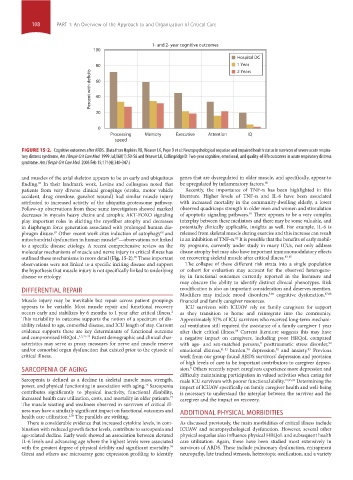
                 FIGURE 15-2.  Cognitive outcomes after ARDS. (Data from Hopkins RO, Weaver LK, Pope D et al: Neuropsychological sequelae and impaired health status in survivors of severe acute respira-
                 tory distress syndrome, Am J Respir Crit Care Med. 1999 Jul;160(1):50-56 and Weaver LK, Collingridge D: Two-year cognitive, emotional, and quality-of-life outcomes in acute respiratory distress
                 syndrome. Am J Respir Crit Care Med. 2005 Feb 15;171(4):340-347.)


                 and muscles of the axial skeleton appears to be an early and ubiquitous   genes that are dysregulated in older muscle, and specifically, appear to
                 finding.  In their landmark work, Levine and colleagues noted that   be upregulated by inflammatory factors. 80
                       33
                 patients from very diverse clinical groupings (stroke, motor vehicle   Recently,  the  importance  of  TNF-α  has  been  highlighted  in  this
                 accident, drug overdose, gunshot wound) had similar muscle injury   literature. Higher levels of TNF-α and IL-6 have been associated
                 attributed  to  increased  activity  of  the  ubiquitin-proteosome  pathway.   with increased mortality in the community-dwelling elderly, a lower
                 Follow-up observations from these same investigators showed marked   observed quadriceps strength in older men and women and stimulation
                 decreases in myosin heavy chains and atrophic AKT-FOXO signaling   of apoptotic signaling pathways.  There appears to be a very complex
                                                                                               81
                 play important roles in eliciting the myofiber atrophy and decreases   interplay between these mediators and there may be some valuable, and
                 in diaphragm force generation associated with prolonged human dia-  potentially clinically applicable, insights as well. For example, IL-6 is
                 phragm disuse.  Other recent work cites induction of autophagy  and   released from skeletal muscle during exercise and this increase can result
                                                                 68
                            67
                 mitochondrial dysfunction in human muscle —observations not linked   in an inhibition of TNF-α.  It is possible that the benefits of early mobil-
                                                                                          82
                                                 69
                 to a specific disease etiology. A recent comprehensive review on the   ity programs, currently under study in many ICUs, not only address
                 molecular mechanisms of muscle and nerve injury in critical illness has   disuse atrophy but may also have important immunomodulatory effects
                 outlined these mechanisms in more detail (Fig. 15-2).  These important   on recovering skeletal muscle after critical illness. 83-85
                                                        70
                 observations were not linked to a specific inciting disease and support   The collapse of these different risk strata into a single population
                 the hypothesis that muscle injury is not specifically linked to underlying   or cohort for evaluation may account for the observed heterogene-
                 disease or etiology.                                  ity in functional outcomes currently reported in the literature and
                                                                       may obscure the ability to identify distinct clinical phenotypes. Risk
                 DIFFERENTIAL REPAIR                                   modification is also an important consideration and deserves mention.
                                                                       Modifiers may include mood disorders,  cognitive dysfunction, 87,88
                                                                                                     9,86
                 Muscle injury may be inevitable but repair across patient groupings   financial and family caregiver resources.
                 appears to be variable. Most muscle repair and functional recovery   ICU survivors with ICUAW rely on family caregivers for support
                 occurs early and stabilizes by 6 months to 1 year after critical illness.    as they transition to home and reintegrate into the community.
                                                                    2
                 This variability in outcome supports the notion of a spectrum of dis-  Approximately 57% of ICU survivors who received long-term mechani-
                 ability related to age, comorbid disease, and ICU length of stay. Current   cal ventilation still required the assistance of a family caregiver 1 year
                 evidence supports these are key determinants of functional outcome   after  their  critical  illness.   Current  literature  suggests  this  may  have
                                                                                          89
                 and compromised HRQoL. 4,5,71-75  Patient demographic and clinical char-  a negative impact on caregivers, including poor HRQoL compared
                 acteristics may serve as proxy measures for nerve and muscle reserve   with age- and sex-matched persons,  posttraumatic stress disorder,
                                                                                                                          90
                                                                                                   8
                 and/or comorbid organ dysfunction that existed prior to the episode of   emotional distress, 91-93  burden,  depression,  and anxiety.  Previous
                                                                                              94
                                                                                                        92
                                                                                                                   93
                 critical illness.                                     work from our group found ARDS survivors’ depression and provision
                                                                       of high levels of care to be important contributors to caregiver depres-
                 SARCOPENIA OF AGING                                   sion.  Others recently report caregivers experience more depression and
                                                                           8
                                                                       difficulty maintaining participation in valued activities when caring for
                 Sarcopenia is defined as a decline in skeletal muscle mass, strength,   male ICU survivors with poorer functional ability. 91,95,96  Determining the
                 power, and physical functioning in association with aging.  Sarcopenia   impact of ICUAW specifically on family caregiver health and well-being
                                                           76
                 contributes significantly  to  physical  inactivity,  functional  disability,   is necessary to understand the interplay between the survivor and the
                 increased health care utilization, costs, and mortality in older patients.    caregiver and the impact on recovery.
                                                                    77
                 The muscle wasting and weakness observed in survivors of critical ill-
                 ness may have a similarly significant impact on functional outcomes and   ADDITIONAL PHYSICAL MORBIDITIES
                 health care utilization.  The parallels are striking.
                                 1,78
                   There is considerable evidence that increased cytokine levels, in com-  As discussed previously, the main morbidities of critical illness include
                 bination with reduced growth factor levels, contribute to sarcopenia and   ICUAW  and  neuropsychological  dysfunction.  However,  several  other
                 age-related decline. Early work showed an association between elevated   physical sequelae also influence physical HRQoL and subsequent health
                 IL-6 levels and advancing age where the highest levels were associated   care utilization. Again, these have been studied most extensively in
                 with the greatest degree of physical debility and significant mortality.    survivors of ARDS. These include pulmonary dysfunction, entrapment
                                                                    79
                 Giresi and others use microarray gene expression profiling to identify   neuropathy, late tracheal stenosis, heterotopic ossification, and a variety
            Section01.indd   108                                                                                       1/22/2015   9:37:37 AM

