


Page 144 - Hall et al (2015) Principles of Critical Care-McGraw-Hill
P. 144
110     PART 1: An Overview of the Approach to and Organization of Critical Care


                        Heterotopic ossification   Tracheal stenosis   PHASE-SPECIFIC APPROACH TO RECOVERY
                 Frozen joints                                         AFTER CRITICAL ILLNESS
                 contractures  Cosmesis—scars from CVC, art line, CT, drain sites    ■
                           Nerve and muscle    Brain                      TIMING IT RIGHT FRAMEWORK 104
                 Striae                                        Alopecia  The need for longer-term follow-up and ongoing support in the com-
                                                                       munity are priorities for ICU survivors and their family caregivers.
                                                           Bronchiectasis  Thus,  when  constructing  rehabilitation  interventions, their  needs
                 Pulmonary                                             must be considered across the full care continuum. In response to this
                 fibrosis    Weakness   Mental health & cognition  Ischemic digits  need, Cameron and colleagues  developed the timing it right (TIR)
                                                                                              104
                                                                       framework to promote an organized approach for the development
                                                                       and evaluation of interventions designed to meet patients’ and family
                    Renal impairment                 Taste changes     caregivers’ changing needs. It was developed using the clinical course
                                      Caregiver   Hearing loss         of stroke as a model of acute illness requiring ongoing recovery and
                                                                       rehabilitation. This framework has been adapted to the ICU population.
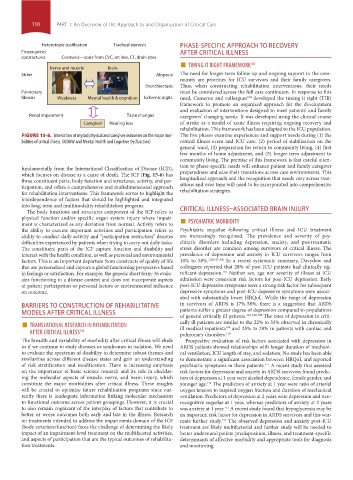
                 FIGURE 15-6.  Interaction of myriad physical and caregiver outcomes on the major mor-  The five phases examine experiences and support needs during (1) the
                 bidities of critical illness. (ICUAW and Mental Health and Cognitive Dysfunction)  critical illness event and ICU care, (2) period of stabilization on the
                                                                       general ward, (3) preparation for return to community living, (4) first
                                                                       few months of home adjustment, and (5) longer-term adjustment to
                                                                       community living. The premise of this framework is that careful atten-
                 fundamentally from the International Classification of Disease (ICD),   tion to phase-specific needs will enhance patient and family caregiver
                 which focuses on disease as a cause of death. The ICF (Fig. 15-6) has   preparedness and ease their transitions across care environments. This
                 three constituent parts, body function and structures, activity, and par-  longitudinal approach and the recognition that needs vary across tran-
                 ticipation, and offers a comprehensive and multidimensional approach   sitions and over time will need to be incorporated into comprehensive
                 for rehabilitation interventions. This framework serves to highlight the   rehabilitation strategies.
                 interdependence of factors that should be highlighted and integrated
                 into long-term and multimodality rehabilitation program.  CRITICAL ILLNESS–ASSOCIATED BRAIN INJURY
                   The body functions and structures component of the ICF refers to
                 ment is characterized as any deviation from normal. Activity refers to   ■  PSYCHIATRIC MORBIDITY
                 physical function and/or specific organ system injury where impair-
                 the ability to execute important activities and participation refers to   Psychiatric sequelae following critical illness and ICU treatment
                 ability to conduct daily activity and “participation restriction” denotes   are increasingly recognized. The prevalence and severity of psy-
                 difficulties experienced by patients when trying to carry out daily tasks.   chiatric  disorders  including  depression,  anxiety,  and  posttraumatic
                 The constituent parts of the ICF capture function and disability and   stress disorder are common among survivors of critical illness. The
                 interact with the health condition, as well as personal and environmental   prevalence of depression and anxiety in ICU survivors ranges from
                 factors. This is an important departure from constructs of quality of life   10% to 58%. 1,28,105,106  In a recent systematic summary, Davydow and
                 that are personalized and capture a global functioning perspective based   colleagues reported that 28% of post-ICU patients had clinically sig-
                                                                                      107
                 in feelings or satisfaction. For example, the generic short form-36 evalu-  nificant depression.  Neither sex, age nor severity of illness at ICU
                 ates functioning in a disease context and does not incorporate aspects   admission were consistent risk factors for post-ICU depression. Early
                 of patient participation or personal factors or environmental influence   post-ICU depressive symptoms were a strong risk factor for subsequent
                 on outcome.                                           depressive symptoms and post-ICU depressive symptoms were associ-
                                                                       ated with substantially lower HRQoL. While the range of depression
                 BARRIERS TO CONSTRUCTION OF REHABILITATIVE            in survivors of ARDS is 17%-58%, there is a suggestion that ARDS
                 MODELS AFTER CRITICAL ILLNESS                         patients suffer a greater degree of depression compared to populations
                                                                                                    The rates of depression in criti-
                                                                       of general critically ill patients.
                     ■  TRANSLATIONAL RESEARCH IN REHABILITATION       cally ill patients are similar to the 22% to 33% observed in chronically
                                                                                              12,15,20,108
                                                                                       109
                    AFTER CRITICAL ILLNESS 103                         ill medical inpatients  and 25% to 28% in patients with cardiac and
                                                                       pulmonary disorders.
                                                                                       110
                 The breadth and variability of morbidity after critical illness will elude   Prospective evaluation of risk factors associated with depression in
                 us if we continue to study diseases or syndromes in isolation. We need   ARDS patients showed relationships with longer duration of mechani-
                 to evaluate the spectrum of disability to determine robust themes and   cal ventilation, ICU length of stay, and sedation. No study has been able
                 similarities across different disease states and gain an understanding   to demonstrate a significant association between HRQoL and reported
                 of risk stratification and modification. There is increasing emphasis   psychiatric symptoms in these patients.  A recent study that assessed
                                                                                                    111
                 on the importance of basic science research and its role in elucidat-  risk factors for depression and anxiety in ARDS survivors found predic-
                 ing the molecular aspects of muscle, nerve, and brain injury, which   tors of depression at 1 year were alcohol dependence, female gender, and
                 constitute the major morbidities after critical illness. These insights   younger age.  The predictors of anxiety at 1 year were ratio of arterial
                                                                                112
                 will  be  crucial  to  optimize  future  rehabilitation  programs  since  cur-  oxygen tension to inspired oxygen fraction and duration of mechanical
                 rently  there  is  inadequate  information  linking  molecular  mechanism   ventilation. Predictors of depression at 2 years were depression and neu-
                 to functional outcome across patient groupings. However, it is crucial   rocognitive sequelae at 1 year, whereas predictors of anxiety at 2 years
                 to also remain cognizant of the interplay of factors that contribute to   was anxiety at 1 year.  A recent study found that hypoglycemia may be
                                                                                      113
                 better or worse outcomes both early and late in the illness. Research   an important risk factor for depression in ARDS survivors and this war-
                 on treatments intended to address the impairments domain of the ICF   rants further study.  The observed depression and anxiety post-ICU
                                                                                     114
                 (body structure/function) faces the challenge of determining the likely   treatment are likely multifactorial and further study will be needed to
                 impact of an impairment-level treatment on the multifaceted activities,   better understand patient predisposition, illness, and treatment-specific
                 and aspects of participation that are the typical outcomes of rehabilita-  determinants of affective morbidity and appropriate tools for diagnosis
                 tion treatments.                                      and monitoring.


            Section01.indd   110                                                                                       1/22/2015   9:37:44 AM

