


Page 140 - Hall et al (2015) Principles of Critical Care-McGraw-Hill
P. 140
106     PART 1: An Overview of the Approach to and Organization of Critical Care


                 with neurocognitive sequelae had worse quality of life than individuals   1.0                       1.0
                 without neuropsychological dysfunction.  Decreased HRQoL has also
                                               30
                 been associated with psychiatric morbidities such as posttraumatic stress   0.8                     0.8
                 disorder (PTSD), which may represent yet another important contribu-
                 tor to subsequent disability and loss of employment. 15,31,32  A more ful-  0.6                     0.6
                 some discussion of neuropsychological morbidities will follow later in   Proportion alive
                 this chapter.                                                   0.4                                 0.4
                   There is clear evidence that HRQoL in ARDS survivors is adversely
                 influenced by physical and neuropsychological morbidities. These   0.2                              0.2
                 observations have helped to elevate awareness about the important   0.0                             0.0
                 consequences of critical illness in the critical care community, but an
                 important limitation that remains is the lack of generalizability of the   500          % Predicted
                 ARDS outcomes literature to all ICU survivors. Rapidly accruing out-                                75.0
                 comes data from international cohorts, evaluating both functional and
                 neurocognitive long-term outcomes, has helped us begin to understand   400                          62.5
                 the heterogeneous nature of reported morbidity and the complexity of   Distance walked (m) 450  Distance  Percent predicted
                                                                                350
                 interaction among physical, emotional, and neurocognitive domains in
                 individual patients (Fig. 15-2).                               300                                  50.0
                                                                                250
                                                                                                                     37.5
                 NEUROMUSCULAR DYSFUNCTION                                      200

                 Recent research work has highlighted the concept of a continuum of
                 weakness that begins with muscle injury documented within hours of   50                    MCS      Norm
                 mechanical ventilation,  is evident with bedside testing using clinical
                                  33
                 strength measures (MRC scoring system) within 1 week of ICU admis-  40                              Norm-1SD
                 sion,  and may persist with incomplete recovery for years after ICU dis-  SF-36 subscale score
                     34
                 charge (Fig. 15-1B).  Muscle weakness and impaired function constitute                     PCS
                                2
                 an important morbidity of severe critical illness.              30
                   ICUAW appears to be ubiquitous in severe lung injury and also with
                 other complex critical illnesses. Regardless of disease process, muscles
                 and nerves are injured and this manifests as prolonged mechanical   20  0.0  1.0  2.0  3.0  4.0  5.0
                 ventilation and poor functional outcomes. However, ICUAW does not              Year of study
                 completely explain functional impairment since this is influenced by   N at risk  109 92  86 79 77  74  69  64
                 many factors. In 2009, a Round Table Conference was held in Brussels,   N for 6 min walk  80 78  81 60 64  64  57  54
                 which produced a series of publications that serve as a good review   N for SF-36  67 74  74 56 57  57  49  50
                 on this topic including a framework for classification of ICUAW.  An
                                                                 13
                 overview of the findings was included in a summary by Griffiths and
                 Hall.  ICUAW comprised a nerve or muscle lesion or a combination
                     35
                 of each as outlined below and recently reviewed in detail by Latronico
                 and Bolton. 36

                 CRITICAL ILLNESS POLYNEUROPATHY
                     ■  BACKGROUND AND INCIDENCE

                 Bolton  and  colleagues  first  described  critical  illness  polyneuropathy
                 (CIP) in 1984  and reported on five critically ill patients who were
                            37
                 having difficulties with liberation from mechanical ventilation. On
                 electrophysiological testing, these patients had a primary axonopathy,
                 which manifested clinically as a mixed sensorimotor neuropathy.
                 Since this initial publication, it has become clear that CIP is very com-
                 mon in patients with the systemic inflammatory response syndrome
                                                                                                           12 Months
                                                                                     3 Months
                 (SIRS) and sepsis, with an occurrence of 70% to 100% of longer stay   3 Months            12 Months
                 ICU patients. It affects the limb and respiratory muscles and facial
                 muscles are typically spared. Limb involvement is symmetrical, most
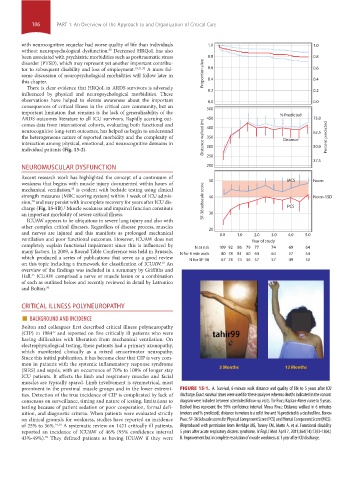
                 prominent in the proximal muscle groups and in the lower extremi-  FIGURE 15-1.  A. Survival, 6-minute walk distance and quality of life to 5 years after ICU
                 ties. Detection of the true incidence of CIP is complicated by lack of   discharge. Exact survival times were used for these analyses whereas deaths indicated in the consort
                 consensus on surveillance, timing and nature of testing, limitations to   diagram were included between scheduled follow-up visits. Top panel: Kaplan-Meier curve to 5 years.
                 testing because of patient sedation or poor cooperation, formal defi-  Dashed lines represent the 95% confidence interval. middle panel: Distance walked in 6 minutes
                 nition, and diagnostic criteria. When patients were evaluated strictly   (meters and % predicted); distance in meters is a solid line and % predicted is a dashed line. BoTTom
                 on clinical grounds for weakness, studies have reported an incidence   panel: SF-36 Subscale scores for Physical Component Score (PCS) and Mental Component Score (MCS).
                 of 25% to 36%. 34,38  A systematic review on 1421 critically ill patients,   (Reproduced with permission from Herridge MS, Tansey CM, Matte A, et al. Functional disability
                 reported an incidence of ICUAW of 46% (95% confidence interval   5 years after acute respiratory distress syndrome. N Engl J Med. April 7, 2011;364(14):1293-1304.)
                 43%-49%).  They defined patients as having ICUAW if they were   B. Improvement but incomplete resolution of muscle weakness at 1 year after ICU discharge.
                         39


            Section01.indd   106                                                                                       1/22/2015   9:37:35 AM

