


Page 152 - Hall et al (2015) Principles of Critical Care-McGraw-Hill
P. 152
118     PART 1: An Overview of the Approach to and Organization of Critical Care


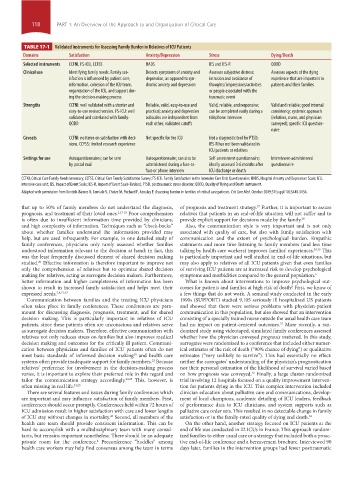
                   TABLE 17-1    Validated Instruments for Assessing Family Burden in Relatives of ICU Patients
                  Domains        Satisfaction               Anxiety/Depression   Stress               Dying/Death
                  Selected instruments  CCFNI, FS-ICU, CCFSS  HADS               IES and IES-R        QODD
                  Clinical use   Identifying family needs. Family sat-  Detects symptoms of anxiety and   Assesses subjective distress:   Assesses aspects of the dying
                                 isfaction is influenced by patient care,   depression, as opposed to syn-  intrusion and avoidance of   experience that are important to
                                 information, cohesion of the ICU team,   dromic anxiety and depression  thoughts/ impressions/activities   patients and their families
                                 organization of the ICU, and support dur-       or people associated with the
                                 ing the decision-making process                 traumatic event
                  Strengths      CCFNI: well validated with a shorter and   Reliable, valid, easy-to-use and   Valid, reliable, and responsive;   Valid and reliable; good internal
                                 easy-to-use revised version. FS-ICU: well   practical; anxiety and depression   can be completed easily during a      consistency; systemic approach
                                 validated and correlated with family-  subscales are independent from   telephone interview  (relatives, nurse, and physician
                                 QODD                       each other; validated cutoffs             surveyed); specific ICU question-
                                                                                                      naire
                  Caveats        CCFNI: no items on satisfaction with deci-  Not specific for the ICU  Not a diagnostic tool for PTSD;
                                 sions. CCFSS: limited research experience       IES-R has not been validated in
                                                                                 ICU patients or relatives
                  Settings for use  Autoquestionnaires; can be sent    Autoquestionnaire; can also be   Self-assessment questionnaire;    Interviewer-administered
                                 by postal mail             administered during a face-to-  ideally assessed 3-6 months after     questionnaire
                                                            face or phone interview  ICU discharge or death
                 CCFNI, Critical Care Family Needs Inventory; CCFSS, Critical Care Family Satisfaction Survey; FS-ICU, Family Satisfaction in the Intensive Care Unit Questionnaire; HADS, Hospital Anxiety and Depression Scale; ICU,
                 intensive care unit; IES, Impact of Event Scale; IES-R, Impact of Event Scale-Revised; PTSD, posttraumatic stress disorder; QODD, Quality of Dying and Death instrument.
                 Adapted with permission from Kentish-Barnes N, Lemiale V, Chaize M, Pochard F, Azoulay E: Assessing burden in families of critical care patients. Crit Care Med. October 2009;37(suppl 10):S448-S456.

                 that up to 50% of family members do not understand the diagnosis,   of prognosis and treatment strategy.  Further, it is important to assure
                                                                                                 27
                 prognosis, and treatment of their loved ones. 2,17-19  Poor comprehension   relatives that patients in an end-of-life situation will not suffer and to
                 is often due to insufficient information time provided by clinicians,   provide explicit support for decisions made by the family. 28
                 and high complexity of information. Techniques such as “check-backs”   Also, the communication style is very important and is not only
                 about  whether  families  understand  the  information  provided  may   associated with quality of care, but also with family satisfaction with
                 help, but are used infrequently. For example, in one detailed study of   communication and the extent of psychological burden. Empathic
                 family conferences, physicians only rarely assessed whether families   statements and more time listening to family members (and less time
                 understood information relevant to the decision at hand; in fact, this   talking by health care workers) improves families’ experiences. 29,30  This
                 was the least frequently discussed element of shared decision making   is particularly important and well studied in end-of-life situations, but
                 studied.  Effective information is therefore important to improve not   may also apply to relatives of all ICU patients given that even families
                       20
                 only  the  comprehension  of  relatives  but  to  optimize  shared  decision   of surviving ICU patients are at increased risk to develop psychological
                 making for relatives, acting as surrogate decision makers. Furthermore,    symptoms and morbidities compared to the general population. 6
                 better information and higher completeness of information has been   What is known about interventions to improve psychological out-
                 shown to result in increased family satisfaction and helps meet their   comes for patients and families at high risk of death? First, we know of
                 expressed needs. 7,8,21,22                            a few things that do not work. A seminal study conducted in the early
                   Communication between families and the treating ICU physicians   1990s (SUPPORT) studied 9,105 seriously ill hospitalized US patients
                 often  takes  place  in  family  conferences.  These  conferences  are  para-  and showed that there were serious problems with physician-patient
                 mount for discussing diagnosis, prognosis, treatment, and for shared   communication in this population, but also showed that an intervention
                 decision  making.  This  is particularly  important  in relatives of ICU   consisting of a specially trained nurse outside the usual health care team
                 patients, since these patients often are unconscious and relatives serve   had no impact on patient-centered outcomes.  More recently, a ran-
                                                                                                         31
                 as surrogate decision makers. Therefore, effective communication with    domized study using videotaped, simulated family conferences assessed
                 relatives not only reduces stress on families but also improves medical   whether how the physician conveyed prognosis mattered. In this study,
                 decision making and outcomes for the critically ill patient. Communi-  surrogates were randomized to a conference that included either numer-
                 cation between physicians and families of ICU patients often do not   ical estimates of the risk of death (“90% chance of dying”) or qualitative
                 meet basic standards of informed decision making  and health care   estimates (“very unlikely to survive”). This had essentially no effect:
                                                       20
                                                              23
                 systems often provide inadequate support for family members.  Because   neither the surrogates’ understanding of the physician’s prognostication
                 relatives’ preference for involvement in the decision-making process   nor their personal estimation of the likelihood of survival varied based
                 varies, it is important to explore their preferred role in this regard and   on how prognosis was conveyed.  Finally, a large cluster-randomized
                                                                                                32
                 tailor the communication strategy accordingly. 24,25  This, however, is   trial involving 12 hospitals focused on a quality improvement interven-
                 often missing in real life. 24,25                     tion for patients dying in the ICU. This complex intervention included
                   There are several features and issues during family conferences which   clinician education about palliative care and communications, develop-
                 are important and may influence satisfaction of family members. First,   ment of local champions, academic detailing of ICU leaders, feedback
                 conferences should occur promptly. Conferences held within 72 hours of   of performance data to ICU clinicians, and system supports such as
                 ICU admission result in higher satisfaction with care and lower lengths   palliative care order sets. This resulted in no detectable change in family
                 of ICU stay without changes in mortality.  Second, all members of the   satisfaction or in the family-rated quality of dying and death. 33
                                               26
                 health  care  team  should  provide  consistent  information.  This  can  be   On the other hand, another strategy focused on ICU patients at the
                 hard to accomplish with a multidisciplinary team with many consul-  end of life was conducted in 22 ICUs in France. This approach random-
                 tants, but remains important nonetheless. There should be an adequate   ized families to either usual care or a strategy that included both a proac-
                 private room for the conference.  Preconference “huddles” among   tive end-of-life conference and a bereavement brochure. Interviewed 90
                                           4
                 health care workers may help find consensus among the team in terms   days later, families in the intervention groups had fewer posttraumatic


            Section01.indd   118                                                                                       1/22/2015   9:37:47 AM

