


Page 153 - Hall et al (2015) Principles of Critical Care-McGraw-Hill
P. 153
CHAPTER 17: Caring for the Family  119


                                                                          huddle and “time-out” by clinicians and others just before the meeting
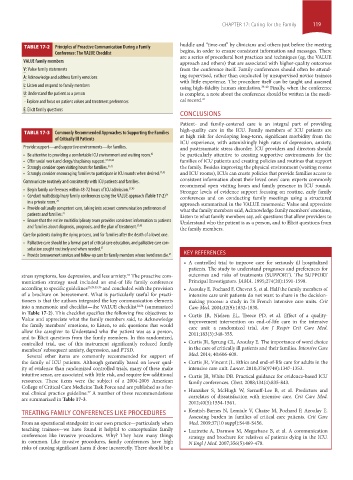
                      TABLE 17-2     Principles of Proactive Communication During a Family
                               Conference: The VALUE Checklist            begins, in order to ensure consistent information and messages. There
                                                                          are a series of procedural best practices and techniques (eg, the VALUE
                    VALUE family members                                  approach and others) that are associated with higher-quality outcomes
                    V: Value family statements                            from the conference itself. Family conferences should often be attend-
                    A: Acknowledge and address family emotions            ing supervised, rather than conducted by unsupervised novice trainees
                                                                          with little experience. The procedure itself can be taught and assessed
                    L: Listen and respond to family members
                                                                          using high-fidelity human simulation. 38-40  Finally, when the conference
                    U: Understand the patient as a person                 is complete, a note about the conference should be written in the medi-
                     - Explore and focus on patient values and treatment preferences  cal record. 41
                    E: Elicit family questions
                                                                          CONCLUSIONS
                                                                          Patient- and family-centered care is an integral part of providing
                                                                            high-quality care in the ICU. Family members of ICU patients are
                      TABLE 17-3     Commonly Recommended Approaches to Supporting the Families    at high risk for developing long-term, significant morbidity from the
                               of Critically Ill Patients                 ICU experience, with astonishingly high rates of depression, anxiety,
                    Provide support—and supportive environments—for families.  and posttraumatic stress disorder. ICU providers and directors should
                    •  Be attentive to providing a comfortable ICU environment and waiting room. 42  be particularly attentive to creating supportive environments for the
                    •  Offer social work and clergy/chaplaincy support. 37,43,44  families of ICU patients and creating policies and routines that support
                    •  Strongly consider open visiting hours for families. 37,45  the family. Besides improving the physical environment (waiting rooms
                    •  Strongly consider encouraging families to participate in ICU rounds when desired. 37,45  and ICU rooms), ICUs can create policies that provide families access to
                    Communicate routinely and consistently with ICU patients and families.  consistent information about their loved ones’ care: experts commonly
                                                                          recommend open visiting hours and family presence in ICU rounds.
                    •  Begin family conferences within 48-72 hours of ICU admission. 37,45  Stronger levels of evidence support focusing on routine, early family
                    •  Conduct multidisciplinary family conferences using the VALUE approach (Table 17-2)    conferences  and  on  conducting  family  meetings  using  a  structured
                                                                     34
                      in a private room. 24                               approach summarized in the VALUE mnemonic: Value and appreciate
                    •  Provide culturally competent care, taking into account communication preferences of   what the family members said, Acknowledge family members’ emotions,
                      patients and families. 37                           Listen to what family members say, ask questions that allow providers to
                    •  Ensure that the entire multidisciplinary team provides consistent information to patients   Understand who the patient is as a person, and to Elicit questions from
                      and families about diagnosis, prognosis, and the plan of treatment. 37,45  the family members.
                    Care for patients during the dying process, and for families after the death of a loved one.
                    •  Palliative care should be a formal part of critical care education, and palliative care con-
                      sultation sought routinely and when needed. 37
                    •  Provide bereavement services and follow-up care for family members whose loved ones die. 37  KEY REFERENCES
                                                                              • A controlled trial to improve care for seriously ill hospitalized
                                                                             patients. The study to understand prognoses and preferences for
                    stress symptoms, less depression, and less anxiety.  The proactive com-  outcomes and risks of treatments (SUPPORT). The SUPPORT
                                                        34
                    munication strategy used included an end-of life family conference   Principal Investigators. JAMA. 1995;274(20):1591-1598.
                    according to specific guidelines 25,29,35,36  and concluded with the provision     • Azoulay E, Pochard F, Chevret S, et al. Half the family members of
                    of a brochure on bereavement. What is particularly useful for practi-  intensive care unit patients do not want to share in the decision-
                    tioners is that the authors integrated the key communication elements   making process: a study in 78 French intensive care units.  Crit
                    into a mnemonic and checklist—the VALUE checklist 24,34  (summarized   Care Med. 2004;32(9):1832-1838.
                    in Table 17-2). This checklist specifies the following five objectives: to     • Curtis JR, Nielsen EL, Treece PD, et al. Effect of a quality-
                    Value and appreciate what the family members said, to Acknowledge   improvement intervention on end-of-life care in the intensive
                    the family members’ emotions, to Listen, to ask questions that would   care unit: a randomized trial.  Am J Respir Crit Care Med.
                    allow the caregiver to  Understand who the patient was as a person,   2011;183(3):348-355.
                    and to Elicit questions from the family members. In this randomized,
                    controlled trial, use of this instrument significantly reduced family     • Curtis JR, Sprung CL, Azoulay E. The importance of word choice
                    members’ subsequent anxiety, depression, and PTSD.       in the care of critically ill patients and their families. Intensive Care
                     Several other items are commonly recommended for support of   Med. 2014; 40:606-608.
                    the family of ICU patients. Although generally based on lower qual-    • Curtis JR, Vincent JL. Ethics and end-of-life care for adults in the
                    ity of evidence than randomized controlled trials, many of these make   intensive care unit. Lancet. 2010;376(9749):1347-1353.
                    intuitive sense, are associated with little risk, and require few additional     • Curtis JR, White DB. Practical guidance for evidence-based ICU
                    resources. These items were the subject of a 2004-2005 American   family conferences. Chest. 2008;134(4):835-843.
                    College of Critical Care Medicine Task Force and are published as a for-
                                          37
                    mal clinical practice guideline.  A number of these recommendations     • Hunziker S, McHugh W, Sarnoff-Lee B, et al. Predictors and
                    are summarized in Table 17-3.                            correlates  of dissatisfaction  with  intensive care.  Crit Care Med.
                                                                             2012;40(5):1554-1561.
                    TREATING FAMILY CONFERENCES LIKE PROCEDURES               • Kentish-Barnes N, Lemiale V, Chaize M, Pochard F, Azoulay E.
                                                                             Assessing burden in families of critical care patients.  Crit Care
                    From an operational standpoint in our own practice—particularly when   Med. 2009;37(10 suppl):S448-S456.
                    teaching  trainees—we  have  found  it  helpful  to  conceptualize  family     • Lautrette A, Darmon M, Megarbane B, et al. A communication
                    conferences like invasive procedures. Why? They have many things   strategy and brochure for relatives of patients dying in the ICU.
                    in common. Like invasive procedures, family conferences have high   N Engl J Med. 2007;356(5):469-478.
                    risks of causing significant harm if done incorrectly. There should be a


            Section01.indd   119                                                                                       1/22/2015   9:37:47 AM

