


Page 156 - Hall et al (2015) Principles of Critical Care-McGraw-Hill
P. 156
122     PART 1: An Overview of the Approach to and Organization of Critical Care


                   The second step is to assess family preferences in decision making   additional guidance for a structured and evidence-based approach to
                 and finally to adapt the strategy to both the clinical context and fam-  communication  during  ICU family  conferences.   The three stages  of
                                                                                                           59
                 ily preferences. Significant communication skills are necessary to align   an ICU family conference include activities prior to the conference,
                 clinicians and families around shared goals of care and implement this   during the conference, and following the conference. Prior to the family
                 decision-making framework, and most physicians have not received   conference, consensus should be achieved among the clinicians treat-
                 formal education or training in communication. 60,61  Fortunately there   ing the patient to ensure consistency and avoid confusion. The setting
                 are descriptive reports and clinical trials that provide insights into how   for the conference should include a private, quiet location free from
                 ICU clinicians should approach family conferences. 58,62  distractions,  and each person present should introduce themselves and
                                                                                64
                   After evaluating 21 articles representing 16 unique interventions,   describe their relationship, whether clinical or personal, to the patient.
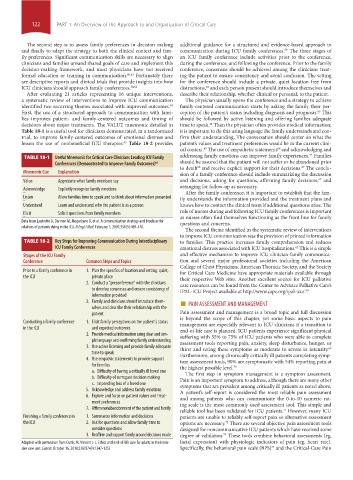
                 a systematic review of interventions to improve ICU communication   The physician usually opens the conference and a strategy to achieve
                 identified two recurring themes associated with improved outcomes.    family-centered communication starts by asking the family their per-
                                                                    62
                 First, the use of a structured approach to communication with fami-  ception of the patient’s status including diagnosis and prognosis.  This
                                                                                                                      65
                 lies improves patient- and family-centered outcomes and timing of   should be followed by active listening and offering families adequate
                 decisions about major treatments. The VALUE mnemonic detailed in   time to speak.  Then the physician often provides medical information;
                                                                                 44
                 Table 18-1 is a useful tool for clinicians demonstrated, in a randomized   it is important to do this using language the family understands and con-
                 trial, to improve family-centered outcomes of emotional distress and   firm their understanding. The conversation should center on what the
                 lessen the use of nonbeneficial ICU therapies.   Table  18-2 provides   patient’s values and treatment preferences would be in the current clini-
                                                    63
                                                                       cal context.  The use of empathetic statements  and acknowledging and
                                                                                                        66
                                                                               43
                                                                                                                   43
                   TABLE 18-1     Useful Mnemonic for Critical Care Clinicians Leading ICU Family   addressing family emotions can improve family experiences.  Families
                             Conferences (Demonstrated to Improve Family Outcomes) 63  should be assured that the patient will not suffer or be abandoned prior
                                                                       to death  and receive explicit support for their decisions.  The conclu-
                                                                                                                 67
                                                                             66
                  Mnemonic Cue  Explanation                            sion of a family conference should include summarizing the discussion
                                                                                                                      67
                  Value       Appreciate what family members say       and decisions, asking for questions, affirming family decisions,  and
                                                                       arranging for follow-up as necessary.
                  Acknowledge  Explicitly recognize family emotions
                                                                         After the family conference, it is important to establish that the fam-
                  Listen      Allow families time to speak and to think about information presented  ily understands the information provided and the treatment plans and
                  Understand  Learn and understand who the patient is as a person  knows how to contact the clinical team if additional questions arise. The
                  Elicit      Solicit questions from family members    role of nurses during and following ICU family conferences is important
                                                                       as nurses often find themselves functioning as the front line for family
                 Data from Lautrette A, Darmon M, Megarbane B, et al. A communication strategy and brochure for    questions and concerns.
                 relatives of patients dying in the ICU. N Engl J Med. February 1, 2007;356(5):469-478.
                                                                         The second theme identified in the systematic review of interventions
                                                                       to improve ICU communication was the provision of printed information
                   TABLE 18-2     Key Steps for Improving Communication During Interdisciplinary    to families. This practice increases family comprehension and reduces
                             ICU Family Conferences                    emotional distress associated with ICU hospitalizations.  This is a simple
                                                                                                               62
                  Stages of the ICU Family                             and effective mechanism to improve ICU  clinician-family communica-
                  Conference           Common Steps and Topics         tion and several major professional societies including the American
                                                                       College of Chest Physicians, American Thoracic Society, and the Society
                  Prior to a family conference in     1.  Plan the specifics of location and setting: quiet,   for Critical Care Medicine have appropriate materials available through
                  the ICU                private place                 their respective Web sites. Another excellent source for ICU palliative
                                         2.  Conduct a “preconference” with the clinicians   care resources can be found from the Center to Advance Palliative Care’s
                                         to develop consensus and ensure consistency of   IPAL-ICU Project available at http://www.capc.org/ipal-icu/. 68
                                         information provided
                                         3.  Family and clinicians should introduce them-    ■  PAIN ASSESSMENT AND MANAGEMENT
                                         selves and describe their relationship with the
                                         patient                       Pain assessment and management is a broad topic and full discussion
                                                                       is beyond the scope of this chapter, yet some basic aspects to pain
                  Conducting a family conference      1.  Elicit family perceptions on the patient’s status   management are especially relevant to ICU clinicians if a transition to
                  in the ICU             and expected outcomes         end-of-life care is planned. ICU patients experience significant physical
                                         2.  Provide medical information using clear and sim-  suffering with 55% to 75% of ICU patients who were able to complete
                                         ple language and confirming family understanding  assessment tools reporting pain, anxiety, sleep disturbance, hunger, or
                                         3.  Use active listening and provide family adequate   thirst and rating these symptoms as moderate to severe in intensity.
                                                                                                                          69
                                         time to speak                 Furthermore, among chronically critically ill patients completing symp-
                                         4.  Use empathic statements to provide support    tom assessment tools, 90% are symptomatic with 54% reporting pain at
                                         for families                  the highest possible level. 70
                                          a.  Difficulty of having a critically ill loved one  The first step in symptom management is a symptom assessment.
                                          b.  Difficulty of surrogate decision making  Pain is an important symptom to address, although there are many other
                                          c.  Impending loss of a loved one  symptoms that are prevalent among critically ill patients as noted above.
                                         5.  Acknowledge and address family emotions  A patient’s self-report is considered the most reliable pain assessment
                                         6.  Explore and focus on patient values and treat-  and among patients who can communicate the 0-to-10 numeric rat-
                                         ment preferences              ing scale is the most commonly used assessment tool. This simple and
                                         7.  Affirm nonabandonment of the patient and family
                                                                                                          71
                                                                       reliable tool has been validated for ICU patients.  However, many ICU
                  Finishing a family conference in     1.  Summarize information and decisions  patients are unable to reliably self-report pain so alternative assessment
                  the ICU                2.  Ask for questions and allow family time to    options are necessary.  There are several objective pain assessment tools
                                                                                       72
                                         consider questions            designed for noncommunicative ICU patients which have received some
                                         3.  Reaffirm and support family around decisions made  degree of  validation.  These tools combine behavioral assessments (eg,
                                                                                      73
                 Adapted with permission from Curtis JR, Vincent J-L. Ethics and end-of-life care for adults in the inten-  facial expression) with physiologic indicators of pain (eg, heart rate).
                                                                                                      74
                 sive care unit. Lancet. October 16, 2010;376(9749):1347-1353.  Specifically, the behavioral pain scale (BPS)  and the Critical-Care Pain


            Section01.indd   122                                                                                       1/22/2015   9:37:49 AM

