


Page 155 - Hall et al (2015) Principles of Critical Care-McGraw-Hill
P. 155
CHAPTER 18: Providing Palliative Care and Withholding or Withdrawing Life-Sustaining Therapy  121


                    found a difference in overall mortality between their control and inter-  significant deficiencies in the quality of communication 40,41  as well as
                    vention groups suggesting proactive, palliative care interventions do   resultant adverse psychological outcomes among families have been
                    not shorten survival. Furthermore, each found high rates of acceptance   reported.  Analyses of audiotaped ICU family conferences have found
                                                                                42
                    among ICU clinicians and families.                    specific opportunities for improvement including listening and respond-
                        ■  THE INTERFACE BETWEEN CRITICAL CARE,           ing to questions, providing emotional support, and addressing palliative
                                                                          or ethical principles.  Other analyses of these data found that when
                                                                                         43
                      END-OF-LIFE CARE, AND PALLIATIVE CARE               physicians spoke less and families spoke more during ICU family con-
                                                                                                                            44
                    In the United States, 22% of deaths are associated with an ICU admis-  ferences, families’ ratings of the quality of communication were higher.
                                                                          Notably, families of patients who survive report less satisfaction with
                    sion,  an observation that may seem incongruous with the notion of   communication than families of patients who die, suggesting a broad
                       32
                    intensive care as representing aggressive attempts at cure. However,   opportunity for improvement in communication regardless of antici-
                    given that the leading causes of death in the United States often incor-  pated survival status. 45
                    porate a trajectory that includes an unexpected and potentially revers-  Communication about end-of-life care in the ICU can be especially
                    ible decline, it becomes understandable why a substantial proportion of   challenging. This communication is complicated by several factors:
                    US deaths are accompanied by ICU admissions. The top four causes of   There is typically reliance on surrogate decision makers,  ICU clinicians
                                                                                                                  46
                    death for Americans today are chronic health conditions and include   often lack a longitudinal relationship with the patient and family, and
                    heart disease, cancer, stroke, and chronic respiratory diseases. 33  the time between consideration of end-of-life care and death is often
                     The trajectory of declining health status preceding death has been con-  brief.  An important objective of communication about end-of-life care
                                                                             47
                    ceptualized as assuming  one of several patterns. 34,35  The most common   in the ICU is to determine the goals of care for the patient. Physicians
                      pattern is of chronic illness with progressive organ failure punctuated by   have an obligation to provide information on the diagnosis and progno-
                    acute exacerbations and incomplete improvement. Examples of condi-  sis whereas families are generally the best source of information about
                    tions that often assume this pattern include congestive heart failure and   patients’ beliefs and values. The recommended framework for end-of-
                    chronic respiratory diseases. A second common pattern is observed in   life decisions is a shared decision-making model in which the physician
                    terminal conditions such as advanced cancer where patients often expe-  and family jointly assume responsibility for decisions about end-of-life
                    rience good functional status until an acute, rapid decline followed by   care. 48,49   Substantial  variation,  however, is  observed  in  the  degree  to
                    death. Frailty that may accompany advanced age or progressive demen-  which families want to be responsible for decisions about end-of-life
                    tia generally imposes a poor functional status over an extended period   care. Some family members favor a shared decision-making role with
                    of time prior to death.                               physicians 50,51  whereas others do not wish to be involved in decision
                     Acute care hospitalizations may occur at any stage during declining   making or conversely prefer the physician not be involved in decision
                    health status and especially during an acute exacerbation of a chronic   making. 52-54  There is also substantial variation in the degree to which
                    health condition. These three conceptual representations of health status   physicians report involving families in ICU discussions about end-of-
                    prior to death, combined with inherent uncertainty in prognostication,   life care. Families in the United States are traditionally more involved in
                    help explain why the majority of Americans die in an institutional setting.   these decisions than families in Europe  and nearly 100% involvement
                                                                                                      55
                    Fifty-eight percent of Americans die in an acute care hospital, 21% die in   among families is reported in some Asian countries. 56,57
                    a nursing home or other chronic care facility, and 21% die at home.  The   In order to accommodate the variation in preferences among families,
                                                                   36
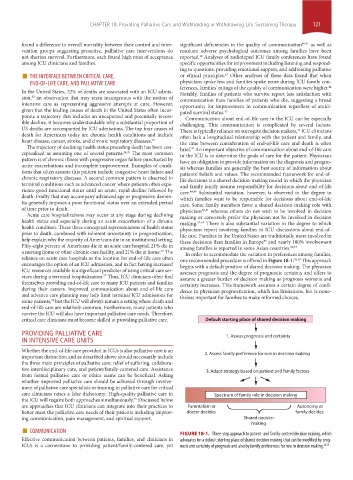
                    reliance on acute care hospitals as the location for end-of-life care often   one recommended procedure is offered in Figure 18-1. 58,59  This approach
                    encourages the option of an ICU admission, and in fact having increased   begins with a default position of shared decision making. The physician
                    ICU resources available is a significant predictor of using critical care ser-  assesses prognosis and the degree of prognostic certainty and offers to
                    vices during a terminal hospitalization.  Thus, ICU clinicians often find   assume a greater burden of decision making as prognosis worsens and
                                               37
                    themselves providing end-of-life care to many ICU patients and families   certainty increases. This framework assumes a certain degree of confi-
                    during their careers. Improved communication about end-of-life care   dence in physician prognostication, which has limitations, but is none-
                    and advance care planning may help limit terminal ICU admissions for   theless important for families to make informed choices.
                    some patients,  but the ICU will always remain a setting where death and
                              38
                    end-of-life care are relatively common. Furthermore, many patients who
                    survive the ICU will also have important palliative care needs. Therefore,
                    critical care clinicians must become skilled at providing palliative care.  Default starting place of shared decision making

                    PROVIDING PALLIATIVE CARE                                            1. Assess prognosis and certainty
                    IN INTENSIVE CARE UNITS
                    Whether the end-of-life care provided in ICUs is also palliative care is an
                    important distinction and as described above should necessarily include   2. Assess family preference for role in decision making
                    the three main principles of palliative care: relief of suffering, collabora-
                    tive interdisciplinary care, and patient/family-centered care. Assistance   3. Adapt strategy based on patient and family factors
                    from formal palliative care or ethics teams can be  beneficial. Asking
                    whether improved palliative care should be achieved through involve-
                    ment of palliative care specialists or training in palliative care for critical
                    care clinicians raises a false dichotomy: High-quality palliative care in   Spectrum of family role in decision making
                    the ICU will require both approaches simultaneously.  Discussed below
                                                          39
                    are approaches that ICU clinicians can integrate into their practices to   Parentalism or    Autonomy or
                    better meet the palliative care needs of their patients including improv-  doctor decides    family decides
                    ing communication, pain management, and spiritual support.                 Shared decision
                        ■  COMMUNICATION                                                          making

                    Effective communication between patients, families, and clinicians in   FIGURE 18-1.  Three-step approach to patient- and family-centred decision making, which
                                                                          advocates for a default starting place of shared decision making that can be modified by prog-
                    ICUs is a cornerstone to providing patient/family-centered care, yet   nosis and certainty of prognosis and also by family preferences for role in decision making. 58,59


            Section01.indd   121                                                                                       1/22/2015   9:37:49 AM

