


Page 229 - Hall et al (2015) Principles of Critical Care-McGraw-Hill
P. 229
CHAPTER 20: Nutrition Therapy in the Critically Ill  133


                    RELATIONSHIP OF THE GASTROINTESTINAL                  systemic circulation via the left subclavian vein. These proinflammatory
                    TRACT, IMMUNE SYSTEM, AND                             cytokines pass directly into the microcapillary system of the lungs where
                                                                          activation of platelet activating factor and neutrophils lead to acute
                    ISCHEMIA/REPERFUSION INJURY
                                                                          respiratory distress syndrome.
                    The GI tract is the largest immune organ in the body, containing 65% of   In a situation of even brief disuse, gut integrity may deteriorate. The
                    immune tissue overall and up to 80% of the immunoglobulin-producing   mass  of  GALT  and  MALT  tissue  may  diminish  rapidly  over  a  brief
                    tissues of the body. 15,16  In the fed state, the normal motility, villous   period of 7 to 10 days. Increased permeability occurs, opening up
                    microanatomy, rich blood supply, and epithelial intercellular tight junc-  paracellular  channels,  allowing  bacteria  or  other  gut-derived  factors
                    tions contribute to the overall integrity and barrier function of the GI   such as endotoxin to activate elements of the innate immune system
                                                                                     26
                    tract. In response to luminal nutrients, propulsive contractions assist in   (macrophages).  Activated macrophages will prime neutrophils passing
                    controlling the concentration of luminal bacteria, and the secretion of   through the splanchnic circulation. Primed neutrophils passing out to
                    bile salts, mucus glycoproteins, and secretory IgA retard bacterial adhe-  distant sites such as the liver, lung, and kidney may become activated
                    sion to gut epithelial cells and subsequent translocation. 26,27  The healthy   by a second insult (such as hypoxemia or hypotension). At such sites,
                    gut  acts  as  an  important  antigen-sensing  organ,  in  which  bacterial   they may mediate tissue injury, resulting in the generation of oxida-
                                  https://kat.cr/user/tahir99/ivation is a key
                    antigen is sampled and processed by the M cells, ultimately stimulating   tive species. Macrophage and subsequent neutrophil act
                    the release and maturation of a population of pluripotential stem cells   step  linking  gut  functional  compromise  with  more  systemic  factors
                    or naïve CD4 helper T lymphocytes. 28,29  These cells migrate out from   that adversely affect patient outcome.  Activated macrophages and
                                                                                                      30
                    the lamina propria of the gut, through the mesenteric lymph nodes and    neutrophils also initiate the arachidonic acid cascade. Generation of
                    thoracic duct, and into the systemic circulation as a mature line of   prostaglandin E  (PGE ) suppresses delayed hypersensitivity reaction,
                                                                                     2
                                                                                          2
                    B- and T-cell lymphocytes. A proportion of these cells generated in   generates superoxide radicals, and leads to an increased susceptibility
                    the maturation of the pluripotential stem cells migrate out as mucosal-  to sepsis. Generation of leukotriene B  (LTB ) leads to chemotaxis and
                                                                                                          4
                                                                                                     4
                    associated lymphoid tissue (MALT) to distant sites such as the lungs,   edema and the systemic inflammatory response syndrome (SIRS).
                    genitourinary tract, breast, and lacrimal glands. 26-29  Those that return   Thromboxane A , another product of this cascade, leads to vasoconstric-
                                                                                     2
                    to the Peyer patches of the enteric mucosa are known as gut-associated   tion and thrombosis. This event, in turn, promotes physiologic shunts
                    lymphoid tissue (GALT). 27-29  In some situations, instead of seeing an   and multiple organ failure. 31
                    increase in aspiration pneumonia in response to enteral feeding of   The overall tone of the systemic immune response may be modulated
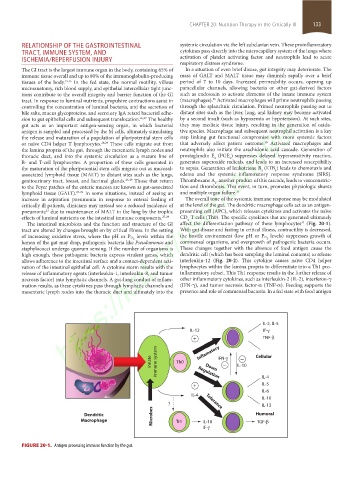
                    critically ill patients, clinicians may instead see a reduced incidence of   at the level of the gut. The dendritic macrophage cells act as an antigen-
                    pneumonia  due to maintenance of MALT in the lung by the trophic   presenting cell (APC), which releases cytokines and activates the naïve
                            22
                    effects of luminal nutrients on the intestinal immune components. 27-29  CD  T cells (Th0). The specific cytokines that are generated ultimately
                                                                            4
                     The intestinal microbiota and the function and structure of the GI   affect the differentiation pathway of these lymphocytes  (Fig. 20-1).
                                                                                                                   32
                    tract are altered by changes brought on by critical illness. In the setting   With gut disuse and fasting in critical illness, contractility is decreased,
                                                            levels within  the                           levels) suppresses growth of
                    of increasing oxidative  stress, where the  pH or  P O 2  the hostile environment (low pH or P O 2
                    lumen of the gut may drop, pathogenic bacteria like Pseudomonas and   commensal organisms, and overgrowth of pathogenic bacteria occurs.
                    staphylococci undergo quorum sensing. If the number of organisms is   These  changes  together  with  the  absence  of  food  antigen  cause  the
                    high enough, these pathogenic bacteria express virulent genes, which   dendritic cell (which has been sampling the luminal contents) to release
                    allows adherence to the intestinal surface and a contact-dependent acti-  interleukin-12 (Fig. 20-2). This cytokine causes naïve CD4 helper
                    vation of the intestinal epithelial cell. A cytokine storm results with the   lymphocytes within the lamina propria to differentiate into a Th1 pro-
                    release of inflammatory agents (interleukin-1, interleukin-8, and tumor   inflammatory subset. This Th1 response results in the further release of
                    necrosis factor) into lymphatic channels. A gut-lung conduit of inflam-  other inflammatory cytokines, such as interleukin-2 (IL-2), interferon-γ
                    mation results, as these cytokines pass through lymphatic channels and   (IFN-γ), and tumor necrosis factor-α (TNF-α). Feeding supports the
                    mesenteric lymph nodes into the thoracic duct and ultimately into the   presence and role of commensal bacteria. In a fed state with food antigen


                                                                                                      IL-2, IL-5
                                                                             IL-12                    IF-
                                                                              +                       TNF-


                                                                                              −
                                                                Innate  immune system  Th0  Inflamatory IFN-   IL-10  Cellular
                                                                                        −
                                                                                  Down
                                                                                Regulation
                                                                              +                      IL-4
                                                                                                     IL-5
                                                                                                     IL-6
                                                                             IL-4
                                                                                                     IL-10
                                                                      ?           Tolerance          IL-13
                                                                Microbes
                                         Dendritic                                                 Humoral
                                        Macrophage                      Tr1      IL-10              TGF-
                                                                                 IF-


                    FIGURE 20-1.  Antigen processing immune function by the gut.


            section02.indd   133                                                                                       1/13/2015   2:04:54 PM

