


Page 233 - Hall et al (2015) Principles of Critical Care-McGraw-Hill
P. 233
CHAPTER 20: Nutrition Therapy in the Critically Ill  137


                    frequently than aspiration.  A number of risk factors have been identi-  ill patients assigned to semirecumbent or supine position.  Drakulovic and
                                       68
                                                                                                                 72
                    fied that increase risk of aspiration in the ICU.  While it is difficult to   colleagues demonstrated that providing EN into the stomach in patients kept
                                                      69
                    quantify or stratify degree of risk among these factors, a simple categori-  in the supine position was associated with a much higher risk of pneumonia
                    zation differentiates major risk factors for which change in management   compared to feeding patients with the head of the bed elevated to 45° (23%
                    strategy may be needed, versus additional minor risk factors that may   vs 5%, p <0.05). In subsequent randomized trial, van Nieuwenhoven et al
                                                                                                                            73
                    not warrant specific change in therapeutic course.  Major risk factors   tried to replicate these findings but were unable. They were unsuccessful in
                    include documented previous episodes of aspiration, decreased level of   fully achieving 45° elevation in the intervention group and the supine group
                    consciousness (including sedation or increased intracranial pressure),   was nursed at approximately 20°. These facts may explain the negative find-
                    neuromuscular disease, structural abnormalities of the aerodigestive   ings associated with this study. Thus, a simple maneuver (ie, elevating the
                    tract, need for endotracheal intubation, overt vomiting or regurgitation,   head of the bed to 30°-45°) may reduce the risks associated with enteral feed-
                    need for prolonged supine position, and persistently high gastric resid-  ings and is recommended.
                                  https://kat.cr/user/tahir99/
                    ual volumes.  Additional risk factors include presence of a nasoenteric
                             69
                    tube, noncontinuous or bolus intermittent feeding, abdominal/thoracic     ■  MOTILITY AGENTS
                    surgery or trauma, delayed gastric emptying, poor oral care, advanced   Gastrointestinal prokinetic agents improve gastric emptying, improve
                    age,  inadequate  nursing  staff,  large bore  feeding  tube, malpositioned   tolerance to enteral nutrition, reduce gastroesophageal reflux and pul-
                    enteral tube (back into the esophagus), or transport out of the ICU.    monary aspiration, and therefore may have the potential to improve
                                                                     1,69
                    Strategies to prevent aspiration in patients receiving nutrition support   outcomes in critically ill patients.  While no study has demonstrated
                                                                                                  74
                    who have significant risk factors, as outlined below, should be utilized   an  impact  from  use  of  these  agents  on  clinical  outcomes,  their  low
                    to minimize the risks associated with EN in this setting.  probability of harm and favorable feasibility and cost considerations
                        ■  ROLE OF SMALL BOWEL FEEDING                    warrant their  use as a strategy to optimize nutritional intake  and
                                                                          minimize regurgitation. Since cisapride is no longer available and due
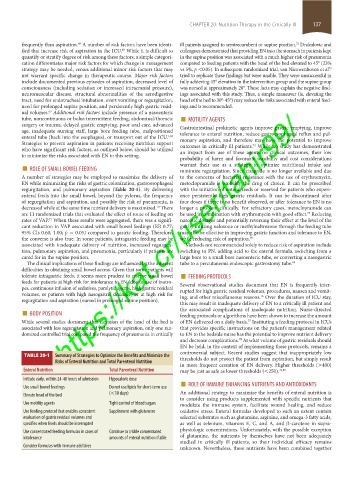
                    A number of strategies may be employed to maximize the delivery of   to the concerns of bacterial resistance with the use of erythromycin,
                    EN while minimizing the risks of gastric colonization, gastroesophageal   metoclopramide is probably the drug of choice. It can be prescribed
                    regurgitation, and pulmonary aspiration (Table 20-1). By delivering   with the initiation of enteral feeds or reserved for patients who experi-
                    enteral feeds into the small bowel, beyond the pylorus, the frequency   ence  persistently  high  gastric  residuals.  It  can  be  discontinued  after
                    of regurgitation and aspiration, and possibly the risk of pneumonia, is   four doses if there is no benefit observed, or after tolerance to EN is no
                    decreased while at the same time nutrient delivery is maximized.  There   longer a problem clinically. For refractory cases, metoclopramide can
                                                                  70
                    are 11 randomized trials that evaluated the effect of route of feeding on   be used in combination with erythromycin with good effect.  Reducing
                                                                                                                     75
                    rates of VAP.  When these results were aggregated, there was a signifi-  narcotic dosages and potentially reversing their effect at the level of the
                             71
                    cant reduction in VAP associated with small bowel feedings (RR 0.77;   gut by infusing naloxone or methylnaltrexone through the feeding tube
                    95% CIs 0.60, 1.00; p = 0.05) compared to gastric feeding. Therefore,   may also be effective in improving gastric function and tolerance to EN,
                    the converse is also true. In some patients, intragastric feeding may be   while reducing risk of aspiration. 69
                    associated with inadequate delivery  of nutrition, increased regurgita-  Methods not recommended solely to reduce risk of aspiration include
                    tion, pulmonary aspiration, and pneumonia, particularly if patients are   switching to PN, adding acid to the enteral formula, switching from a
                    cared for in the supine position.                     large bore to a small bore nasoenteric tube, or converting a nasogastric
                     The clinical implications of these findings are influenced by the inherent   tube to a percutaneous endoscopic gastrostomy tube. 69
                    difficulties in obtaining small bowel access. Given that some patients will
                    tolerate intragastric feeds, it seems more prudent to reserve small bowel     ■  FEEDING PROTOCOLS
                    feeds for patients at high risk for intolerance to EN (due to use of inotro-  Several observational  studies  document  that  EN  is  frequently inter-
                    pes, continuous infusion of sedatives, paralytic agents, high gastric residual   rupted for high gastric residual volumes, procedures, nausea and vomit-
                    volumes, or patients with high nasogastric drainage) or at high risk for   ing, and other miscellaneous reasons.  Over the duration of ICU stay,
                                                                                                     76
                    regurgitation and aspiration (nursed in prolonged supine position).  this may result in inadequate delivery of EN to a critically ill patient and
                        ■  BODY POSITION                                  the  associated  complications  of  inadequate  nutrition. Nurse-directed
                                                                          feeding protocols or algorithms have been shown to increase the amount
                    While several studies document that elevation of the head of the bed is   of EN delivered on a daily basis.  Instituting a feeding protocol in ICUs
                                                                                                 77
                    associated with less regurgitation and pulmonary aspiration, only one ran-  that provides specific instructions on the patient’s management related
                    domized controlled trial compared the frequency of pneumonia in critically   to EN to the bedside nurse has the potential to improve nutrient delivery
                                                                          and decrease complications.  At what volume of gastric residuals should
                                                                                              78
                                                                          EN be held, in the context of implementing these protocols, remains a
                                                                          controversial subject. Recent studies  suggest that  inappropriately  low
                      TABLE 20-1     Summary of Strategies to Optimize the Benefits and Minimize the   thresholds do not protect the patient from aspiration, but simply result
                               Risks of Enteral Nutrition and Total Parenteral Nutrition
                                                                          in more frequent cessation of EN delivery. Higher thresholds (>400)
                    Enteral Nutrition            Total Parenteral Nutrition  may be just as safe as lower thresholds (<250). 79,80
                    Initiate early, within 24-48 hours of admission  Hypocaloric dose    ■
                    Use small bowel feedings     Do not use lipids for short-term use   ROLE OF IMMUNE ENHANCING NUTRIENTS AND ANTIOXIDANTS
                    Elevate head of the bed      (<10 days)               An additional strategy to maximize the benefits of enteral nutrition is
                                                                          to consider using products supplemented with specific nutrients that
                    Use motility agents          Tight control of blood sugars  modulate the immune system, facilitate wound healing, and reduce
                    Use feeding protocol that enables consistent    Supplement with glutamine  oxidative stress. Enteral formulas developed to such an extent contain
                    evaluation of gastric residual volumes and            selected substrates such as glutamine, arginine, and omega-3 fatty acids,
                    specifies when feeds should be interrupted            as well as selenium, vitamins E, C, and A, and  β-carotene in supra-
                    Use concentrated feeding formulas in cases of    Continue to trickle concentrated   physiologic concentrations. Unfortunately, with the possible exception
                    intolerance                  amounts of enteral nutrition if able  of glutamine, the nutrients by themselves have not been adequately
                                                                          studied in critically ill patients, so their individual efficacy remains
                    Consider formulas with immune additives               unknown. Nevertheless, these nutrients have been combined together


            section02.indd   137                                                                                       1/13/2015   2:04:56 PM

