


Page 234 - Hall et al (2015) Principles of Critical Care-McGraw-Hill
P. 234
138     PART 2: General Management of the Patient


                 and marketed as an immune-enhancing diet. We use the term immu-  mortality (RR 1.06; 95% CIs 0.93, 1.20; p = 0.40), no overall effect on
                 nonutrition as a general term to describe all these enteral products,   infectious complications (RR 0.99; 95% CIs 0.85-1.15; p = 0.88), and
                 but attempt to make summary recommendations based on the specific   a trend toward reduction in hospital length of stay (weighted mean
                 nutrients by themselves.                              difference 2.40; 95% CIs 5.90, 1.09 ; p = 0.18).  The presence of sig-
                                                                                                          86
                                                                       nificant statistical heterogeneity across studies weakens the estimate
                     ■  ARGININE                                       of effect on length of stay.
                                                                         Whether arginine-containing products worsen outcomes in critically
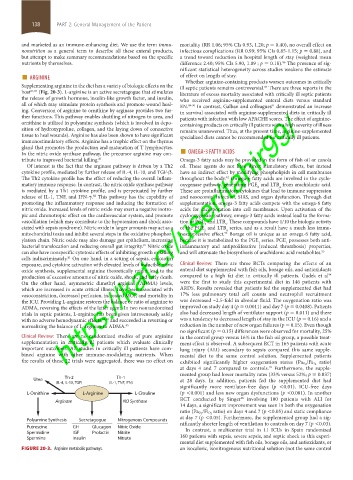
                 Supplementing arginine in the diet has a variety of biologic effects on the   ill septic patients remains controversial.  There are three reports in the
                                                                                                    87
                 host 81,82  (Fig. 20-3). L-arginine is an active secretagogue that stimulates   literature of excess mortality associated with critically ill septic patients
                 the release of growth hormone, insulin-like growth factor, and insulin,   who received arginine-supplemented enteral diets versus standard
                 all of which may stimulate protein synthesis and promote wound heal-  EN. 88-90  In contrast, Galban and colleagues  demonstrated an increase
                                                                                                      91
                                https://kat.cr/user/tahir99/
                 ing. Conversion of arginine to ornithine by arginase provides two fur-  in survival associated with arginine-supplemented diets in critically ill
                 ther functions. This pathway enables shuttling of nitrogen to urea, and   patients with infection with low APACHE scores. The effect of arginine-
                 ornithine is utilized in polyamine synthesis (which is involved in depo-  containing products on critically ill patients with a high severity of illness
                 sition of hydroxyproline, collagen, and the laying down of connective   remains unanswered. Thus, at the present time, arginine-supplemented
                 tissue to heal wounds). Arginine has also been shown to have significant   specialized diets cannot be recommended for critically ill patients.
                 immunostimulatory effects. Arginine has a trophic effect on the thymus
                 In the nitric oxide synthase pathway, the precursor arginine may con-  ■  OMEGA-3 FATTY ACIDS
                 gland that promotes the production and maturation of T lymphocytes.
                 tribute to improved bacterial killing. 81             Omega-3 fatty acids may be provided in the form of fish oil or canola
                   Of interest is the fact that the arginase pathway is driven by a Th2   oil. These agents do not have direct stimulatory effects, but instead
                 cytokine profile, mediated by further release of IL-4, IL-10, and TGF-β.   have an indirect effect by modifying phospholipids in cell membranes
                 The Th2 cytokine profile has the effect of reducing the overall inflam-  throughout the body.  Omega-6 fatty acids are involved in the cyclo-
                                                                                       92
                 matory immune response. In contrast, the nitric oxide synthase pathway   oxygenase pathway, generating PGE  and LTB  from arachidonic acid.
                                                                                                         4
                                                                                                  2
                 is mediated by a Th1 cytokine profile, and is perpetuated by further   These are proinflammatory cytokines that lead to immune suppression
                 release of IL-1, TNF, and IFN-γ.  This pathway has the capability of   and  nosocomial infection, SIRS, and organ dysfunction. Through diet
                                          82
                 promoting the inflammatory response and inducing the formation of     supplementation, omega-3 fatty acids compete with the omega-6 fatty
                 nitric oxide. Increased levels of nitric oxide may exert a negative inotro-  acids for incorporation into cell membranes. Upon activation of the
                 pic and chronotropic effect on the cardiovascular system, and promote   cyclooxygenase pathway, omega-3 fatty acids instead lead to the forma-
                 vasodilation (which may contribute to the hypotension and shock asso-  tion of PGE  and LTB . These compounds have 1/10 the biologic activity
                                                                                3
                                                                                       5
                 ciated with sepsis syndrome). Nitric oxide in larger amounts may act as a   of the PGE  and LTB  series, and as a result have a much less immu-
                                                                               2
                                                                                       4
                 mitochondrial toxin and inhibit several steps in the oxidative phosphor-  nosuppressive effect.  Borage oil is unique as an omega-6 fatty acid,
                                                                                      92
                 ylation chain. Nitric oxide may also damage gut epithelium, increasing   because it is metabolized to the PGE  series. PGE  possesses both anti-
                                                                                                  1
                                                                                                           1
                 bacterial translocation and reducing overall gut integrity.  Nitric oxide   inflammatory and antiproliferative (reduced thrombosis) properties,
                                                           81
                 can also have nonspecific cytotoxic effects of inhibiting growth or killing   and will attenuate the biosynthesis of arachidonic acid metabolites. 93
                 cells indiscriminately.  On one hand, in a setting of sepsis, endotoxin
                                 81
                 exposure, and cytokine activation with elevated levels of inducible nitric   Clinical Review:  There are three RCTs comparing the effects of an
                 oxide synthesis, supplemental arginine theoretically might lead to the   enteral diet supplemented with fish oils, borage oils, and antioxidants
                                                                                                                          94
                 production of excessive amounts of nitric oxide, shock, and early death.   compared to a high fat diet in critically ill patients. Gadek et al
                 On the other hand, asymmetric dimethyl arginine (ADMA) levels,   were the first to study this experimental diet in 146 patients with
                 which are increased in acute critical illness, have been associated with   ARDS. Results revealed that patients fed the supplemented diet had
                 vasoconstriction, decreased perfusion, increased MOF, and mortality in   17% less pulmonary total cell counts and neutrophil recruitment
                 the ICU. Providing L-arginine restores the balance or ratio of arginine to   was decreased ~2.5-fold in alveolar fluid. The oxygenation ratio was
                 ADMA, reversing the effects of the latter agent. In two nonrandomized   improved on study day 4 (p = 0.0011) and day 7 (p = 0.0408). Patients
                 trials in septic patients, L-arginine has been given intravenously safely   also had decreased length of ventilator support (p = 0.011) and there
                 with no adverse hemodynamic effects, 83,84  and succeeded in reversing or   was a tendency to decreased length of stay in the ICU (p = 0.16) and a
                 normalizing the balance of L-arginine to ADMA. 85     reduction in the number of new organ failures (p = 0.15). Even though
                                                                       no significant (p = 0.15) differences were observed for mortality, 25%
                 Clinical Review:  There are no randomized studies of pure arginine   in the control group versus 16% in the fish oil group, a  possible treat-
                 supplementation in critically ill patients which evaluate clinically   ment effect is observed. A subsequent RCT in 165 patients with acute
                 important outcomes. All studies in critically ill patients have com-  lung injury (ALI) secondary to sepsis compared this same supple-
                 bined arginine with  other immune-modulating  nutrients.  When   mental diet to the same control solution. Supplemented patients
                 the results of these 22 trials were aggregated, there was no effect on                                ratio)
                                                                       exhibited significantly higher oxygenation status (Pa O 2 /Fi O 2
                                                                       at days 4 and 7 compared to controls.  Furthermore, the supple-
                                                                                                     95
                                                                       mented group had lower mortality rates (33% versus 52%; p = 0.037)
                     Urea       Th-2              Th-1                 at 28 days. In addition, patients fed the supplemented diet had
                             (IL-4, IL-10, TGF)  (IL-1, TNF, IFN)
                                                                       significantly more ventilator-free days (p  <0.01), ICU-free days
                   L-Ornithine        L-Arginine        L-Citruline    (p <0.001) and less new organ dysfunctions (p <0.001). In another
                                                                       RCT conducted by Singer  involving 100 patients with ALI for
                                                                                            96
                             Arginase               NO Synthase
                                                                       14 days, a significant improvement was seen in both the oxygenation
                                                                                   ratio) on days 4 and 7 (p <0.05) and static compliance
                                                                       ratio (Pa O 2 /Fi O 2
                                                                       at day 7 (p <0.05). Furthermore, the supplemented group had a sig-
                   Polyamine Synthesis  Secretagogue  Nitrogenous Compounds  nificantly shorter length of ventilation to controls on day 7 (p <0.03).
                   Putrescine      GH    Glucagon  Nitric Oxide          In contrast, a multicenter trial in 11 ICUs in Spain randomized
                   Spermidine      IGF   Prolactin  Nitrite            160 patients with sepsis, severe sepsis, and septic shock to this experi-
                   Spermine        Insulin        Nitrate
                                                                       mental diet supplemented with fish oils, borage oils, and antioxidants, or
                 FIGURE 20-3.  Arginine metabolic pathways.            an isocaloric, isonitrogenous nutritional solution (not the same control
            section02.indd   138                                                                                       1/13/2015   2:04:57 PM

