


Page 256 - Hall et al (2015) Principles of Critical Care-McGraw-Hill
P. 256
160     PART 2: General Management of the Patient


                   Parthasarathy and Tobin were among the first to conclusively dem-  pressure support ventilation is used, particularly if the patients also have
                 onstrate that ventilator mode impacts sleep quality in the ICU setting.   congestive heart failure. Similar problems with sleep fragmentation may
                 In a detailed study of 11 patients receiving mechanical ventilation sleep   occur when assist-control ventilation and proportional assist ventilation
                 fragmentation was found to be severe with frequent arousals.  Pressure   are used, but these modes are probably more forgiving in this respect.
                                                             37
                 support adjusted to achieve a tidal volume equivalent to that achieved
                 during assist-control ventilation (8 mL/kg) caused greater sleep frag-    ■  NONINVASIVE VENTILATION
                 mentation than did assist-control ventilation, and six subjects—five   Noninvasive  ventilation  has  been  used  for  years  in  the  management
                 of whom had heart failure—exhibited central apneas. The addition of   of patients with chest wall disease and/or neuromuscular weakness,
                 dead space to the ventilator circuit decreased sleep fragmentation in the   and has been associated not only with improvements in dyspnea and
                 pressure support mode. Subsequently, a randomized crossover study   health-related quality of life, but also with improved sleep quality (see
                 of patients nearing extubation after treatment for acute-on-chronic   Chapter 44). In contrast, little is known about the effects of noninvasive
                 respiratory failure compared the effect on sleep quality of assist-control   ventilation on sleep quality in the  acutely ill  patient. In  one study of
                 ventilation and pressure support ventilation with a low, fixed (6 cm H O)   patients being treated in a medical ICU with noninvasive ventilation
                                                                  2
                 level of inspiratory pressure.  The investigators noted improvements in   for  >48  hours,  patients  who  ultimately  failed  noninvasive  ventilation
                                      38
                 sleep quality, including increased SWS, with the assist-control setting.   exhibited worse sleep quality than those who did not, manifest as the
                 In contrast, Cabello et al found no differences in sleep quality between   more frequent occurrence of an abnormal electroencephalographic
                 assist-control ventilation, clinically adjusted pressure support ven-  pattern, reduced REM sleep, and a reduced percentage of total sleep time
                 tilation, and automatically adjusted pressure support ventilation in 15   occurring at night.  A particular strength of this study was the inclusion
                                                                                     44
                 conscious,  nonsedated,  mechanically  ventilated  patients.   Differences   of the behavioral state in the analysis of the EEG; however, the reproduc-
                                                           39
                 in results between these studies may reflect differences in the subjects’   ibility of the method used by the investigators has not been examined.
                 severity of illness, residual effects of sedation, differing degrees of prior   Of course, even if the results are valid, whether the “sleep” abnormalities
                 sleep  deprivation  and/or  circadian-determined  sleep  propensity,  or   witnessed by the investigators actually led to harm or were themselves an
                 subtle differences in ventilator settings. Common to all three studies was   epiphenomenon that served only to mark worsening illness is unknown.
                 the scarcity of REM sleep.
                   Proportional assist ventilation is designed to adjust the level of support      ■  SEDATION AND SLEEP
                 to instantaneous flow and volume and has been shown in many stud-                                        45
                 ies to improve synchrony between the patient and the ventilator (see   The relationship between sedation and sleep is extraordinarily complex.
                 Chapter 50). Conceivably, such a strategy could improve sleep quality   Sedatives and narcotics commonly used in the ICU may, in fact, pro-
                 as well. In fact, one study conducted by Bosma et al showed propor-  mote sleep in some situations by alleviating pain, dyspnea, and anxiety.
                 tional assist ventilation to be superior to pressure support ventilation   On the other hand, even relatively small doses of these medications may
                 in this regard.  This advantage was not reproduced in a study that   impair sleep quality: benzodiazepines can cause in increase in stage
                            40
                 compared pressure support ventilation with proportional assist ventila-  N2 sleep while reducing slow wave sleep and REM sleep, while opiates
                 tion with load-adjustable gain factors (so-called PAV+).  This study   powerfully suppress REM sleep. While the overall effect of such doses
                                                           41
                 was performed in a somewhat different patient population than that of   on the EEG is relatively minor, high doses of sedatives and narcotics
                 Bosma et al, however. Notably, both modes were able to induce periodic   are capable of inducing significant EEG suppression, leading even to an
                 breathing during sleep in both sedated and nonsedated patients. This   isoelectric state. It appears likely that, somewhere in the middle between
                 study confirms the importance of individualized titration of ventila-  these two extremes, exist most acutely ill patients receiving continuous
                 tor support to patient effort. It also highlights the primitive nature of    intravenous sedation.
                 current forms of mechanical ventilatory support, in that even those   When considering the relationship between sleep and sedation it is
                 systems that employ some form of feedback control—like propor-  worth remembering that, while sedation is similar to sleep in many ways,
                 tional assist ventilation—do not effectively navigate changes in sleep   there are also many differences between the two (Table 23-4). Normal
                 state. However, in a study comparing a more sophisticated method of   sleep is a naturally occurring state that is reversible with external stimuli.
                   mechanical ventilation—neurally adjusted ventilator assist (NAVA)—  It is highly oscillatory and characterized by approximately 90-minute
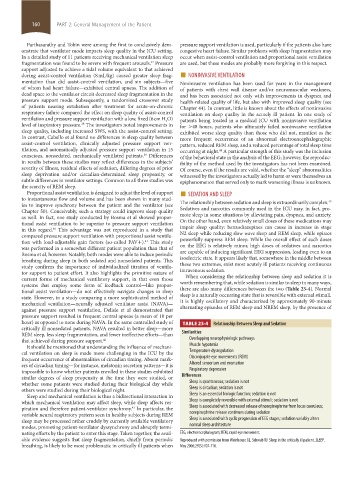
                 against pressure support ventilation, Delisle et al demonstrated that   alternating episodes of REM sleep and NREM sleep, by the presence of
                 pressure support resulted in frequent central apneas (a mean of 10 per
                 hour) as opposed to none during NAVA. In the same controlled study of     TABLE 23-4    Relationship Between Sleep and Sedation
                 critically ill nonsedated patients, NAVA resulted in better sleep—more
                 REM sleep, less sleep fragmentation, and fewer ineffective efforts—than   Similarities
                 that achieved during pressure support. 42                Overlapping neurophysiologic pathways
                   It should be mentioned that understanding the influence of mechani-  Muscle hypotonia
                 cal ventilation on sleep is made more challenging in the ICU by the    Temperature dysregulation
                 frequent occurrence of abnormalities of circadian timing. Absent mark-  Disconjugate eye movements (REM)
                 ers of circadian timing—for instance, melatonin secretion patterns—it is   Altered sensorium and mentation
                 impossible to know whether patients enrolled in these studies exhibited   Respiratory depression
                 similar  degrees  of  sleep  propensity  at  the  time  they  were  studied,  or   Differences
                 whether some patients were studied during their biological day while   Sleep is spontaneous; sedation is not
                 others were studied during their biological night.       Sleep is circadian; sedation is not
                   Sleep and mechanical ventilation is thus a bidirectional interaction in   Sleep is an essential biologic function; sedation is not
                 which mechanical ventilation may affect sleep, while sleep affects res-  Sleep is completely reversible with external stimuli; sedation is not
                 piration and therefore patient-ventilator synchrony.  In particular, the   Sleep is associated with decreased release of norepinephrine from locus coeruleus;
                                                       43
                 variable neural respiratory pattern seen in healthy subjects during REM   norepinephrine release continues during sedation
                 sleep may be processed rather crudely by currently available ventilatory   Sleep is associated with cyclic progression of EEG stages; sedation variably alters
                 modes, promoting patient-ventilator dyssynchrony and abruptly termi-  normal sleep architecture
                 nating efforts by the patient to enter this stage. Taken together, the avail-  EEG, electroencephalogram; REM, rapid eye movement.
                 able evidence suggests that sleep fragmentation, chiefly from periodic   Reproduced with permission from Weinhouse GL, Schwab RJ. Sleep in the critically ill patient. SLEEP.
                 breathing, is likely to be most problematic in critically ill patients when   May 2006;29(5):707-716.


            section02.indd   160                                                                                       1/13/2015   2:05:07 PM

