


Page 253 - Hall et al (2015) Principles of Critical Care-McGraw-Hill
P. 253
CHAPTER 23: Sleep   157


                                       Awake
                                        REM
                                      Stage 1

                                      Stage 2
                                      Stage 3
                                                                                          Young adults
                                      Stage 4
                                           0        1       2       3      4       5      6       7       8
                                                                      Hours of sleep

                                       Awake
                                        REM

                                      Stage 1
                                      Stage 2
                                      Stage 3
                                                                                         Elderly
                                      Stage 4

                                           0        1       2       3      4       5      6       7       8
                                                                      Hours of sleep
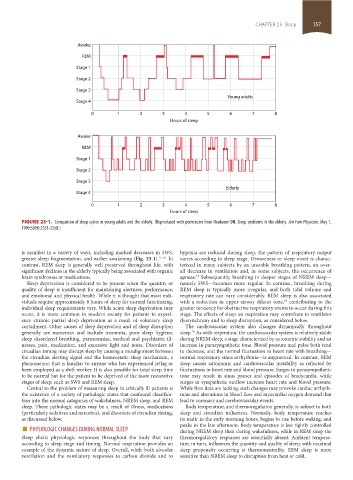
                    FIGURE 23-1.  Comparison of sleep cycles in young adults and the elderly. (Reproduced with permission from Neubauer DN. Sleep problems in the elderly. Am Fam Physician. May 1,
                    1999;59(9):2551-2558.)


                    is manifest in a variety of ways, including marked decreases in SWS,   hypoxia  are  reduced  during  sleep,  the  pattern  of  respiratory  output
                    greater sleep fragmentation, and earlier awakening (Fig. 23-1). 11, 61  In   varies according to sleep stage. Drowsiness or sleep onset is charac-
                    contrast, REM sleep is generally well preserved throughout life, with   terized in many subjects by an unstable breathing pattern, an over-
                    significant declines in the elderly typically being associated with organic   all decrease in ventilation and, in some subjects, the occurrence of
                    brain syndromes or medications.                       apneas.  Subsequently, breathing in deeper stages of NREM sleep—
                                                                               12
                     Sleep deprivation is considered to be present when the quantity or   namely SWS—becomes more regular. In contrast, breathing during
                    quality of sleep is insufficient for maintaining alertness, performance,   REM sleep is typically more irregular, and both tidal volume and
                    and emotional and physical health. While it is thought that most indi-  respiratory rate can vary considerably. REM sleep is also associated
                    viduals require approximately 8 hours of sleep for normal functioning,   with a reduction in upper airway dilator tone,  contributing to the
                                                                                                             13
                    individual sleep requirements vary. While acute sleep deprivation may   greater tendency for obstructive respiratory events to occur during this
                    occur, it is more common in modern society for patients to experi-  stage. The effects of sleep on respiration may contribute to ventilator
                    ence chronic partial sleep deprivation as a result of voluntary sleep   dyssynchrony and to sleep disruption, as considered below.
                    curtailment. Other causes of sleep deprivation and of sleep disruption   The cardiovascular system also changes dynamically throughout
                    generally  are  numerous  and  include  insomnia,  poor  sleep  hygiene,   sleep.  As with respiration, the cardiovascular system is relatively stable
                                                                              14
                    sleep disordered breathing, parasomnias, medical and psychiatric ill-  during NREM sleep, a stage characterized by autonomic stability and an
                    nesses,  pain,  medication,  and  excessive  light  and  noise.  Disorders  of   increase in parasympathetic tone. Blood pressure and pulse both tend
                    circadian timing may disrupt sleep by causing a misalignment between   to decrease, and the normal fluctuation in heart rate with breathing—
                    the circadian alerting signal and the homeostatic sleep mechanism, a   normal respiratory sinus arrhythmia—is augmented. In contrast, REM
                    phenomenon that is familiar to anyone who has experienced jetlag or   sleep causes autonomic and cardiovascular instability as reflected by
                    been employed as a shift worker. It is also possible for total sleep time   fluctuations in heart rate and blood pressure. Surges in parasympathetic
                    to be normal but for the patient to be deprived of the more restorative   tone may result in sinus pauses  and episodes of bradycardia, while
                    stages of sleep, such as SWS and REM sleep.           surges in sympathetic outflow increase heart rate and blood pressure.
                     Central to the problem of measuring sleep in critically ill patients is   While firm data are lacking, such changes may provoke cardiac arrhyth-
                    the existence of a variety of pathologic states that confound classifica-  mias and alterations in blood flow and myocardial oxygen demand that
                    tion into the normal categories of wakefulness, NREM sleep, and REM   lead to coronary and cerebrovascular events.
                    sleep. These pathologic states may be a result of illness, medications   Body temperature, and thermoregulation generally, is subject to both
                    (particularly sedatives and narcotics), and disorders of circadian timing,   sleep  and  circadian  influences.  Normally,  body  temperature  reaches
                    as discussed below.                                   its nadir in the early morning hours, begins to rise before waking, and
                        ■  PHYSIOLOGIC CHANGES DURING NORMAL SLEEP        peaks in the late afternoon. Body temperature is less tightly controlled
                                                                          during NREM sleep than during wakefulness, while in REM sleep the
                    Sleep elicits physiologic responses throughout the body that vary   thermoregulatory  responses are  essentially  absent.  Ambient  tempera-
                    according to sleep stage and timing. Normal respiration provides an   ture, in turn, influences the quantity and quality of sleep, with maximal
                    example of the dynamic nature of sleep. Overall, while both alveolar   sleep propensity occurring at thermoneutrality. REM sleep is more
                    ventilation and the ventilatory responses to carbon dioxide and to   sensitive than NREM sleep to disruption from heat or cold.


            section02.indd   157                                                                                       1/13/2015   2:05:07 PM

