


Page 255 - Hall et al (2015) Principles of Critical Care-McGraw-Hill
P. 255
CHAPTER 23: Sleep   159


                    in the 24-hour pattern of blood pressure, heart rate, body tempera-  Patient care activities are obvious and frequent causes of sleep disrup-
                    ture,  and  spontaneous  motor  activity.   A  recent  study  that  analyzed    tion. Countless examples exist: nursing and physician assessments, blood
                                                26
                    6-sulfatoxymelatonin excretion patterns from samples collected hourly   draws, bathing, wound changes, endotracheal suctioning, radiography,
                    showed that while the circadian rhythms of critically ill patients receiv-  transportation, automated blood pressure monitoring, etc. In a study of
                    ing mechanical ventilation and continuous intravenous sedation were   ICU survivors vital sign measurement and phlebotomy were considered
                    usually preserved, abnormalities in timing were frequent, most com-  more disruptive than noise.  While in certain cases the timing of par-
                                                                                              33
                    monly in the form of a phase delay. 27                ticular patient care activities cannot or should not be modified, there
                     The relative contribution of disease, medications, and the ICU envi-  are numerous other activities—bathing and chest radiography being two
                    ronment to the development of these abnormalities is unknown. Even if   obvious examples—that are typically performed at times that have less
                    the circadian rhythms of critically ill patients are abnormal at the time   to do with the patient’s condition and more to do with the organization
                    of admission to the ICU, the results of the preceding studies suggest that   of work activities by the ICU or by the ancillary service involved. These
                    they do not synchronize effectively to the ICU environment. This may   activities represent obvious opportunities for improving patient sleep.
                    be partly due to weak light-dark and activity cycles in modern ICUs. It   While the effects of sedatives and narcotics on sleep are considered
                    is also possible that entrainment is inhibited by sedative-induced eye     separately below, it is important to remember that many other medica-
                    closure, which limits retinal exposure to ambient light. In addition, it is   tions administered to ICU patients have the potential to affect sleep.
                                                                                                                            34
                    not known whether the dispersion of sleep-like activity from sedation   For instance, vasoactive drugs like norepinephrine, phenylephrine,
                    over a 24-hour period itself affects circadian rhythmicity. Conceivably,   and epinephrine reduce N3 and REM sleep. Beta-blockers can cause
                    appropriately timed light exposure could help normalize circadian tim-  sleep disturbances including reduced REM sleep and vivid nightmares.
                    ing in such individuals similar to its use in ambulatory patients with cir-  Antihistamines and tricyclic antidepressants can cause sleepiness while
                    cadian rhythm disorders; however, this remains to be studied. Overall,   also reducing sleep quality in some subjects. Corticosteroids can cause
                    much work remains to be done to elucidate the causes and clinical   insomnia and nightmares and reduce REM sleep and sleep continuity.
                    significance of these abnormalities in circadian rhythmicity.  Acute illness may itself affect sleep quality, whether though indirect
                                                                          means of inducing pain, breathlessness, or anxiety, or through direct
                    SLEEP IN THE CRITICALLY ILL PATIENT                   means, as in the sleep-wake cycle reversal that may complicate the early
                                                                          stages of hepatic encephalopathy. Some illnesses are associated with
                        ■  OVERVIEW OF SLEEP ARCHITECTURE                 altered states of consciousness and electroencephalographic abnormali-
                      AND POTENTIAL DISRUPTERS TO SLEEP                   ties that defy discrete classification into wakefulness or sleep. Indeed, in
                                                                          a study performed by Freedman et al, patients with sepsis exhibited EEG
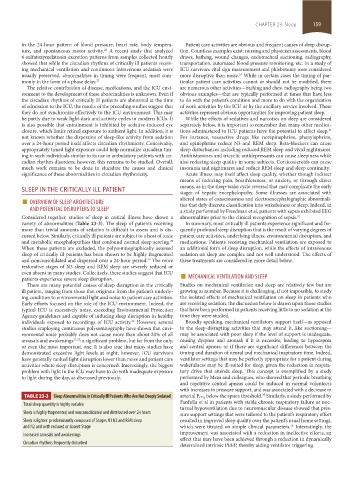
                    Considered together, studies of sleep in critical illness have shown a   abnormalities prior to the clinical recognition of sepsis. 31
                    variety of abnormalities (Table 23-3). The sleep of patients receiving   In summary, most critically ill patients experience significant and fre-
                    more than trivial amounts of sedation is difficult to assess and is dis-  quently profound sleep disruption that is the result of varying degrees of
                    cussed below. Similarly, critically ill patients are subject to a host of toxic   patient care activities, underlying illness, environmental disruption, and
                    and metabolic encephalopathies that confound normal sleep scoring.    medications. Patients receiving mechanical ventilation are exposed to
                                                                      28
                    When these patients are excluded, the polysomnographically assessed   an additional form of sleep disruption, while the effects of intravenous
                    sleep of critically ill patients has been shown to be highly fragmented   sedation on sleep are complex and not well understood. The effects of
                    and nonconsolidated and dispersed over a 24-hour period.  The more   these treatments are considered in more detail below.
                                                               29
                    restorative stages of N3 sleep and REM sleep are severely reduced or
                    even absent in many studies. Collectively, these studies suggest that ICU     ■
                    patients experience severe sleep disruption.            MECHANICAL VENTILATION AND SLEEP
                     There are many potential causes of sleep disruption in the critically   Studies on mechanical ventilation and sleep are relatively few but are
                    ill patient, ranging from those that originate from the patient’s underly-  growing in number. Because it is challenging, if not impossible, to study
                    ing condition to environmental light and noise to patient care activities.   the isolated effects of mechanical ventilation on sleep in patients who
                    Early efforts focused on the role of the ICU environment. Indeed, the   are receiving sedation, the discussion below is drawn upon those studies
                    typical ICU is excessively noisy, exceeding  Environmental  Protection   that have been performed in patients receiving little to no sedation at the
                    Agency guidelines and capable of inducing sleep disruption in healthy   time they were studied.
                    individuals exposed to recordings of ICU activity.  However, several   Broadly speaking, mechanical ventilatory support itself—as opposed
                                                         30
                    studies employing continuous polysomnography have shown that envi-  to the sleep-disrupting activities that may attend it, like suctioning—
                    ronmental noise probably does not cause more than about 20% of all   may be associated with poor sleep if the level of support is inadequate,
                    arousals and awakenings 31,32 : a significant problem, but far from the only,   causing dyspnea and arousal; if it is excessive, leading to hypocapnia
                    or even the most important, one. It is also true that many studies have   and central apneas; or if there are significant differences between the
                    demonstrated  excessive  light  levels  at  night;  however,  ICU  survivors   timing and duration of neural and mechanical inspiratory time. Indeed,
                    have generally ranked light disruption lower than noise and patient care   ventilator settings that may be perfectly appropriate for a patient during
                    activities where sleep disruption is concerned. Interestingly, the biggest   wakefulness may be ill-suited for sleep, given the reduction in respira-
                    problem with light in the ICU may have to do with inadequate exposure   tory drive that attends sleep. This concept is exemplified by a study
                    to light during the day, as discussed previously.     performed by Meza and colleagues, who showed that periodic breathing
                                                                          and repetitive central apneas could be induced in normal volunteers
                                                                          with increases in pressure support, and was associated with a decrease in
                                                                                                      35
                      TABLE 23-3    Sleep Abnormalities in Critically Ill Patients Who Are Not Deeply Sedated  arterial P CO 2  below the apnea threshold.  Similarly, a study performed by
                                                                          Fanfulla et al in patients with stable chronic respiratory failure or noc-
                    Total sleep quantity is highly variable
                                                                          turnal hypoventilation due to neuromuscular disease showed that pres-
                    Sleep is highly fragmented and nonconsolidated and distributed over 24 hours  sure support settings that were tailored to the patient’s respiratory effort
                    Sleep is lighter: predominantly composed of Stages N1 N3 and REM sleep   resulted in improved sleep quality over the patient’s usual home settings,
                    and N2 and with reduced or absent Stage               which were titrated on simple clinical parameters.  Interestingly, the
                                                                                                               36
                    Increased arousals and awakenings                     improvement was associated with a reduction in ineffective efforts, an
                                                                          effect that may have been achieved through a reduction in dynamically
                    Circadian rhythms frequently disturbed                determined intrinsic PEEP, thereby aiding ventilator triggering.


            section02.indd   159                                                                                       1/13/2015   2:05:07 PM

