


Page 280 - Hall et al (2015) Principles of Critical Care-McGraw-Hill
P. 280
184     PART 2: General Management of the Patient


                                               A central venous catheter in place for  3 days and at least one of the
                                               following: suspected infection without another confirmed source,
                                               signs of sepsis, sepsis, septic shock, or exit-site infection


                      Remove catheter             No
                      Order two blood cultures                 Catheter needed?
                      Continue evaluation for infection

                                                                  Yes


                                                             Order two blood cultures


                                                                                               Exit-Site Infection
                                                                                      Yes      Remove catheter
                                                              Catheter site infected?          Insert new catheter at new site
                                                                                               Start empirical antibiotics if sepsis
                                                                                                   or septic shock is present
                                                                  No

                                                                                      Yes
                                                              Sepsis or septic shock?             Start empirical antibiotics


                                                                  No                     No
                                                                                                     Septic shock?

                                                         Change catheter over guide wire               Yes
                                                         Culture catheter tip
                                                                                                  Source of infection other
                                                                                        Yes       than catheter probable?
                                                                                                       No
                        Catheter Infection Unlikely  No                                         Remove catheter
                        Continue evaluation for other         Tip culture positive?             Culture catheter tip
                            sources of infection                                                Insert new catheter at new site
                                                                  Yes


                                                             Blood cultures positive?

                                                        No                      Yes


                                Catheter Colonization                         Catheter-Related Bloodstream Infection
                                Remove catheter and insert new catheter       Remove catheter and insert new catheter
                                    at new site (if not already done)             at new site (if not already done)
                                Antibiotics are not indicated                 Antibiotics are indicated
                                                                              Tailor antibiotics to the sensitivity
                                                                                  of organisms
                                                                              Treat for 10-14 days

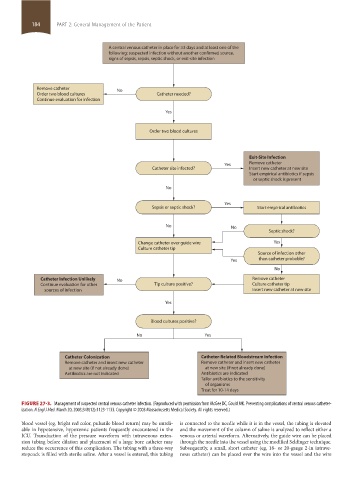
                 FIGURE 27-3.  Management of suspected central venous catheter infection. (Reproduced with permission from McGee DC, Gould MK. Preventing complications of central venous catheter-
                 ization. N Engl J Med. March 20, 2003;348(12):1123-1133. Copyright © 2003 Massachusetts Medical Society. All rights reserved.)

                 blood vessel (eg, bright red color, pulsatile blood return) may be unreli-  is connected to the needle while it is in the vessel, the tubing is elevated
                 able in hypotensive, hypoxemic patients frequently encountered in the   and the movement of the column of saline is analyzed to reflect either a
                 ICU. Transduction of the pressure waveform with intravenous exten-  venous or arterial waveform. Alternatively, the guide wire can be placed
                 sion tubing before dilation and placement of a large bore catheter may   through the needle into the vessel using the modified Seldinger technique.
                 reduce the occurrence of this complication. The tubing with a three-way   Subsequently, a small, short catheter (eg, 18- or 20-gauge 2-in intrave-
                 stopcock is filled with sterile saline. After a vessel is entered, this tubing   nous catheter) can be placed over the wire into the vessel and the wire


            section02.indd   184                                                                                       1/13/2015   2:05:24 PM

