


Page 283 - Hall et al (2015) Principles of Critical Care-McGraw-Hill
P. 283
CHAPTER 28: Interpretation of Hemodynamic Waveforms  187


                                                                          test can be used to make a more precise assessment of the dynamic
                    A                            B
                                                                          response characteristics. 22
                                                                           For the hydraulic monitoring system to display accurate pressures, it
                                                                          is essential that the system is first zeroed with the transducer exposed
                                                                          to  atmospheric  pressure.  The  air-fluid  interface  of  the  monitoring
                                                                          system (ie, the stopcock attached to the transducer) is then placed at
                                                                          the phlebostatic axis (the midpoint between the most anterior and
                    FIGURE 28-1.  Rapid-flush test. A. Appropriately damped system. B. Overdamped system.
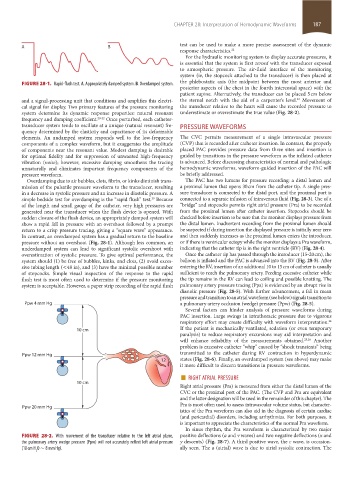
                                                                          posterior aspects of the chest in the fourth intercostal space) with the
                                                                          patient supine. Alternatively, the transducer can be placed 5 cm below
                    and a signal-processing unit that conditions and amplifies this electri-  the sternal notch with the aid of a carpenter’s level.  Movement of
                                                                                                                 23
                    cal signal for display. Two primary features of the pressure monitoring   the transducer relative to the heart will cause the recorded pressure to
                    system determine its dynamic response properties: natural resonant   underestimate or overestimate the true value (Fig. 28-2).
                    frequency and damping coefficient. 20-22  Once perturbed, each catheter-
                    transducer system tends to oscillate at a unique (natural resonant) fre-  PRESSURE WAVEFORMS
                    quency determined by the elasticity and capacitance of its deformable
                    elements. An undamped system responds well to the low-frequency   The CVC permits measurement of a single intravascular pressure
                    components of a complex waveform, but it exaggerates the amplitude   (CVP) that is recorded after catheter insertion. In contrast, the properly
                    of components near the resonant value. Modest damping is desirable   placed PAC provides pressure data from three sites and insertion is
                    for optimal fidelity and for suppression of unwanted high-frequency   guided by transitions in the pressure waveform as the inflated catheter
                    vibration  (noise); however, excessive  damping smoothens the  tracing   is advanced. Before discussing characteristics of normal and pathologic
                    unnaturally and eliminates important frequency components of the   hemodynamic waveforms, waveform-guided insertion of the PAC will
                    pressure waveform.                                    be briefly addressed.
                     Overdamping due to air bubbles, clots, fibrin, or kinks diminish trans-  The PAC has two lumens for pressure recording: a distal lumen and
                    mission of the pulsatile pressure waveform to the transducer, resulting   a proximal lumen that opens 30 cm from the catheter tip. A single pres-
                    in a decrease in systolic pressure and an increase in diastolic pressure. A   sure transducer is connected to the distal port, and the proximal port is
                    simple bedside test for overdamping is the “rapid flush” test.  Because   connected to a separate infusion of intravenous fluid (Fig. 28-3). Use of a
                                                                20
                    of the length and small gauge of the catheter, very high pressures are   “bridge” and stopcocks permits right atrial pressure (Pra) to be recorded
                    generated near the transducer when the flush device is opened. With   from the proximal lumen after catheter insertion. Stopcocks should be
                    sudden closure of the flush device, an appropriately damped system will   checked before insertion to be sure that the monitor displays pressure from
                    show a rapid fall in pressure with an overshoot followed by a prompt   the distal lumen. Inadvertent recording from the proximal lumen should
                    return to a crisp pressure tracing, giving a “square wave” appearance.   be suspected if during insertion the displayed pressure is initially near zero
                    In contrast, an overdamped system has a gradual return to the baseline   and then suddenly increases as the proximal lumen enters the introducer,
                    pressure without an overshoot (Fig. 28-1). Although less common, an   or if there is ventricular ectopy while the monitor displays a Pra waveform,
                    underdamped  system  can  lead  to  significant  systolic  overshoot  with   indicating that the catheter tip is in the right ventricle (RV) (Fig. 28-4).
                    overestimation  of  systolic  pressure.  To  give  optimal  performance,  the   Once the catheter tip has passed through the introducer (15-20 cm), the
                    system should (1) be free of bubbles, kinks, and clots, (2) avoid exces-  balloon is inflated and the PAC is advanced into the RV (Fig. 28-5). After
                    sive tubing length (<48 in), and (3) have the minimal possible number   entering the RV, insertion of an additional 10 to 15 cm of catheter is usually
                    of stopcocks. Simple visual inspection of the response to the rapid   sufficient to reach the pulmonary artery. Feeding excessive catheter while
                    flush test is most often used to determine if the pressure monitoring   the tip remains in the RV can lead to coiling and possible knotting. The
                    system is acceptable. However, a paper strip recording of the rapid flush     pulmonary artery pressure tracing (Ppa) is evidenced by an abrupt rise in
                                                                          diastolic pressure (Fig. 28-5). With further advancement, a fall in mean
                                                                          pressure and transition to an atrial waveform (see below) signals transition to
                     Ppw 4 mm Hg                                          a pulmonary artery occlusion (wedge) pressure (Ppw) (Fig. 28-5).
                                                                           Several factors can hinder analysis of pressure waveforms during
                                                                          PAC insertion. Large swings in intrathoracic pressure due to vigorous
                                                                          respiratory effort may create difficulty with waveform interpretation.
                                                                                                                            24
                                                                          If the patient is mechanically ventilated, sedation (or even temporary
                                      10 cm
                                                                          paralysis) to reduce respiratory excursions may aid interpretation and
                                                                          will enhance reliability of the measurements obtained. 25,26  Another
                                                                          problem is excessive catheter “whip” caused by “shock transients” being
                                                                          transmitted to the catheter during RV contraction in hyperdynamic
                    Ppw 12 mm Hg
                                                                   12     states (Fig. 28-6). Finally, an overdamped system (see above) may make
                                                                          it more difficult to discern transitions in pressure waveforms.
                                                                              ■  RIGHT ATRIAL PRESSURE
                                      10 cm
                                                                          Right atrial pressure (Pra) is measured from either the distal lumen of the
                                                                          CVC or the proximal port of the PAC. (The CVP and Pra are equivalent
                                                                          and the latter designation will be used in the remainder of this chapter). The
                                                                          Pra is most often used to assess intravascular volume status, but character-
                    Ppw 20 mm Hg
                                                                          istics of the Pra waveform can also aid in the diagnosis of certain cardiac
                                                                          (and pericardial) disorders, including arrhythmias. For both purposes, it
                                                                          is important to appreciate the characteristics of the normal Pra waveform.
                                                                           In sinus rhythm, the Pra waveform is characterized by two major
                    FIGURE  28-2.  With movement of the transducer relative to the left atrial plane,   positive deflections (a and v waves) and two negative deflections (x and
                    the pulmonary artery wedge pressure (Ppw) will not accurately reflect left atrial pressure    y descents) (Fig. 28-7). A third positive wave, the c wave, is occasion-
                    (10 cm H O ∼ 8 mm Hg).                                ally seen. The a (atrial) wave is due to atrial systolic contraction. The
                        2


            section02.indd   187                                                                                       1/13/2015   2:05:26 PM

