


Page 321 - Hall et al (2015) Principles of Critical Care-McGraw-Hill
P. 321
CHAPTER 30: Interventional Radiology  225

                        ■  RESULTS AND COMPLICATIONS                      a variety of percutaneous methods and in some patients, shunt occlu-

                    Technical success of TIPS is greater than 90% when the portal vein is   sion may be necessary.
                    patent. TIPS creation in the presence of a thrombosed portal vein has
                    been reported, but technical success rates are lower. 67,68  Primary shunt  INTRAVASCULAR FOREIGN BODY RETRIEVAL
                    patency at 6 months approximates 75% for bare metal stents, 69,70  but with
                    the Viatorr™ endoprosthesis, the primary patency rate at 12 months is   KEY POINTS
                    79.9% to 84%. 71,72  Recurrent bleeding after TIPS occurs in 4% to 17% of
                    patients. The main predictors of mortality after TIPS are poor liver func-    • Percutaneous image-guided intravascular foreign body retrieval
                    tion, urgency, and comorbidities. A 30-day mortality rate of approxi-  should be pursued prior to surgical therapy.
                    mately 15% and a 6-month mortality rate of 30% have been reported.     • If foreign bodies are not removed acutely, they may become impos-
                    The reported 1-year survival rate is 48% to 90% for variceal hemorrhage   sible to retrieve later due to endothelialization and incorporation
                    and 48% to 76% for ascites in the bare stent literature. For Viatorr™ stent   into the adjacent vasculature.
                    shunts, the survival rate is 65% to 88%.  The overall mortality rate varies
                                               64
                    by the Child-Pugh classification and patient stability at the time of the
                    shunt procedure. A series showed the cumulative 30-day survival rates   Central venous catheters and IVC filters are among the most common
                                                            73
                    for Child-Pugh classes A and B (91%) and class C (71%).  These figures   medical devices inserted in ICU patients. On occasion, fragmentation
                    compare very favorably with surgically placed portosystemic shunts in   and migration of catheters or filters within the vascular system may
                    terms of overall morbidity and mortality and the length of postproce-  occur, necessitating removal. Endovascular retrieval is the treatment of
                    dure survival.                                        choice; the alternative, surgery, poses greater risks and requires general
                     TIPS creation acutely relieves portal hypertension and its complica-  anesthesia. Other implantable devices at risk for migration include
                    tions in the vast majority of patients. Shunt stenosis may occur in up   stents, embolization coils, pacemaker leads, and guide wires.
                    improved long-term patency. Routine surveillance with Doppler US   ■  INDICATIONS AND PATIENT SELECTION
                    to 70% of patients with the bare metal stents but covered stents have
                    is necessary to identify shunt problems requiring further venographic   Catheter fracture and migration can occur at the time of placement or
                    examination and intervention. TIPS venography and revision can be   removal, or may even occur during day-to-day usage. Catheter tips should
                    performed on an outpatient basis in most cases.       routinely be inspected at the time of removal to ensure that the catheter has
                     Complications of TIPS include shunt dysfunction, neck hema-  been removed in its entirety. Because the integrity of the catheter material
                    toma, liver capsule puncture with or without abdominal hemorrhage,   deteriorates with time and usage, the risk of catheter fracture increases with
                    hemobilia, or worsening liver failure, sepsis, and stent migration.   dwell time of the catheter. Catheter fracture can also occur secondary to
                    Occasionally, patients develop  multisystem  organ failure  with no   “pinch-off syndrome” when the catheter is repeatedly compressed between
                      evident source of sepsis.  New or worsening encephalopathy appears   the costoclavicular ligaments and first rib leading to fatigue and finally
                                      64
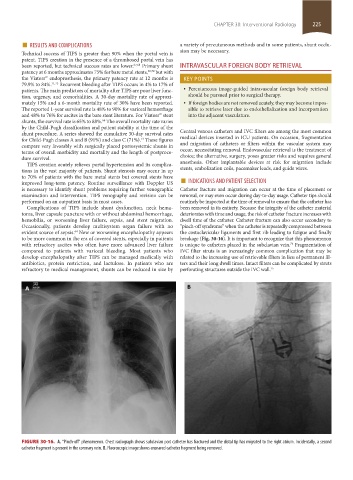
                    to be more common in the era of covered stents, especially in patients   breakage (Fig. 30-16). It is important to recognize that this phenomenon
                    with refractory ascites who often have more advanced liver failure   is unique to catheters placed in the subclavian vein.  Fragmentation of
                                                                                                               74
                    compared to patients with variceal bleeding. Most patients who   IVC filter struts is an increasingly common complication that may be
                    develop encephalopathy after TIPS can be managed medically with   related to the increasing use of retrievable filters in lieu of permanent fil-
                    antibiotics, protein restriction, and lactulose. In patients who are   ters and their long dwell times. Intact filters can be complicated by struts
                    refractory to medical management, shunts can be reduced in size by   perforating structures outside the IVC wall. 75


                    FIGURE 30-16.  A. “Pinch-off” phenomenon. Chest radiograph shows subclavian port catheter has fractured and the distal tip has migrated to the right atrium. Incidentally, a second
                    catheter fragment is present in the coronary vein. B. Fluoroscopic image shows ensnared catheter fragment being removed.


            section02.indd   225                                                                                       1/13/2015   2:06:02 PM

