


Page 320 - Hall et al (2015) Principles of Critical Care-McGraw-Hill
P. 320
224     PART 2: General Management of the Patient

                     ■  TECHNIQUE                                      again obtained to confirm the reduction of the portosystemic gradient,

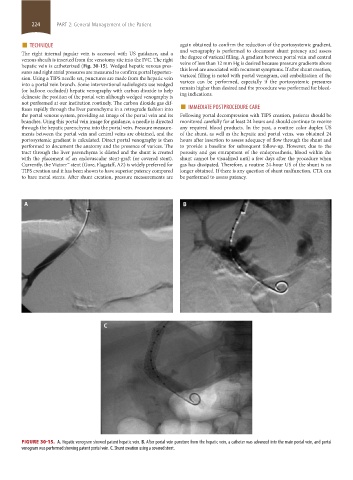
                 The right internal jugular vein is accessed with US guidance, and a   and venography is  performed to document  shunt patency and  assess
                                                                       the degree of variceal filling. A gradient between portal vein and central
                 venous sheath is inserted from the venotomy site into the IVC. The right
                 hepatic vein is catheterized (Fig. 30-15). Wedged hepatic venous pres-  veins of less than 12 mm Hg is desired because pressure gradients above
                                                                       this level are associated with recurrent symptoms. If after shunt creation,
                 sures and right atrial pressures are measured to confirm portal hyperten-
                 sion. Using a TIPS needle set, punctures are made from the hepatic vein   variceal filling is noted with portal venogram, coil embolization of the
                                                                       varices can be performed, especially if the portosystemic pressures
                 into a portal vein branch. Some interventional radiologists use wedged
                 (or balloon occluded) hepatic venography with carbon dioxide to help   remain higher than desired and the procedure was performed for bleed-
                                                                       ing indications.
                 delineate the position of the portal vein although wedged venography is
                 fuses rapidly through the liver parenchyma in a retrograde fashion into   ■  IMMEDIATE POSTPROCEDURE CARE
                 not performed at our institution routinely. The carbon dioxide gas dif-
                 the portal venous system, providing an image of the portal vein and its   Following portal decompression with TIPS creation, patients should be
                 branches. Using this portal vein image for guidance, a needle is directed   monitored carefully for at least 24 hours and should continue to receive
                 through the hepatic parenchyma into the portal vein. Pressure measure-  any required blood products. In the past, a routine color duplex US
                 ments between the portal vein and central veins are obtained, and the   of the shunt, as well as the hepatic and portal veins, was obtained 24
                 portosystemic gradient is calculated. Direct portal venography is then   hours after insertion to assess adequacy of flow through the shunt and
                 performed to document the anatomy and the presence of varices. The   to provide a baseline for subsequent follow-up. However, due to the
                 tract through the liver parenchyma is dilated and the shunt is created   porosity  and  gas  entrapment  of  the  endoprosthesis,  blood  within  the
                 with the placement of an endovascular stent-graft (or covered stent).   shunt cannot be visualized until a few days after the procedure when
                 Currently, the Viatorr™ stent (Gore, Flagstaff, AZ) is widely preferred for   gas has dissipated. Therefore, a routine 24-hour US of the shunt is no
                 TIPS creation and it has been shown to have superior patency compared   longer obtained. If there is any question of shunt malfunction, CTA can
                 to bare metal stents. After shunt creation, pressure measurements are   be performed to assess patency.


                 FIGURE 30-15.  A. Hepatic venogram showed patent hepatic vein. B. After portal vein puncture from the hepatic vein, a catheter was advanced into the main portal vein, and portal
                 venogram was performed showing patent portal vein. C. Shunt creation using a covered stent.


            section02.indd   224                                                                                       1/13/2015   2:06:01 PM

