


Page 393 - Hall et al (2015) Principles of Critical Care-McGraw-Hill
P. 393
CHAPTER 34: Judging the Adequacy of Fluid Resuscitation   263


                    (ARDS) or sepsis. 13-15  For example, in a large European observational   boost the circulation. As discussed below, however, these measures have
                    cohort, positive fluid balance was among the strongest predictors of death,   almost no ability to distinguish fluid responders from nonresponders.
                    even after correcting for severity of illness.  The Vasopressin in Septic   In contrast, dynamic  indices such as SVV  are quite accurate,  having
                                                   16
                    Shock Trial (VASST) showed that positive fluid balance correlated with a   much higher positive and negative predictive values.
                    higher risk of dying. 17
                     Similar results have been shown in patients with acute renal failure.      ■  STATIC MEASURES TO PREDICT FLUID RESPONSIVENESS
                                                                      18
                    In a study of monitoring techniques in critically ill patients a secondary
                    logistic regression analysis identified positive fluid balance as a signifi-  CVP or Right Atrial Pressure:  CVP is probably the most used parameter
                    cant predictor of mortality (OR 1.0002 for each mL/day; p = 0.0073).    for judging whether fluids should be given. Nevertheless, a large number
                                                                      19
                    Similar results were seen in a prospective trial of goal-directed fluid   of studies show that CVP fails to discriminate responders from nonre-
                    therapy in patients undergoing major colorectal surgery.  Those ran-  sponders. 29,39-41  Following the EGDT trial and publication of the original
                                                             20
                    domized to goal-directed treatment got significantly more fluid but did   Surviving Sepsis Campaign guidelines (which proposed a CVP target
                    not have better outcomes. In fact, in aerobically fit subjects, outcomes   of greater than 8 mm Hg for nonventilated patients and greater than or
                                                                                                       42
                    were inferior. Positive fluid balance may also impede liberation from   equal to 12 mm Hg for ventilated patients ) a group of French investiga-
                    mechanical ventilation in general critically ill patients. In a study of   tors examined the role of cardiac filling pressures as predictors of fluid
                                                                                                            28
                    87 ventilated subjects, both cumulative and short-term positive fluid   responsiveness in 96 ventilated, septic subjects.  Overall, the predictive
                    balance were associated with failure of a spontaneous breathing trial.    power of the CVP was poor: When CVP was less than 12, the positive
                                                                      21
                    Negative fluid balance was as predictive of weaning outcomes as the   predictive value was only 47%. Even when CVP was much lower in these
                    rapid shallow breathing index. This association has also been noted in   ventilated patients (less than 5 mm Hg), the positive predictive value was
                    critically ill surgical patients.  Lastly, restrictive fluid strategies may   still only 47%. These results should not be surprising. Raising CVP can
                                         22
                    reduce length of stay following major surgery. 23     only augment perfusion when cardiac function is not limited, as can be
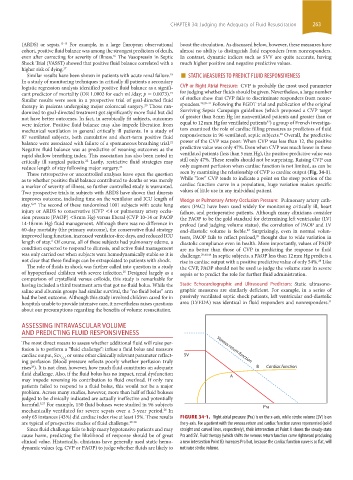
                     These retrospective or uncontrolled analyses leave open the question   seen by examining the relationship of CVP to cardiac output (Fig. 34-1).
                    as to whether positive fluid balance contributed to deaths or was merely   While “low” CVP tends to indicate a point on the steep portion of the
                    a marker of severity of illness, so further controlled study is warranted.   cardiac function curve in a population, huge variation makes specific
                    Two prospective trials in subjects with ARDS have shown that diuresis   values of little use in any individual patient.
                    improves outcome, including time on the ventilator and ICU length of   Wedge or Pulmonary Artery Occlusion Pressure:  Pulmonary artery cath-
                    stay.  The second of these randomized 1001 subjects with acute lung   eters  (PAC)  have  been  used  widely  for  monitoring  critically  ill,  heart
                       6,24
                    injury or ARDS to conservative (CVP <4 or pulmonary artery occlu-  failure, and perioperative patients. Although many clinicians consider
                    sion pressure [PAOP] <8 mm Hg) versus liberal (CVP 10-14 or PAOP   the PAOP to be the gold standard for determining left ventricular (LV)
                    14-18 mm Hg) fluid management. Although there was no difference in   preload (and judging volume status), the correlation of PAOP and LV
                    60-day mortality (the primary outcome), the conservative fluid strategy   end-diastolic volume is feeble.  Surprisingly, even in normal volun-
                                                                                                43
                    improved lung function, increased ventilator-free days, and reduced ICU   teers, PAOP fails to reflect preload,  thought due to wide variation in
                                                                                                   39
                    length of stay.  Of course, all of these subjects had pulmonary edema, a   diastolic compliance even in health. More importantly, values of PAOP
                              6
                    condition expected to respond to diuresis, and active fluid management   are no better than those of CVP in predicting the response to fluid
                    was only carried out when subjects were hemodynamically stable so it is     challenge. 29,40,44  In septic subjects, a PAOP less than 12 mm Hg predicts a
                    not clear that these findings can be extrapolated to patients with shock.  rise in cardiac output with a positive predictive value of only 54%.  Like
                                                                                                                         28
                     The role of fluids in shock was further called into question in a study   the CVP, PAOP should not be used to judge the volume state in severe
                    of hypoperfused children with severe infection.  Designed largely as a   sepsis or to predict the role for further fluid administration.
                                                      25
                    comparison of crystalloid versus colloids, this study is remarkable for
                    having included a third treatment arm that got no fluid bolus. While the   Static Echocardiographic and Ultrasound Predictors:  Static ultrasono-
                    saline and albumin groups had similar survival, the “no fluid bolus” arm   graphic measures are similarly deficient. For example, in a series  of
                    had the best outcome. Although this study involved children cared for in   passively ventilated septic shock patients, left ventricular end-diastolic
                                                                                                                            31
                    hospitals unable to provide intensive care, it nevertheless raises questions   area (LVEDA) was identical in fluid responders and nonresponders.
                    about our presumptions regarding the benefits of volume resuscitation.
                    ASSESSING INTRAVASCULAR VOLUME
                    AND PREDICTING FLUID RESPONSIVENESS

                    The most direct means to assess whether additional fluid will raise per-
                    fusion is to perform a “fluid challenge”: infuse a fluid bolus and  measure   Venous return function
                    cardiac output, Scv , or some other clinically relevant parameter reflect-  SV
                                 O 2
                    ing perfusion (blood pressure reflects poorly whether perfusion truly
                    rises ). It is not clear, however, how much fluid constitutes an adequate       B  Cardiac function
                       26
                    fluid challenge. Also, if the fluid bolus has no impact, renal dysfunction   A
                    may  impede  reversing  its  contribution  to  fluid  overload.  If  only  rare
                    patients failed to respond to a fluid bolus, this would not be a major
                    problem. Across many studies, however, more than half of fluid boluses
                    judged to be clinically indicated are actually ineffective and potentially
                    harmful.  For example, 150 fluid boluses were studied in 96 subjects              Pra
                          5,27
                    mechanically ventilated for severe sepsis over a 3-year period.  In
                                                                    28
                    only 65 instances (43%) did cardiac index rise at least 15%. These results   FIGURE 34-1.  Right atrial pressure (Pra) is on the x-axis, while stroke volume (SV) is on
                    are typical of prospective studies of fluid challenge. 29-38  the y-axis. For a patient with the venous return and cardiac function curves represented (solid
                     Since fluid challenge fails to help many hypotensive patients and may   straight and curved lines, respectively), their intersection at Point A shows the steady-state
                    cause harm, predicting the likelihood of response should be of great   Pra and SV. Fluid therapy (which shifts the venous return function curve rightward producing
                    clinical value. Historically, clinicians have generally used static hemo-  a new intersection Point B) increases Pra but, because the cardiac function curve is so flat, will
                    dynamic values (eg, CVP or PAOP) to judge whether fluids are likely to   not raise stroke volume.


            section03.indd   263                                                                                       1/23/2015   2:06:58 PM

