


Page 397 - Hall et al (2015) Principles of Critical Care-McGraw-Hill
P. 397
CHAPTER 35: Ventricular Dysfunction in Critical Illness   267


                                                  200


                                                  150


                                                 LV Pressure  100      3


                                                   50
                                                                4             2


                                                                       1
                                                   0
                                                    0              40            80            120
                                                                       LV Volume
                       150                                                   150

                                            Decreased
                                             systolic
                                Normal      contractility
                       100               Stroke volume                       100                   Stroke volume
                      LV Pressure                   Stroke volume           LV Pressure      Stroke volume


                        50                                                    50
                                                                                                Decreased
                                                                                                 diastolic           Normal
                                                                                                compliance
                         0                                                     0
                          0             40            80            120         0             40            80            120
                                            LV Volume                                             LV Volume
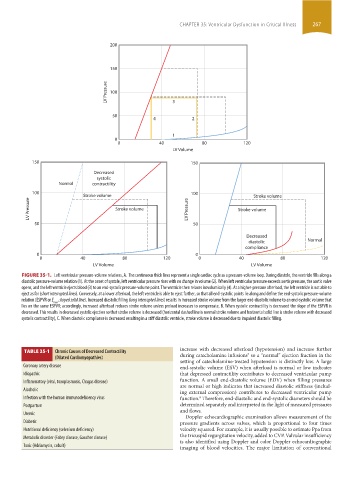
                    FIGURE 35-1.  Left ventricular pressure-volume relations, A.  The continuous thick lines represent a single cardiac cycle as a pressure-volume loop. During diastole, the ventricle fills along a
                    diastolic pressure-volume relation (1). At the onset of systole, left ventricular pressure rises with no change in volume (2). When left ventricular pressure exceeds aortic pressure, the aortic valve
                    opens, and the left ventricle ejects blood (3) to an end-systolic pressure-volume point. The ventricle then relaxes isovolumically (4). At a higher-pressure afterload, the left ventricle is not able to
                    eject as far (short interrupted lines). Conversely, at a lower afterload, the left ventricle is able to eject farther, so that all end-systolic points lie along and define the end-systolic pressure-volume
                    relation (ESPVR or E , sloped solid line). Increased diastolic filling (long interrupted lines) results in increased stroke volume from the larger end-diastolic volume to an end-systolic volume that
                               max
                    lies on the same ESPVR; accordingly, increased afterload reduces stroke volume unless preload increases to compensate, B. When systolic contractility is decreased the slope of the ESPVR is
                    decreased. This results in decreased systolic ejection so that stroke volume is decreased (horizontal dashed line is normal stroke volume and horizontal solid line is stroke volume with decreased
                    systolic contractility), C. When diastolic compliance is decreased resulting in a stiff diastolic ventricle, stroke volume is decreased due to impaired diastolic filling.


                                                                          increase  with decreased afterload (hypotension) and increase further
                      TABLE 35-1     Chronic Causes of Decreased Contractility    during catecholamine infusions  so a “normal” ejection fraction in the
                                                                                                 7
                               (Dilated Cardiomyopathies)
                                                                          setting of catecholamine-treated hypotension is distinctly low. A large
                    Coronary artery disease                               end-systolic volume (ESV) when afterload is normal or low indicates
                    Idiopathic                                            that depressed contractility contributes to decreased ventricular pump
                    Inflammatory (viral, toxoplasmosis, Chagas disease)   function. A small end-diastolic volume (EDV) when filling pressures
                                                                          are normal or high indicates that increased diastolic stiffness (includ-
                    Alcoholic
                                                                          ing  external  compression)  contributes  to  decreased  ventricular  pump
                    Infection with the human immunodeficiency virus       function.  Therefore, end-diastolic and end-systolic diameters should be
                                                                                8
                    Postpartum                                            determined separately and interpreted in the light of measured  pressures
                    Uremic                                                and flows.
                                                                           Doppler echocardiographic examination allows measurement of the
                    Diabetic                                              pressure  gradients across  valves, which is  proportional  to four  times
                    Nutritional deficiency (selenium deficiency)          velocity squared. For example, it is usually possible to estimate Ppa from
                    Metabolic disorder (Fabry disease, Gaucher disease)   the tricuspid regurgitation velocity, added to CVP. Valvular insufficiency
                                                                          is also identified using Doppler and color Doppler echocardiographic
                    Toxic (Adriamycin, cobalt)                            imaging of blood velocities. The major limitation of conventional


            section03.indd   267                                                                                       1/23/2015   2:07:00 PM

