


Page 394 - Hall et al (2015) Principles of Critical Care-McGraw-Hill
P. 394
264     PART 3: Cardiovascular Disorders


                 Most other studies have also reported that LVEDA, as well as the ratio   the forms of pulse contour analysis of the arterial blood pressure
                 of pulsed Doppler transmitral flow in early diastole to the early dia-  tracing, is used to assess the impact 1 minute following PLR.  The
                                                                                                                      50
                 stolic mitral annular velocity, is unable to distinguish responders and   arterial  pulse  pressure  variation  (PPV)  can  also  serve  to  judge  the
                   nonresponders. 45,46                                effect, but this may not be as accurate as stroke volume measures.
                                                                                                                          51
                   The LV ejection time fails similarly in separating responders from   One study that included 71 ventilated subjects, some actively breath-
                 nonresponders.  Right ventricular (RV) end-diastolic volume has not   ing  and  some  passive,  showed  that  a  PLR  increase  of  aortic  blood
                            47
                 been shown effective in identifying fluid responsiveness. 48  flow  ≥10% signaled a response to fluids (sensitivity 97%; specific-
                   The inferior vena cava (IVC) is easily imaged in a subxiphoid, long-  ity 94%).  Multiple other studies have confirmed that PLR predicts
                                                                              48
                 axis view either off of the frozen image with caliper function or with   well the response to subsequent volume challenge. 45,51-56  A major advan-
                 M-mode imaging. The diameter is measured 2 to 3 cm below the right   tage of PLR over other dynamic predictors described below is that
                 atrium or just caudad to the inlet of the hepatic veins at end expira-  it appears accurate even in spontaneously breathing patients and
                 tion. There is only a weak correlation between fluid responsiveness   those with irregular cardiac rhythms. A downside is related to uncer-
                 and the minimum or maximum IVC diameter (r  = 0.58 and 0.44,   tainties regarding the technique of raising the legs. In some studies, this
                 respectively). 34                                     has been accomplished using a specialized bed that simultaneously
                                                                       raises the legs and lowers the head, keeping the angle between the
                 Global End-Diastolic Volume and Intrathoracic Blood Volume:  A single-  legs and the trunk constant. In other studies, the legs have been
                 indicator, transpulmonary thermodilution technique uses injected cold   lifted manually while lowering the head, but this raises concern for
                 saline and a thermistor-tipped arterial catheter to estimate the maxi-  standardization, differing angles between the legs and the trunk,
                 mal cardiac (four-chamber) volume. In a series of septic subjects, this   sympathetic effects related to patient discomfort, and difficulties in
                 global end-diastolic volume was a modestly accurate predictor of   the  morbidly obese. PLR  may not  be valid when  intra-abdominal
                 fluid responsiveness (positive predictive value .77 when in the lowest   pressure is significantly elevated, although it has proven accurate in
                 tercile; negative predictive value .77 when in the highest tercile).  The   late-term pregnancy. 54,57
                                                                49
                 mathematically related intrathoracic blood volume would be expected
                 to be of similar accuracy.                            Dynamic  Predictors Relying  on Perturbing the  Pleural  Pressure:  Cyclic
                     ■  DYNAMIC MEASURES TO PREDICT FLUID RESPONSIVENESS  changes in pleural pressure during ventilation induce fluctuations
                                                                       in right heart filling, pulmonary venous volume, and both right and
                 As reliance on static preload measures has faded, interest in dynamic   LV afterload. The rise in pleural pressure during positive   pressure
                 predictors has heightened. Rather than relying on fixed hemodynamic   inspiration augments LV filling (due, in part, to compression of
                 values, these metrics perturb the circulation by centralizing the blood   pulmonary  veins and  rising  LV  compliance  as  the  right  heart  fills
                 volume or altering the pleural pressure, then assess some output such as   less) and simultaneously lowers LV afterload. These factors combine
                 stroke volume or pulse pressure (Table 34-1).         to transiently raise the LV stroke volume and the systolic arterial
                                                                         pressure. Also during inspiration the rise in pleural pressure impedes
                 Passive Leg Raising:  Passive leg raising (PLR) has been used in several   right heart filling transiently, the effects of which become evident in
                 studies as a surrogate for volume challenge due to ease of perfor-  the arterial pressure wave several beats later (during expiration) as
                 mance and lack of adverse effects related to volume overload. PLR   a fall in systolic pressure (and stroke volume). In most patients, the
                 shifts blood volume centrally, acting as a substantial but reversible   respiratory impact on RV preload dominates to account for variations
                 volume challenge. Patients are studied first in the semirecumbent   in  stroke  volume,  while  the  consequences  for  RV  and  LV  afterload
                 position, then the head is lowered and the legs are raised, generally   and LV filling are minor. Occasionally, however, the effects on after-
                 using a specialized bed. A measure of cardiac output, such as echo-  load or LV filling are not trivial. For example, in patients with acute
                 cardiographic left ventricular outflow tract velocity-time integral   cor pulmonale the modest ventilation-induced rise in RV afterload
                 (LVOT-VTI) (from the transthoracic five-chamber view) or one of   may contribute greatly to respiratory variation, falsely predicting
                                                                       fluid responsiveness.  If not recognized as being due to RV failure,
                                                                                       58
                                                                       this variation might prompt harmful additional fluids, compounding
                                                                       the shock. A variation on the use of ventilator-induced changes is the
                                                                       end-expiratory occlusion test in which the ventilator is paused for
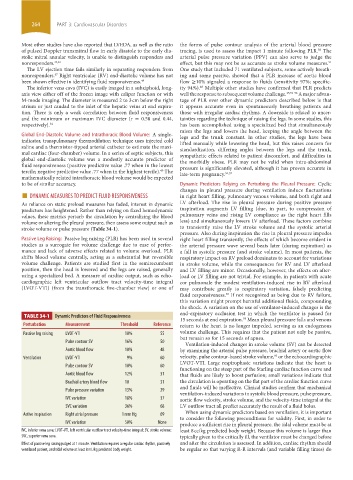
                   TABLE 34-1    Dynamic Predictors of Fluid Responsiveness
                                                                       15 seconds at end expiration.  Mean pleural pressure falls and venous
                                                                                             59
                  Perturbation  Measurement        Threshold  Reference  return to the heart is no longer impeded, serving as an endogenous
                  Passive leg raising  LVOT-VTI     10%         55     volume challenge. This requires that the patient not only be passive,
                                Pulse contour SV    16%         50     but remain so for 15 seconds of apnea.
                                                                         Ventilation-induced changes in stroke volume (SV) can be detected
                                Aortic blood flow   10%         48     by examining the arterial pulse pressure, brachial artery or aortic flow
                                                                                                       60
                  Ventilation   LVOT-VTI             9%         60     velocity, pulse contour-based stroke volume,  or the echocardiographic
                                                                       LVOT-VTI. Large respirophasic variations indicate that the heart is
                                Pulse contour SV    10%         60     functioning on the steep part of the Starling cardiac function curve and
                                Aortic blood flow   12%         31     that fluids are likely to boost perfusion; small variations indicate that
                                Brachial artery blood flow  10  31     the circulation is operating on the flat part of the cardiac function curve
                                                                       and fluids will be ineffective. Clinical studies confirm that mechanical
                                Pulse pressure variation  13%   29
                                                                       ventilation-induced variations in systolic blood pressure, pulse pressure,
                                IVC variation       18%         37     aortic flow velocity, stroke volume, and the velocity-time integral at the
                                SVC variation       36%         68     LV outflow tract all predict accurately the result of a fluid bolus.
                  Active inspiration  Right atrial pressure  1 mm Hg  69  When using dynamic predictors based on ventilation, it is important
                                                                       to consider the following preconditions for validity. First, in order to
                                IVC variation       50%         None   produce a sufficient rise in pleural pressure, the tidal volume must be at
                 IVC, inferior vena cava; LVOT-VTI, left ventricular outflow tract velocity-time integral; SV, stroke volume;   least 8 cc/kg predicted body weight. Because this volume is larger than
                 SVC, superior vena cava.                              typically given to the critically ill, the ventilator must be changed before
                 Effect of passive leg raising judged at 1 minute. Ventilation requires a regular cardiac rhythm, passively   and after the circulation is assessed. In addition, cardiac rhythm should
                 ventilated patient, and tidal volume at least 8 mL/kg predicted body weight.  be regular so that varying R-R intervals (and variable filling times) do


            section03.indd   264                                                                                       1/23/2015   2:06:59 PM

