


Page 558 - Hall et al (2015) Principles of Critical Care-McGraw-Hill
P. 558
378     PART 4: Pulmonary Disorders


                   Soon after the introduction of endotracheal MV, many complications   increased from less than 5% to around 15% of all admitted patients in
                 of positive pressure ventilation were identified.  These complications   the ICUs, with a constant success rate and therefore a higher number of
                                                    3,4
                 were found to be common and generated concern about the invasiveness   patients avoiding the need for intubation. A greater number of patients
                 of MV. ETI itself has been implicated in a large number of complications.   with chronic obstructive pulmonary disease (COPD) or heart failure
                 Of these, some are directly related to the procedure, such as cardiac   were also successfully treated with NIPPV out of the ICU. A limitation of
                 arrest following ETI and laryngeal or tracheal injury leading to long-  these studies is that only patients who received MV in the ICU for longer
                 term sequelae. Others are ascribable to the fact that the endotracheal   than 12 hours were included. Thus, some patients treated with NIPPV
                 tube bypasses the barrier of the upper airway: An important example   for a shorter period and/or outside the ICU may have been excluded as
                 is nosocomial pneumonia, which carries its own risk of morbidity and   well as patients treated outside the ICU.
                 mortality. Other  complications are  indirectly  related  to ETI,  such as   Similar  observational studies  performed  in  France  in  1997,  2002,
                 the need for sedation, which often prolongs weaning and duration of   and 2011, 17-19  respectively, showed a major increase in NIPPV use as
                                https://kat.cr/user/tahir99/
                 MV. These major safety considerations prompted efforts to develop   a first-line ventilation support for all ICU patients requiring mechani-
                 noninvasive methods for delivering positive pressure ventilation. Thus,   cal ventilatory support (16%, 24%, and 31%; p <0.0001). Importantly,
                 in patients with ARF, the main goal of NIPPV is to provide ventilatory   when comparing the three periods, a significant increase of NIPPV
                 assistance while lowering the risk of adverse events by reducing the need   as first-line therapy (52% vs 35%;  p  <0.0001) was observed among
                 for invasive MV. Convincing evidence that NIPPV diminishes the risk of   those patients who were not intubated before or at ICU admission. The
                 infectious complications has been obtained not only from randomized   French survey published in 2006  indicated that Pressure Support was
                                                                                               18
                 controlled trials and meta-analysis, but also from multivariate analyses   the most usual ventilatory mode (83%) during NIPPV (CPAP—8% and
                 of large cohort studies and case-control studies, all of which show sub-  assist-control ventilation 7%). The last French observational  study still
                                                                                                                  19
                 stantial decreases in all categories of nosocomial infection.  NIPPV is   showed a continuing increase in the overall use of NIPPV but interest-
                                                            5-7
                 indeed associated with a reduction in the overall invasiveness of patient   ingly, with a slight but significant decrease of its use in case of hypox-
                 management: Sedation is not given or at low levels, and the use of central   emic respiratory failure.
                 venous lines, urinary catheters, and other invasive devices is consider-  Although these results cannot be extrapolated to all ICUs worldwide,
                 ably reduced, as compared to patients receiving endotracheal MV. 8  they indicate strong trends toward increasing use of NIPPV in ICU
                   Another important factor in promoting the use of NIPPV is the   patients with a variety of conditions, and they also reflect the current
                 growing number of patients who are either unwilling to accept ETI or   approach trying to reduce the invasiveness of ICU management.
                 considered poor candidates for endotracheal MV because of their fragile   The progressive interest regarding NIPPV use can be evidenced by
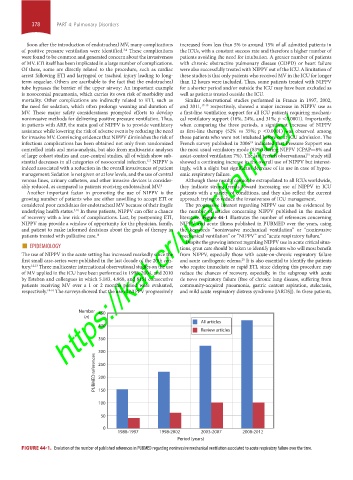
                 underlying health status.  In these patients, NIPPV can offer a chance   the  number of  articles concerning NIPPV  published  in the  medical
                                   9,10
                 of recovery with a low risk of complications. Last, by postponing ETI,   literature. Figure 44-1 illustrates the number of references concerning
                 NIPPV may provide a window of opportunity for the physician, family,   NIPPV and acute illness published in PUBMED over the years, using
                 and patient to make informed decisions about the goals of therapy in   the keywords “noninvasive mechanical ventilation” or “noninvasive
                 patients treated with palliative care. 11             mechanical ventilation” or “NIPPV” and “acute respiratory failure.”
                     ■  EPIDEMIOLOGY                                   tions, great care should be taken to identify patients who will most  benefit
                                                                         Despite the growing interest regarding NIPPV use in acute critical situa-
                 The use of NIPPV in the acute setting has increased markedly since the   from NIPPV, especially those with  acute-on-chronic respiratory  failure
                 first small case-series were published in the last decade of the 20th cen-  and acute cardiogenic edema.  It is also essential to identify the patients
                                                                                            20
                 tury. 12,13  Three multicenter international observational studies on the use   who require immediate or rapid ETI, since delaying this procedure may
                 of MV applied in the ICU have been performed in 1998, 2004, and 2010   reduce the chances of recovery, especially, in the subgroup with acute
                 by Esteban and colleagues in which 5.183, 4.968, and 8151 consecutive   de novo respiratory failure (free of chronic lung disease, suffering from
                 patients receiving MV over a 1 or 2 months period were evaluated,   community-acquired pneumonia, gastric content aspiration, atelectasis,
                 respectively. 14-16  The surveys showed that the use of NIPPV progressively   and mild acute respiratory distress syndrome [ARDS]). In these patients,


                                     Number  450
                                       (n)
                                                                              All articles
                                           400
                                                                              Review articles
                                           350

                                          PUBMED references 300

                                           250
                                           200

                                           150

                                           100
                                            50

                                             0
                                                  1988-1997     1998-2002     2003-2007      2008-2012
                                                                      Period (years)
                 FIGURE 44-1.  Evolution of the number of published references in PUBMED regarding noninvasive mechanical ventilation associated to acute respiratory failure over the time.


            section04.indd   378                                                                                       1/23/2015   2:18:44 PM

