


Page 555 - Hall et al (2015) Principles of Critical Care-McGraw-Hill
P. 555
CHAPTER 43: The Pathophysiology and Differential Diagnosis of Acute Respiratory Failure  375


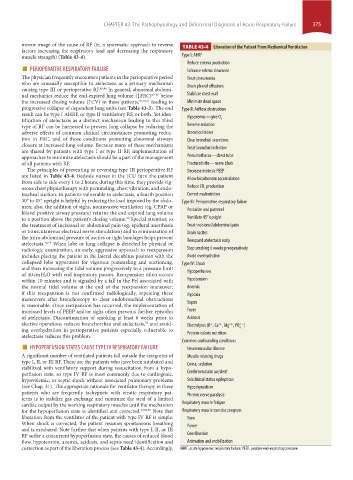
                    mirror image of the cause of RF (ie, a systematic approach to reverse     TABLE 43-4    Liberation of the Patient From Mechanical Ventilation
                    factors increasing the respiratory load and decreasing the respiratory
                    muscle strength) (Table 43-4).                        Type I: AHRF
                        ■  PERIOPERATIVE RESPIRATORY FAILURE                Reduce edema production
                                                                            Enhance edema clearance
                    The physician frequently encounters patients in the perioperative period     Treat pneumonia
                    who are unusually susceptible to atelectasis as a primary mechanism     Drain pleural effusions
                    causing type III or perioperative RF. 45,46  In general, abnormal abdomi-
                    nal mechanics reduce the end-expired lung volume (↓FRC) 47-49  below     Stabilize chest wall
                    the increased closing volume (↑CV) in these patients, 47,50,51  leading to     Minimize dead space
                    progressive collapse of dependent lung units (see Table 43-3). The end   Type II: Airflow obstruction
                    result can be type I AHRF, or type II ventilatory RF, or both. Yet iden-    Hypoxemia—give O
                    tification of atelectasis as a distinct mechanism leading to this third   2
                    type of RF can be harnessed to prevent lung collapse by reducing the     Reverse sedation
                    adverse effects of common clinical circumstances promoting reduc-    Bronchodilation
                    tion in FRC, and of those conditions promoting abnormal airways     Clear bronchial secretions
                    closure at increased lung volume. Because many of these mechanisms
                    are shared by patients with type I or type II RF, implementation of     Treat bronchial infection
                    approaches to minimize atelectasis should be a part of the management     Pneumothorax—chest tube
                    of all patients with RF.                                Fractured ribs—nerve block
                     The principles of preventing or reversing type III perioperative RF     Decrease intrinsic PEEP
                    are listed in Table 43-4. Bedside nurses in the ICU turn the patient     Allow bicarbonate accumulation
                    from side to side every 1 to 2 hours; during this time, they provide vig-
                    orous chest physiotherapy with pummeling, chest vibration, and endo-    Reduce CO  production
                                                                                  2
                    tracheal suction. In patients vulnerable to atelectasis, a fourth position     Correct malnutrition
                    30° to 45° upright is helpful by reducing the load imposed by the abdo-  Type III: Perioperative respiratory failure
                    men; also, the addition of sighs, noninvasive ventilation (eg, CPAP or
                    bilevel positive airway pressure) returns the end-expired lung volume     Posturize and pummel
                    to a position above the patient’s closing volume.  Special attention to     Ventilate 45° upright
                                                       50
                    the treatment of incisional or abdominal pain (eg, epidural anesthesia     Treat incisional/abdominal pain
                    or transcutaneous electrical nerve stimulation) and to minimization of     Drain ascites
                    the intra-abdominal pressure of ascites or tight bandages helps prevent     Reexpand atelectasis early
                    atelectasis. 48,42  When lobe or lung collapse is detected by physical or
                    radiologic examination, an early, aggressive approach to reexpansion     Stop smoking 6 weeks preoperatively
                    includes placing the patient in the lateral decubitus position with the     Avoid overhydration
                    collapsed lobe uppermost for vigorous pummeling and suctioning,   Type IV: Shock
                    and then increasing the tidal volume progressively to a pressure limit
                    of 40 cm H 2O with end inspiratory pauses. Reexpansion often occurs     Hypoperfusion
                    within 10 minutes and is signaled by a fall in the Pel associated with     Hypotension
                    the  normal  tidal  volume  at  the  end  of  the  reexpansion  maneuver;     Anemia
                    if this reexpansion is not confirmed radiologically, repeating these     Hypoxia
                    maneuvers after bronchoscopy to clear endobronchial obstructions
                    is reasonable. Once reexpansion has occurred, the implementation of     Sepsis
                    increased levels of PEEP and/or sighs often prevents further episodes     Fever
                    of atelectasis. Discontinuation of smoking at least 6 weeks prior to     Acidosis
                    elective operations reduces bronchorrhea and atelectasis,  and avoid-    Electrolytes (K , Ca , Mg , PO )
                                                              53
                                                                                    +
                                                                                       2+
                                                                                              2 −
                                                                                          2+
                    ing overhydration in perioperative patients especially vulnerable to      4
                    atelectasis reduces this problem.                       Protein-calorie nutrition
                        ■  HYPOPERFUSION STATES CAUSE TYPE IV RESPIRATORY FAILURE  Common confounding conditions
                                                                            Neuromuscular disease
                    A significant number of ventilated patients fall outside the categories of     Muscle-relaxing drugs
                    type I, II, or III RF. These are the patients who have been intubated and     Coma, sedation
                    stabilized with ventilatory support during resuscitation from a hypo-
                    perfusion state, so type IV RF is most commonly due to cardiogenic,     Cerebrovascular accident
                    hypovolemic, or septic shock without associated pulmonary problems     Subclinical status epilepticus
                    (see Chap. 31). The appropriate rationale for ventilator therapy in these     Hypothyroidism
                    patients who are frequently tachypneic with erratic respiratory pat-    Phrenic nerve paralysis
                    terns  is  to  stabilize  gas  exchange  and  minimize  the  steal  of  a  limited
                    cardiac output by the working respiratory muscles until the mechanism   Respiratory muscle fatigue
                    for the hypoperfusion state is identified and corrected. 37,54,55  Note that     Respiratory muscle exercise program
                    liberation from the ventilator of the patient with type IV RF is simple:     Tone
                    When shock is corrected, the patient resumes spontaneous breathing     Power
                    and is extubated. Note further that when patients with type I, II, or III
                    RF suffer a concurrent hypoperfusion state, the causes of reduced blood     Coordination
                    flow, hypotension, anemia, acidosis, and sepsis need identification and     Animation and mobilization
                    correction as part of the liberation process (see Table 43-4). Accordingly,     AHRF, acute hypoxemic respiratory failure; PEEP, positive end-expiratory pressure.


            section04.indd   375                                                                                       1/23/2015   2:18:43 PM

