


Page 553 - Hall et al (2015) Principles of Critical Care-McGraw-Hill
P. 553
CHAPTER 43: The Pathophysiology and Differential Diagnosis of Acute Respiratory Failure  373


                      TABLE 43-3    Mechanistic Approach to Respiratory Failure
                                 Type I, Acute Hypoxemic  Type II, Ventilatory  Type III, Perioperative  Type IV, Shock
                    Mechanism    Q ˙ s/Q ˙ t         V ˙ a                   Atelectasis            Hypoperfusion


                    Etiology     Airspace flooding   1.  CNS drive           1. FRC                 1. Cardiogenic


                                                     2.  N-M coupling        2. CV                  2. Hypovolemic

                                                     3.  Work/dead space                            3. Septic


                    Clinical Description  1.  ARDS   1.  Overdose/CNS injury  1. Supine/obese, ascites/peritonitis  1. Myocardial infarct, pulmonary hypertension

                                 2.  Cardiogenic pulmonary edema 2.   Myasthenia gravis, polyradiculitis/   2.  Age/smoking, fluid overload,   2.  Hemorrhage, dehydration, tamponade
                                                       ALS, botulism/curare      bronchospasm, airway secretions
                                 3.  Pneumonia       3.   Asthma/COPD, pulmonary fibrosis,
                                                       kyphoscoliosis
                    ALS, amyotrophic lateral sclerosis; ARDS, acute respiratory distress syndrome; CNS, central nervous system; COPD, chronic obstructive pulmonary disease; CV, cardiovascular; FRC, functional residual capacity; N-M,
                    neuromuscular; Q ˙ s/Q ˙ t, intrapulmonary shunt; V ˙ a, alveolar ventilation.
                      relation to their perfusion (low V ˙ a/Q ˙  units), and the hypoxemia is made   leading to respiratory muscle dysfunction and fatigue. The schematic
                    worse by low mixed venous oxygen content 30-33  (see Chap. 52); again,   illustration of the normal respiratory system (see Fig. 43-3A) indicates
                                        correct this hypoxemia (see Fig. 43-2A). By   that spontaneous respiration is effected by the pressure (ΔP) generated
                    modest increments in Fi O 2
                                    of 1.0 cannot fully correct the hypoxemia induced   by inspiratory muscles to expand the lung and chest wall (ΔV) against
                    contrast, even an Fi O 2
                    by increased Q ˙ s/Q ˙ t (see Fig. 43-2B), and this refractory hypoxemia of   their elastance and to cause inspiratory flow (V ˙ i) past the airways resis-
                    AHRF is often associated with increased V ˙ e and V ˙ a and so decreased   tance (R). When R is increased in acute-on-chronic respiratory failure
                                                                                                   34
                       1  (see Chap. 52).                                 (ACRF) or in status asthmaticus,  the P required to breathe often
                        ■  ABNORMALITIES IN RESPIRATORY MECHANICS         exceeds the strength of the respiratory muscles, resulting in fatigue of
                    Pa CO 2
                                                                          the muscles. When such a patient is mechanically ventilated using a
                    These two classic types of RF have distinctly different abnormalities in   volume-controlled mode, the peak pressure (Ppeak) generated at the
                    the mechanics of breathing (Fig. 43-3), while they share mechanisms   airway opening increases well above the normal value (about 20 cm H 2O
                                          A         Very low V /Q           B    Q /Q  Acute hypoxemic
                                                                                  S
                                                                                     T
                                                           A
                                                Acute airflow obstruction          respiratory failure
                                                      140          280              PI O 2  140          700
                                                   PI O 2


                                             PA O 2              PA O 2       PA O 2              PA O 2
                                           100          240    27          55  100          660  27          32


                                                 2             1


                                              PV O 2           PV O 2           PV O 2         PV O 2
                                            27          40ū  27          40   27          32  27          32
                                                       40          100                   40          50
                                                   Pa O 2                           Pa O 2
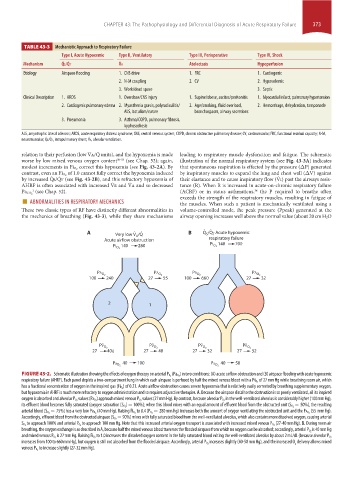
                                                                         ) in two conditions: (A) acute airflow obstruction and (B) airspace flooding with acute hypoxemic
                    FIGURE 43-2.  Schematic illustration showing the effects of oxygen therapy on arterial P O 2  (Pa O 2
                                                                                                   -
                    respiratory failure (AHRF). Each panel depicts a two-compartment lung in which each airspace is perfused by half the mixed venous blood with a Pv O 2  of 27 mm Hg while breathing room air, which
                                                      ) of 0.21. Acute airflow obstruction causes severe hypoxemia that is relatively easily corrected by breathing supplementary oxygen,
                    has a fractional concentration of oxygen in the inspired gas (Fi O 2
                    but hypoxemia in AHRF is much more refractory to oxygen administration and so requires adjunctive therapies. A. Because the airspace distal to the obstruction is so poorly ventilated, all its inspired
                                                                                          in the well-ventilated alveolus is considerably higher (100 mm Hg),
                    oxygen is absorbed and alveolar P O 2  values (Pa O 2 ) approach mixed venous P O 2  values (27 mm Hg). By contrast, because alveolar P O 2
                                                                                                                 = 50%), the resulting
                    its effluent blood becomes fully saturated (oxygen saturation [S O 2 ] = 100%); when this blood mixes with an equal amount of effluent blood from the obstructed unit (S O 2
                                                                                                                       (55  mm Hg).
                    arterial blood (S O 2  = 75%) has a very low Pa O 2  (40 mm Hg). Raising Fi O 2  to 0.4 (P O 2  = 280 mm Hg) increases both the amount of oxygen ventilating the obstructed unit and the Pa O 2
                                                     = 90%) mixes with fully saturated blood from the well-ventilated alveolus, which also contains more dissolved oxygen, causing arterial
                    Accordingly, effluent blood from the obstructed airspace (S O 2
                                                                                                           (27-40 mm Hg). B. During room air
                    S O 2  to approach 100% and arterial P O 2  to approach 100 mm Hg. Note that this increased arterial oxygen transport is associated with increased mixed venous P O 2
                                                                                                                       is 40 mm Hg
                    breathing, the oxygen exchange is as described in A, because half the mixed venous blood traverses the flooded airspace from which no oxygen can be absorbed; accordingly, arterial P O 2

                    and mixed venous P O 2  is 27 mm Hg. Raising Fi O 2  to 1.0 increases the dissolved oxygen content in the fully saturated blood exiting the well-ventilated alveolus by about 2 mL/dL (because alveolar P O 2
                                                                                    increases slightly (40-50 mm Hg), and the increased O  delivery allows mixed
                    increases from 100 to 660 mm Hg), but oxygen is still not absorbed from the flooded airspace. Accordingly, arterial P O 2  2
                          to increase slightly (27-32 mm Hg).
                    venous P O 2
            section04.indd   373                                                                                       1/23/2015   2:18:42 PM

