


Page 565 - Hall et al (2015) Principles of Critical Care-McGraw-Hill
P. 565
CHAPTER 45: Airway Management  385


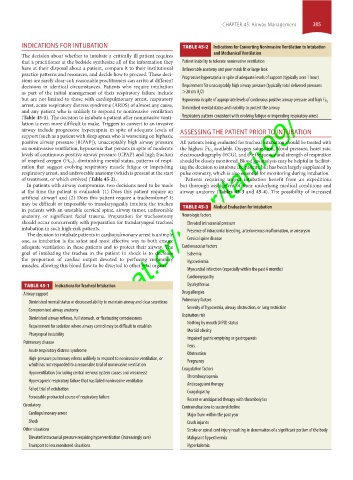
                    INDICATIONS FOR INTUBATION                              TABLE 45-2     Indications for Converting Noninvasive Ventilation to Intubation

                    The decision about whether to intubate a critically ill patient requires   and Mechanical Ventilation
                    that a practitioner at the bedside synthesize all of the information they   Patient inability to tolerate noninvasive ventilation
                    have at their disposal about a patient, compare it to their institutional   Unfavorable anatomy and poor mask fit or large leak
                    practice patterns and resources, and decide how to proceed. These deci-
                    sions are rarely clear-cut; reasonable practitioners can arrive at different   Progressive hypercapnia in spite of adequate levels of support (typically over 1 hour)
                    decisions  in  identical  circumstances.  Patients  who  require  intubation   Requirement for unacceptably high airway pressure (typically total delivered pressures
                    as part of the initial management of their respiratory failure include   >20 cm H O)
                                                                                2
                    but are not limited to those with cardiopulmonary arrest, respiratory   Hypoxemia in spite of appropriate levels of continuous positive airway pressure and high Fi O 2
                    arrest, acute respiratory distress syndrome (ARDS) of almost any cause,
                                  https://kat.cr/user/tahir99/
                    and any patient who is unlikely to respond to noninvasive ventilation   Diminished mental status and inability to protect the airway
                    (Table 45-1). The decision to intubate a patient after noninvasive venti-  Respiratory pattern consistent with evolving fatigue or impending respiratory arrest
                    lation is even more difficult to make. Triggers to convert to an invasive
                    airway  include progressive hypercapnia  in spite of adequate  levels  of   ASSESSING THE PATIENT PRIOR TO INTUBATION
                    support (such as a patient with sleep apnea who is worsening on biphasic
                    positive airway pressure [BIPAP]), unacceptably high airway pressure   All patients being evaluated for tracheal intubation should be treated with
                    on noninvasive ventilation, hypoxemia that persists in spite of moderate   the highest Fi O 2  available. Oxygen saturation, blood pressure, heart rate,
                    levels of continuous positive airway pressure (CPAP) and high fraction   electrocardiography (ECG), and the frequency and strength of respiration
                                     ), diminishing mental status, patterns of respi-  should be closely monitored. Blood gas analysis may be helpful in facilitat-
                    of inspired oxygen (Fi O 2
                    ration  that  suggest  evolving  respiratory  muscle  fatigue  or  impending   ing the decision to intubate the patient, but has been largely supplanted by
                    respiratory arrest, and unfavorable anatomy (which is present at the start   pulse oximetry, which is also essential for monitoring during intubation.
                    of treatment, or which evolves) (Table 45-2).          Patients requiring urgent intubation benefit from an expeditious
                     In patients with airway compromise, two decisions need to be made   but thorough assessment of their underlying medical conditions and
                    at the time the patient is evaluated: (1) Does this patient require an   airway anatomy (Tables 45-3 and 45-4). The possibility of increased
                    artificial airway? and (2) Does this patient require a tracheostomy? It
                    may be difficult or impossible to translaryngeally intubate the trachea
                    in patients with an unstable cervical spine, airway tumor, unfavorable     TABLE 45-3    Medical Evaluation for Intubation
                    anatomy, or significant  facial trauma. Preparation for tracheostomy   Neurologic factors
                    should occur concurrently with preparation for translaryngeal tracheal     Elevated intracranial pressure
                    intubation in such high-risk patients.                  Presence of intracranial bleeding, arteriovenous malformation, or aneurysm
                     The decision to intubate patients in cardiopulmonary arrest is a  simple
                    one, as intubation is the safest and most effective way to both ensure     Cervical spine disease
                    adequate ventilation in these patients and to protect their airway. The     Cardiovascular factors
                    goal of intubating the trachea in the patient in shock is to decrease       Ischemia
                    the   proportion of cardiac output devoted to perfusing respiratory     Hypovolemia
                      muscles, allowing this blood flow to be diverted to other vital organs.
                                                                            Myocardial infarction (especially within the past 6 months)
                                                                            Cardiomyopathy
                      TABLE 45-1    Indications for Tracheal Intubation     Dysrhythmias
                    Airway support                                        Drug allergies
                      Diminished mental status or decreased ability to maintain airway and clear secretions  Pulmonary factors
                      Compromised airway anatomy                            Severity of hypoxemia, airway obstruction, or lung restriction
                                                                          Aspiration risk
                      Diminished airway reflexes, full stomach, or fluctuating consciousness
                                                                            Nothing by mouth (NPO) status
                      Requirement for sedation where airway control may be difficult to establish
                                                                            Morbid obesity
                      Pharyngeal instability
                                                                            Impaired gastric emptying or gastroparesis
                    Pulmonary disease
                                                                            Ileus
                      Acute respiratory distress syndrome
                                                                            Obstruction
                       High-pressure pulmonary edema unlikely to respond to noninvasive ventilation, or     Pregnancy
                      which has not responded to a reasonable trial of noninvasive ventilation
                                                                          Coagulation factors
                      Hypoventilation (including central nervous system causes and weakness)
                                                                            Thrombocytopenia
                      Hypercapneic respiratory failure that has failed noninvasive ventilation
                                                                            Anticoagulant therapy
                      Failed trial of extubation
                                                                            Coagulopathy
                      Forseeable protracted course of respiratory failure    Recent or anticipated therapy with thrombolytics
                    Circulatory                                           Contraindications to succinylcholine
                      Cardiopulmonary arrest                                Major burn within the past year
                      Shock                                                 Crush injuries
                    Other situations                                        Stroke or spinal cord injury resulting in denervation of a significant portion of the body
                      Elevated intracranial pressure requiring hyperventilation (increasingly rare)    Malignant hyperthermia
                      Transport to less monitored situations                Hyperkalemia


            section04.indd   385                                                                                       1/23/2015   2:18:46 PM

