


Page 570 - Hall et al (2015) Principles of Critical Care-McGraw-Hill
P. 570
390     PART 4: Pulmonary Disorders


                                                                       is more properly used as a rescue device than an approach of first choice
                                                                       in any ICU patient who may have a full stomach. In the settings of upper
                                                                       airway bleeding or copious secretions and failed rigid laryngoscopy, it is
                                                                       reasonable to attempt to use an intubating LMA.
                                                                           ■  THE DIFFICULT AIRWAY


                                                                       The difficult airway is far more commonly encountered in the ICU and
                                                                       emergency  room  than  in  the  operating  room.  Under  these  emergent
                                                                       conditions of airway management, multiple attempts at laryngoscopy are
                                                                       common (25%-35%), and between 0.5% and 2% of patients require a sur-
                                                                       gical airway. Copious secretions and inadequate positioning are  common
                                                                       obstacles encountered in the ICU, but not in the operating room. The
                                                                       American Society of Anesthesiologists’ Difficult Airway Algorithm
                                                                         outlines the  options available to practitioners  faced with  a difficult
                                                                         airway (Fig. 45-3).  Choices for proceeding include ventilate with the
                                                                                     32
                                                                       bag and mask, summon help in the form of another operator, reposition,
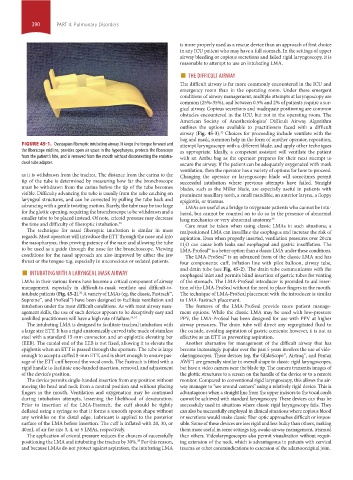
                 FIGURE 45-1.  Ovassapian fiberoptic intubating airway. It keeps the tongue forward and   attempt laryngoscopy with a different blade, and apply other techniques
                 the fiberscope midline, provides open air space in the hypopharynx, protects the fiberscope   as  appropriate.  Ideally,  a  competent  assistant  will  ventilate  the  patient
                 from the patient’s bite, and is removed from the mouth without disconnecting the endotra-  with an Ambu bag as the operator prepares for their next attempt to
                 cheal tube adapter.                                   secure the airway. If the patient can be adequately oxygenated with mask
                                                                       ventilation, then the operator has a variety of options for how to proceed.
                 as it is withdrawn from the trachea. The distance from the carina to the   Changing the  operator  or  laryngoscope blade  will  sometimes  permit
                 tip of the tube is determined by measuring how far the bronchoscope   successful intubation where previous attempts have failed. Straight
                 must be withdrawn from the carina before the tip of the tube becomes   blades, such  as the Miller blade, are  especially  useful in  patients with
                 visible. Difficulty advancing the tube is usually from the tube catching on   prominent maxillary teeth, a small mandible, an anterior larynx, a floppy
                 laryngeal structures, and can be corrected by pulling the tube back and   epiglottis, or trismus.
                 advancing with a gentle twisting motion. Rarely, the tube may be too large   LMAs are useful as a bridge to oxygenate patients who cannot be intu-
                 for the glottic opening, requiring the bronchoscope to be withdrawn and a   bated, but cannot be counted on to do so in the presence of abnormal
                 smaller tube to be placed instead. Of note, cricoid pressure may decrease   lung mechanics or very abnormal anatomy. 36
                 the time and difficulty of fiberoptic intubation. 31    Care must be taken when using classic LMAs in such situations; a
                   The  technique  for  nasal  fiberoptic  intubation  is  similar  in  most     malpositioned LMA can insufflate the esophagus and increase the risk of
                 regards. Most operators will introduce the ETT through the nose and into   aspiration. Even when properly inserted, ventilation pressures over 20 cm
                 the nasopharynx, thus proving patency of the nare and allowing the tube   H O can cause both leaks and esophageal and gastric insufflation. The
                                                                         2
                 to be used as a guide through the nose for the bronchoscope. Viewing   LMA-ProSeal™ is a better option than a classic LMA under these conditions.
                 conditions for the nasal approach are also improved by either the jaw   The LMA-ProSeal™ is an advanced form of the classic LMA and has
                 thrust or the tongue-tug, especially in unconscious or sedated patients.  four components: cuff, inflation line with pilot balloon, airway tube,
                     ■  INTUBATING WITH A LARYNGEAL MASK AIRWAY        and drain tube (see Fig. 45-2). The drain tube communicates with the
                                                                       esophageal inlet and permits blind insertion of gastric tubes for venting
                 LMAs in their various forms have become a critical component of airway   of the stomach. The LMA-ProSeal introducer is provided to aid inser-
                 management, especially in difficult-to-mask ventilate and difficult-to-  tion of the LMA-ProSeal without the need to place fingers in the mouth.
                 intubate patients (Fig. 45-2).  A variety of LMAs (eg, the classic, Fastrach™,   The technique of LMA-ProSeal placement with the introducer is similar
                                     32
                 Supreme™, and ProSeal™) have been designed to facilitate ventilation and   to LMA-Fastrach placement.
                 intubation under the most difficult conditions. As with most airway man-  The features of the LMA-ProSeal provide more patient manage-
                 agement skills, the use of such devices appears to be deceptively easy and   ment options. While the classic LMA may be used with low-pressure
                 unskilled practitioners will have a high rate of failure. 33,34  PPV, the LMA-ProSeal has been designed for use with PPV at higher
                   The intubating LMA is designed to facilitate tracheal intubation with   airway   pressures. The drain tube will direct any regurgitated fluid to
                 a large size ETT. It has a rigid anatomically curved tube made of stainless   the  outside, avoiding aspiration of gastric contents; however, it is not as
                 steel with a standard 15-mm connector, and an epiglottic elevating bar   effective as an ETT in preventing aspiration.
                 (EEB). The caudal end of the EEB is not fixed, allowing it to elevate the   Another alternative for management of the difficult airway that has
                 epiglottis when an ETT is passed through the aperture. The tube is large   become increasingly popular over the past 5 years involves the use of vide-
                 enough to accept a cuffed 8-mm ETT, and is short enough to ensure pas-  olaryngoscopes. These devices (eg, the GlideScope™, Airtraq™, and Pentax
                 sage of the ETT cuff beyond the vocal cords. The Fastrach is fitted with a   AWS™) are generally similar in overall shape to classic rigid laryngoscopes,
                 rigid handle to facilitate one-handed insertion, removal, and adjustment   but have a video camera near the blade tip. The camera transmits images of
                 of the device’s position.                             the glottic structures to a screen on the handle of the device or to a remote
                   The device permits single-handed insertion from any position  without   monitor. Compared to conventional rigid laryngoscopy, this allows the air-
                 moving the head and neck from a neutral position and without placing   way manager to “see around corners” using a relatively rigid device. This is
                 fingers  in  the  mouth.  Ventilation  and  oxygenation  may  be   continued   advantageous when a straight line from the upper incisors to the vocal cords
                 during  intubation  attempts,  lessening  the  likelihood  of  desaturation.   cannot be achieved with standard laryngoscopy. These devices can thus be
                 Prior to insertion of the LMA-Fastrach, the cuff should be tightly   successfully used in situations where classic rigid laryngoscopy fails. They
                 deflated using a syringe so that it forms a smooth spoon shape without   can also be successfully employed in clinical situations where copious blood
                 any wrinkles on the distal edge. Lubricant is applied to the posterior   or secretions would make classic fiber optic approaches difficult or impos-
                 surface of the LMA before insertion. The cuff is inflated with 20, 30, or   sible. Some of these devices are less rigid and less bulky than others, making
                 40 mL of air for size 3, 4, or 5 LMAs, respectively.  them more  useful in some settings (eg, awake airway management, trismus)
                   The application of cricoid pressure reduces the chances of successfully   than others. Videolaryngoscopes also permit visualization without requir-
                 positioning the LMA and intubating the trachea by 30%.  For this  reason,   ing  extension of the neck, which is advantageous in patients with cervical
                                                         35
                 and because LMAs do not protect against aspiration, the intubating LMA   trauma or other contraindications to extension of the atlantooccipital joint.


            section04.indd   390                                                                                       1/23/2015   2:18:52 PM

