


Page 566 - Hall et al (2015) Principles of Critical Care-McGraw-Hill
P. 566
386     PART 4: Pulmonary Disorders


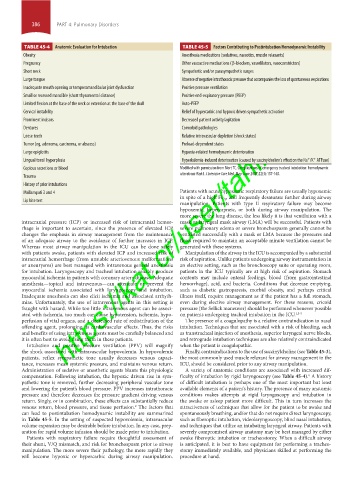
                   TABLE 45-4    Anatomic Evaluation for Intubation      TABLE 45-5    Factors Contributing to Postintubation Hemodynamic Instability
                  Obesity                                               Anesthesia medications (sedatives, narcotics, muscle relaxants)
                  Pregnancy                                             Other vasoactive medications (β-blockers, vasodilators, vasoconstrictors)
                  Short neck                                            Sympathetic and/or parasympathetic surges
                  Large tongue                                          Absence of negative intrathoracic pressure that accompanies the loss of spontaneous respirations
                  Inadequate mouth opening or temporomandibular joint dysfunction  Positive pressure ventilation
                  Small or recessed mandible (short thyromental distance)  Positive end-expiratory pressure (PEEP)
                  Limited flexion at the base of the neck or extension at the base of the skull  Auto-PEEP
                                https://kat.cr/user/tahir99/
                  Cervical instability                                  Relief of hypercarbic and hypoxic driven sympathetic activation
                  Prominent incisors                                    Decreased patient activity/agitation
                  Dentures                                              Comorbid pathologies
                  Loose teeth                                           Relative intravascular depletion (shock states)
                  Tumor (eg, adenoma, carcinoma, or abscess)            Preload-dependent states
                  Large epiglottis                                      Hypoxia-related hemodynamic deterioration
                  Lingual tonsil hyperplasia                            Hyperkalemia-induced deterioration (caused by succinylcholine’s effect on the Na /K  ATPase)
                                                                                                                   +
                                                                                                                     +
                  Copious secretions or blood                          Modified with permission from Mort TC. Complications of emergency tracheal intubation: hemodynamic
                  Trauma                                               alterations-Part I. J Intensive Care Med. May-June 2007;22(3):157-165.
                  History of prior intubations
                  Mallampati 3 and 4                                   Patients with acute hypoxemic respiratory failure are usually hypoxemic
                  Lip bite test                                        in spite of a high Fi O 2 , and frequently desaturate further during airway
                                                                       manipulation. Patients with type II respiratory failure may become
                                                                       hypoxemic,  hypercapneic,  or  both  during  airway  manipulation.  The
                                                                       more severe the lung disease, the less likely it is that ventilation with a
                 intracranial pressure (ICP) or increased risk of intracranial hemor-  mask or laryngeal mask airway (LMA) will be successful. Patients with
                 rhage  is  important  to  ascertain,  since  the  presence  of  elevated  ICP   severe pulmonary edema or severe bronchospasm generally cannot be
                 changes the emphasis in airway management from the maintenance   ventilated successfully with a mask or LMA because the pressures and
                 of  an  adequate  airway  to  the  avoidance  of  further  increases  in  ICP.   flows required to maintain an acceptable minute ventilation cannot be
                 Whereas most airway manipulation in the ICU can be done safely   generated with these systems.
                 with patients awake, patients with elevated ICP and increased risk of   Manipulation of the airway in the ICU is accompanied by a substantial
                 intracranial hemorrhage (from unstable arteriovenous malformations   risk of aspiration. Unlike patients undergoing airway instrumentation in
                 or aneurysms) are best managed with intravenous general anesthesia   an elective setting, such as the bronchoscopy suite or operating room,
                 for intubation. Laryngoscopy and tracheal intubation reliably produce   patients in the ICU typically are at high risk of aspiration. Stomach
                 myocardial ischemia in patients with coronary artery disease. Adequate     contents may include enteral feedings, blood (from gastrointestinal
                 anesthesia—topical and intravenous—can attenuate or prevent the   hemorrhage), acid, and bacteria. Conditions that decrease emptying,
                 myocardial ischemia associated with laryngoscopy and intubation.   such  as  diabetic  gastroparesis,  morbid obesity,  and  perhaps  critical
                 Inadequate anesthesia can also elicit ischemia and associated arrhyth-    illness itself, require management as if the patient has a full stomach,
                 mias. Unfortunately, the use of intravenous agents in this setting is   even  during  elective  airway  management.  For  these  reasons,  cricoid
                 fraught with hazard. While too little intravenous agent can be associ-  pressure (the Sellick maneuver) should be performed whenever possible
                 ated with ischemia, too much can cause hypotension, ischemia, hypo-  on patients undergoing tracheal intubation in the ICU. 1,3-5
                 perfusion of vital organs, and a decreased rate of redistribution of the   The presence of a coagulopathy is a relative contraindication to nasal
                 offending agent, prolonging its cardiovascular effects. Thus, the risks   intubation. Techniques that are associated with a risk of bleeding, such
                 and benefits of using intravenous agents must be carefully balanced and   as transtracheal injection of anesthesia, superior laryngeal nerve blocks,
                 it is often best to avoid using them in these patients.  and retrograde intubation techniques are also relatively contraindicated
                   Intubation and positive pressure ventilation (PPV) will magnify   when the patient is coagulopathic.
                 the shock associated with intravascular hypovolemia. In hypovolemic   Finally, contraindications to the use of succinylcholine (see Table 45-3),
                 patients, reflex sympathetic tone usually decreases venous capaci-  the most commonly used muscle relaxant for airway management in the
                 tance, increases mean systemic pressure, and maintains venous return.   ICU, should be considered prior to any airway manipulation.
                 Administration of sedative or anesthetic agents blunts this physiologic   A variety of anatomic conditions are associated with increased dif-
                 compensation. Following intubation, the hypoxic driven rise in sym-  ficulty of intubation by rigid laryngoscopy (see Table 45-4).  A history
                                                                                                                   6
                 pathetic tone is removed, further decreasing peripheral vascular tone   of difficult intubation is perhaps one of the most important but least
                 and lowering the patient’s blood pressure. PPV increases intrathoracic   available elements of a patient’s history. The presence of many anatomic
                 pressure and therefore decreases the pressure gradient driving venous   conditions makes attempts at rigid laryngoscopy and intubation in
                 return. Singly, or in combination, these effects can substantially reduce   the awake or asleep patient more difficult. This in turn increases the
                 venous return, blood pressure, and tissue perfusion.  The factors that   attractiveness of techniques that allow for the patient to be awake and
                                                        2
                 can lead to postintubation hemodynamic instability are summarized   spontaneously breathing, and/or that do not require direct laryngoscopy,
                 in  Table 45-5. In the setting of suspected hypovolemia, intravascular   such as fiberoptic intubation, videolaryngoscopy, blind nasal intubation,
                   volume expansion may be desirable before intubation. In any case, prep-  and techniques that utilize an intubating laryngeal airway. Patients with
                 aration for rapid volume infusion should be made prior to intubation.  severely compromised airway anatomy may be best managed by either
                   Patients with respiratory failure require thoughtful assessment of   awake fiberoptic intubation or tracheostomy. When a difficult airway
                 their shunt, V/Q mismatch, and risk for bronchospasm prior to  airway   is anticipated, it is best to have equipment for performing a tracheo-
                 manipulation. The more severe their pathology, the more rapidly they   stomy immediately available, and physicians skilled at performing the
                 will become hypoxic or hypercarbic during airway manipulation.     procedure at hand.


            section04.indd   386                                                                                       1/23/2015   2:18:46 PM

