


Page 567 - Hall et al (2015) Principles of Critical Care-McGraw-Hill
P. 567
CHAPTER 45: Airway Management  387


                    EQUIPMENT                                             with all of the equipment required to manage a difficult airway should
                                                                          be available to airway managers, but need not be brought to the bedside
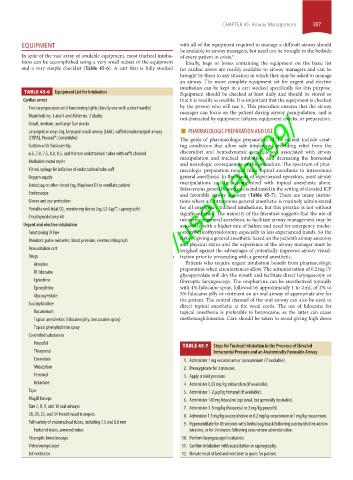
                    In spite of the vast array of available equipment, most tracheal intuba-  of every patient in crisis. 7
                    tions can be accomplished using a very small subset of the equipment   Ideally, bags or boxes containing the equipment on the basic list
                    and a very simple checklist (Table 45-6). A cart that is fully stocked   for cardiac arrest are readily available to airway managers and can be
                                                                          brought by them to any situation in which they may be asked to  manage
                                                                          an airway. The more complete equipment set for urgent and elective
                                                                          intubation can be kept in a cart stocked specifically for this purpose.
                      TABLE 45-6    Equipment List for Intubation         Equipment should be checked at least daily and should be stored so
                    Cardiac arrest                                        that it is readily accessible. It is important that the equipment is checked
                      Two laryngoscopes with functioning lights (ideally one with a short handle)  by the person who will use it. This procedure ensures that the airway
                                  https://kat.cr/user/tahir99/
                                                                          manager can focus on the patient during airway manipulation, and is
                      Macintosh no. 3 and 4 and Miller no. 3 blades
                                                                          not distracted by equipment failures, equipment checks, or preparation.
                      Small, medium, and large face masks
                       Laryngeal airways (eg, laryngeal mask airway [LMA], cuffed oropharyngeal airway     ■  PHARMACOLOGIC PREPARATION AND USE
                      [COPA], Proseal™, Combitube)                        The goals of pharmacologic preparation of the patient include creat-
                      Suction with Yankauer tip                           ing conditions that allow safe intubation, providing relief from the
                      6.5, 7.0, 7.5, 8.0, 8.5, and 9.0 mm endotracheal tubes with cuffs checked  discomfort and hemodynamic consequences associated with airway
                                                                          manipulation and tracheal intubation, and decreasing the hormonal
                      Malleable metal stylet
                                                                          and neurologic consequences of the procedure. The spectrum of phar-
                      10-mL syringe for inflation of endotracheal tube cuff  macologic preparation ranges from topical anesthesia to intravenous
                      Oxygen supply                                       general anesthesia. In the hands of experienced operators, most airway
                                                                          manipulations can be accomplished with topical anesthesia alone.
                      Ambubag or other circuit (eg, Mapleson D) to ventilate patient
                                                                          Intravenous general anesthesia is indicated in the setting of elevated ICP
                      Stethoscope                                         and  favorable airway anatomy  (Table  45-7).  There  are  many  institu-
                      Gloves and eye protection                           tions where an intravenous general anesthetic is routinely administered
                      Portable end-tidal CO  monitoring device (eg, EZ-Cap™, capnograph)  for all emergency tracheal intubations, but this practice is not without
                                  2                                       significant risks. The majority of the literature suggests that the use of
                      Cricothyroidotomy kit
                                                                          intravenous general anesthesia to facilitate airway management may be
                    Urgent and elective intubation                        associated with a higher rate of failure and need for emergency trache-
                      Functioning IV line                                 ostomy/cricothyroidotomy, especially in less experienced hands. So the
                                                                          risks of giving a general anesthetic based on the patient’s airway anatomy
                      Monitors: pulse oximeter, blood pressure, electrocardiograph  and physical status and the experience of the airway manager must be
                      Resuscitation cart                                  weighed against the advantages of potentially improved airway visual-
                      Drugs                                               ization prior to proceeding with a general anesthetic.
                       Atropine                                            Patients who require urgent intubation benefit from pharmacologic
                                                                          preparation when circumstances allow. The administration of 0.2 mg IV
                       IV lidocaine
                                                                          glycopyrrolate will dry the mouth and facilitate direct laryngoscopy or
                       Ephedrine                                          fiberoptic laryngoscopy. The oropharynx can be anesthetized topically
                       Epinephrine                                        with 4% lidocaine spray, followed by approximately 1 to 2 mL of 2% to
                                                                          5% lidocaine jelly or ointment on an oral airway of appropriate size for
                       Glycopyrrolate                                     the patient. The central channel of the oral airway can also be used to
                      Succinylcholine                                     direct topical anesthetic at the vocal cords. The use of lidocaine for
                       Rocuronium                                         topical anesthesia is preferable to benzocaine, as the latter can cause
                        Topical anesthetics (lidocaine jelly, benzocaine spray)  methemoglobinemia. Care should be taken to avoid giving high doses
                        Topical phenylephrine spray
                      Controlled substances
                       Propofol
                                                                            TABLE 45-7     Steps for Tracheal Intubation in the Presence of Elevated
                       Thiopental                                                    Intracranial Pressure and an Anatomically Favorable Airway
                       Etomidate                                            1.  Administer 1 mg vecuronium or pancuronium (if available).
                       Midazolam                                            2.  Preoxygenate for 3 minutes.
                       Fentanyl                                             3.  Apply cricoid pressure.
                       Ketamine                                             4.  Administer 0.03 mg/kg midazolam (if available).
                      Tape                                                  5.  Administer 1-2 μg/kg fentanyl (if available).
                      Magill forceps                                        6.  Administer 100 mg lidocaine (optional, but generally desirable).
                      Size 7, 8, 9, and 10 oral airways                     7.  Administer 3-5 mg/kg thiopental or 2 mg/kg propofol.
                      28, 30, 32, and 34 French nasal trumpets              8.  Administer 1.5 mg/kg succinylcholine or 0.2 mg/kg vecuronium or 1 mg/kg rocuronium.
                      Full variety of endotracheal tubes, including 7.0 and 8.0 mm    9.  Hyperventilate for 45 seconds with Ambu bag/mask following succinylcholine admin-
                        Endotrol tubes, armored tubes                        istration, or for 2 minutes following vecuronium administration.
                      Fiberoptic bronchoscope                               10.  Perform laryngoscopy/intubation.
                      Videolaryngoscope                                     11.  Confirm intubation with auscultation or capnography.
                      Jet ventilator                                        12.  Elevate head of bed and ventilate to goals for patient.


            section04.indd   387                                                                                       1/23/2015   2:18:47 PM

