


Page 573 - Hall et al (2015) Principles of Critical Care-McGraw-Hill
P. 573
CHAPTER 45: Airway Management  393


                    pressure (PEEP). The most common indications for changing ETTs   in  venous return and cardiac output.  Mechanical ventilation  is  also
                    include failure of the cuff to retain volume and pressure, occlusion of the   frequently associated with a resolution of hypoxia, hypercapnia, and
                    tube by inspissated secretions and clots, and the requirement for a differ-  dyspnea, and a proportionate decline in circulating catecholamines.  In
                                                                                                                          43
                    ent tube than the one originally inserted (eg, one of a larger diameter, or   addition, patients with obstructive lung disease can develop high levels
                    a different type such as a single- rather than a double-lumen tube). Tube   of auto-PEEP very quickly during vigorous ventilation with an Ambu
                    changes motivated by complete occlusion or cuff rupture in the face of   bag, which can be associated with hypotension. 44,45  Finally, high levels of
                    high PEEP may be dire emergencies; most other ETT changes are not.  PEEP can increase the pulmonary vascular resistance, with an associated
                     Practitioners called on to change an ETT have the advantage that the   shift of the interventricular septum into the left ventricle and decreased
                    patient already has an artificial airway, and hence the ease or difficulty   stroke volumes 46,47  (see Table 45-5).
                    of obtaining an airway has been discovered at least once for the patient.
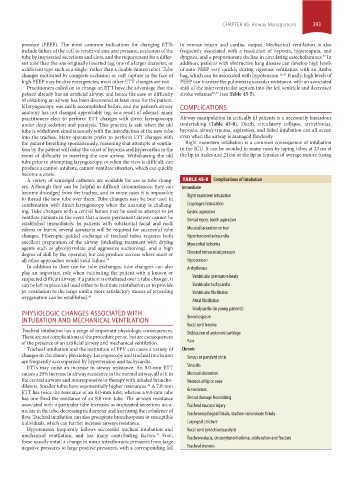
                    If laryngoscopy was easily accomplished before, and the patient’s airway   COMPLICATIONS
                    anatomy has not changed appreciably (eg, as a result of edema), many
                    practitioners elect to perform ETT changes with direct laryngoscopy   Airway manipulation in critically ill patients is a necessarily hazardous
                    under deep sedation and paralysis. This practice is safe when the old   undertaking (Table 45-8). Death, circulatory collapse, arrhythmias,
                    tube is withdrawn simultaneously with the introduction of the new tube   hypoxia, airway trauma, aspiration, and failed intubation can all occur,
                    into the trachea. Many operators prefer to perform ETT changes with   even when the airway is managed flawlessly.
                    the patient breathing spontaneously, reasoning that attempts at ventila-  Right mainstem intubation is a common consequence of intubation
                    tion by the patient will delay the onset of hypoxia and hypercarbia in the   in the ICU. It can be avoided in many cases by taping tubes at 23 cm at
                    event of difficulty in inserting the new airway. Withdrawing the old   the lip in males and 21 cm at the lip in females of average stature (using
                    tube prior to attempting laryngoscopy, or when the view is difficult, can
                    produce a cannot-intubate, cannot-ventilate situation, which can quickly
                    become a crisis.
                     A variety of semirigid catheters are available for use as tube chang-    TABLE 45-8    Complications of Intubation
                    ers. Although they can be helpful in difficult circumstances, they can   Immediate
                    become dislodged from the trachea, and in some cases it is impossible
                    to thread the new tube over them. Tube changers may be best used in     Right mainstem intubation
                    combination with direct laryngoscopy when the anatomy is challeng-    Esophageal intubation
                    ing. Tube changers with a central lumen may be used to attempt to jet     Gastric aspiration
                    ventilate patients in the event that a more permanent airway cannot be
                    established immediately. In patients with substantial facial and neck     Dental injury, tooth aspiration
                    edema or burns, several assistants will be required for successful tube     Mucosal laceration or tear
                    changes. Fiberoptic-guided exchange of tracheal tubes requires both     Hypertension/tachycardia
                    excellent preparation of the airway (including treatment with drying     Myocardial ischemia
                    agents such as glycopyrrolate and aggressive suctioning), and a high
                    degree of skill by the operator, but can produce success where most or     Elevated intracranial pressure
                    all other approaches would yield failure. 39            Hypotension
                     In addition to their use for tube exchanges, tube changers can also     Arrhythmias
                    play an important role when extubating the patient with a known or
                    suspected difficult airway. If a patient is extubated over a tube changer, it       Ventricular premature beats
                    can be left in place and used either to facilitate reintubation or to provide      Ventricular tachycardia
                    jet ventilation to the lungs until a more satisfactory means of providing      Ventricular fibrillation
                    oxygenation can be established. 40
                                                                             Atrial fibrillation
                                                                              Bradycardia (in young patients)
                    PHYSIOLOGIC CHANGES ASSOCIATED WITH                     Bronchospasm
                    INTUBATION AND MECHANICAL VENTILATION
                                                                            Vocal cord trauma
                    Tracheal intubation has a range of important physiologic consequences.     Dislocation of arytenoid cartilage
                    These are not complications of the procedure per se, but are consequences
                    of the presence of an artificial airway and mechanical ventilation.    Pain
                     Tracheal intubation and the institution of PPV can cause a variety of   Chronic
                    changes in circulatory physiology. Laryngoscopy and tracheal intubation     Serous or purulent otitis
                    are frequently accompanied by hypertension and tachycardia.
                     ETTs may cause an increase in airway resistance. An 8.0-mm ETT     Sinusitis
                    causes a 20% increase in airway resistance in the normal airway, all of it in     Mucosal ulceration
                    the central airways and nonresponsive to therapy with inhaled broncho-    Necrosis of lip or nose
                    dilators. Smaller tubes have exponentially higher resistances.  A 7.0-mm
                                                               41
                    ETT has twice the resistance of an 8.0-mm tube, whereas a 9.0-mm tube     Granulomas
                    has one-third the resistance of an 8.0-mm tube. The airways resistance     Dental damage from biting
                    associated with a particular tube increases as inspissated secretions accu-    Tracheal mucosal injury
                    mulate in the tube, decreasing its diameter and increasing the  turbulence of
                    flow. Tracheal intubation can also precipitate bronchospasm in susceptible     Tracheoesophageal fistula, tracheo-innominate fistula
                    individuals, which can further increase airways resistance.    Laryngeal stricture
                     Hypotension frequently follows successful tracheal intubation and     Vocal cord synechiae/paralysis
                    mechanical ventilation, and has many contributing factors.  First,     Tracheomalacia, cricoarytenoid edema, subluxation and fracture
                                                                 42
                    these usually entail a change in mean intrathoracic pressures from large
                    negative pressures to large positive pressures, with a corresponding fall     Tracheal stenosis


            section04.indd   393                                                                                       1/23/2015   2:18:55 PM

