


Page 577 - Hall et al (2015) Principles of Critical Care-McGraw-Hill
P. 577
CHAPTER 46: Tracheostomy  397


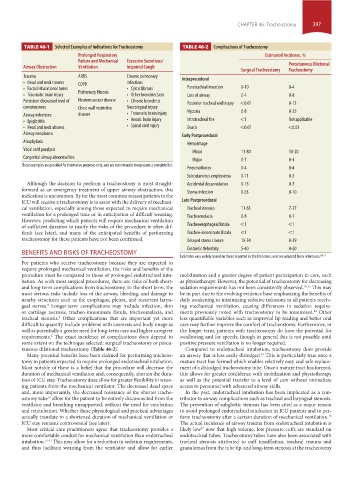
                      TABLE 46-1    Selected Examples of Indications for Tracheostomy    TABLE 46-2    Complications of Tracheostomy
                                       Prolonged Respiratory                                           Estimated Incidence, %
                                       Failure and Mechanical   Excessive Secretions/
                    Airway Obstruction  Ventilation    Impaired Cough                                          Percutaneous Dilational
                                                                                              Surgical Tracheostomy  Tracheostomy
                    Trau ma            ARDS            Chronic pulmonary   Intraprocedural
                    •  Head and neck trauma  COPD        infections
                    •  Facial/inhalational burns       •  Cystic fibrosis    Paratracheal insertion  0-10      0-4
                    •  Traumatic brain injury  Pulmonary fibrosis  •  Other bronchiectasis    Loss of airway  0-4  0-8
                    Persistent decreased level of   Neuromuscular disease  •  Chronic bronchitis    Posterior tracheal wall injury  <0.01  0-13
                      consciousness    Chest wall restrictive   Neurological injury
                    Airway infections  disease         •  Traumatic brain injury    Hypoxia   0-8              0-25
                    •  Epiglottitis                    •  Anoxic brain injury    Intratracheal fire  <1        Not applicable
                    •  Head and neck abscess           •  Spinal cord injury    Death         <0.01           <0.01
                    Airway neoplasms                                      Early Postprocedural
                    Anaphylaxis                                             Hemorrhage
                    Vocal cord paralysis                                     Minor            11-80            10-20
                    Congenital airway abnormalities                          Major            0-7              0-4
                    These examples are provided for illustrative purposes only, and are not intended to represent a complete list.
                                                                            Pneumothorax      0-4              0-4
                                                                            Subcutaneous emphysema  0-11       0-5
                     Although the decision to perform a tracheostomy is most straight-    Accidental decannulation  0-15  0-5
                    forward as an emergency treatment of upper airway obstruction, this     Stoma infection  0-63  0-10
                    indication is uncommon. By far the most common reason patients in the
                    ICU will receive a tracheostomy is to assist with the delivery of mechani-  Late Postprocedural
                    cal ventilation, especially among those expected to require mechanical     Tracheal stenosis  11-63  7-27
                    ventilation for a prolonged time or in anticipation of difficult weaning.     Tracheomalacia  0-8  0-7
                    However, predicting which patients will require mechanical ventilation
                    of sufficient duration to justify the risks of the procedure is often dif-    Tracheoesophageal fistula  <1  <1
                    ficult (see later), and many of the anticipated benefits of performing     Tracheo-innominate fistula  <1  <1
                    tracheostomy for these patients have not been confirmed.    Delayed stoma closure  10-54   0-39
                                                                            Cosmetic deformity  5-40           0-20
                    BENEFITS AND RISKS OF TRACHEOSTOMY
                                                                          Estimates vary widely based on those reported in the literature, and are adapted from references. 8,9,73
                    For patients who receive tracheostomy because they are expected to
                    require prolonged mechanical ventilation, the risks and benefits of the
                    procedure must be compared to those of prolonged endotracheal intu-  mobilization and a greater degree of patient participation in care, such
                    bation. As with most surgical procedures, there are risks of both short-   as physiotherapy. However, the potential of tracheostomy for decreasing
                    and long-term complications from tracheostomy. In the short term, the   sedation requirements has not been consistently observed. 11,13  This may
                    most serious risks include loss of the airway, bleeding, and damage to   be in part due to the evolving evidence base emphasizing the benefits of
                    nearby structures such as the esophagus, pleura, and recurrent laryn-  daily awakening to minimizing sedative infusions in all patients receiv-
                    geal nerves.  Longer-term complications may include infection, skin   ing mechanical ventilation, causing differences in sedation require-
                            8
                    or cartilage necrosis, tracheo-innominate fistula, tracheomalacia, and   ments previously noted with tracheostomy to be minimized.  Other
                                                                                                                       14
                    tracheal stenosis.  Other complications that are important yet more   less quantifiable variables such as improved lip reading and better oral
                                9
                    difficult to quantify include problems with cosmesis and body image as   care may further improve the comfort of tracheostomy. Furthermore, in
                    well as potentially a greater need for long-term care and higher caregiver   the longer term, patients with tracheostomy do have the potential for
                    requirements.   The exact  incidence  of  complications does  depend  to   swallowing and for speech; though in general this is not possible until
                              2
                    some extent on the technique selected: surgical tracheostomy or percu-  positive pressure ventilation is no longer required.
                    taneous dilational tracheostomy (Table 46-2).          Compared to endotracheal intubation, tracheostomy does provide
                     Many potential benefits have been claimed for performing tracheos-  an airway that is less easily dislodged.  This is particularly true once a
                                                                                                     15
                    tomy in patients expected to require prolonged endotracheal intubation.   mature tract has formed which enables relatively easy and safe replace-
                    Most notable of these is a belief that the procedure will decrease the   ment of a dislodged tracheostomy tube. Once a mature tract has formed,
                    duration of mechanical ventilation and, consequently, shorten the dura-  this allows for greater confidence with mobilization and physiotherapy
                    tion of ICU stay. Tracheostomy does allow for greater flexibility in wean-  as well as the potential transfer to a level of care without immediate
                    ing patients from the mechanical ventilator. The decreased dead space   access to personnel with advanced airway skills.
                    and, more importantly, the decreased resistance of the shorter trache-  In the past, endotracheal intubation has been implicated as a con-
                    ostomy tube  allow for the patient to be entirely disconnected from the   tributor to airway complications such as tracheal and laryngeal stenosis.
                            10
                    ventilator and breathing unsupported, without the need for extubation   The prevention of subglottic stenosis has been cited as a major reason
                    and reintubation. Whether these physiological and practical advantages   to avoid prolonged endotracheal intubation in ICU patients and to per-
                    actually translate to a shortened duration of mechanical ventilation or   form tracheostomy after a certain duration of mechanical ventilation.
                                                                                                                            16
                    ICU stay remains controversial (see later).           The actual incidence of airway trauma from endotracheal intubation is
                     Most critical care practitioners agree that tracheostomy provides a   likely low  now that high volume, low pressure cuffs are standard on
                                                                                 17
                    more comfortable conduit for mechanical ventilation than endotracheal   endotracheal tubes. Tracheostomy tubes have also been associated with
                    intubation. 11-13  This may allow for a reduction in sedation requirements,   tracheal stenosis attributed to cuff insufflation, tracheal trauma and
                    and thus facilitate weaning from the ventilator and allow for earlier   granulomas from the tube tip, and long-term stenosis at the tracheotomy


            section04.indd   397                                                                                       1/23/2015   2:18:56 PM

