


Page 572 - Hall et al (2015) Principles of Critical Care-McGraw-Hill
P. 572
392     PART 4: Pulmonary Disorders


                                         1. Assess the likelihood and clinical impact of basic management problems:
                                                 • Difficulty with patient cooperation or consent
                                                 • Difficult mask ventilation
                                                 • Difficult supraglottic airway placement
                                                 • Difficult laryngoscopy
                                                 • Difficult intubation
                                                 • Difficult surgical airway access
                                         2. Actively pursue opportunities to deliver supplemental oxygen throughout the process of difficult airway
                                                  management.
                                         3. Consider the relative merits and feasibility of basic management choices:
                                                • Awake intubation vs intubation after induction of general anesthesia
                                                • Non invasive technique vs invasive techniques for the initial approach to intubation
                                                • Video-assisted laryngoscopy as an initial approach to intubation
                                                • Preservation vs ablation of spontaneous ventilation
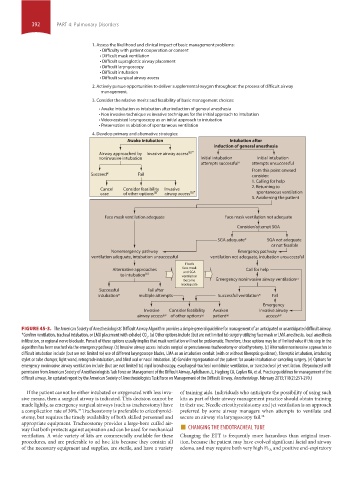
                                         4. Develop primary and alternative strategies:
                                                     Awake intubation                   Intubation after
                                                                                   induction of general anesthesia
                                            Airway approached by  Invasive airway access (b)*
                                           noninvasive intubation             Initial intubation  Initial intubation
                                                                              attempts successful*  attempts unsuccessful
                                                                                                From this point onward
                                         Succeed*        Fail                                   consider:
                                                                                                1. Calling for help
                                                                                                2. Returning to
                                            Cancel  Consider feasibility  Invasive
                                            case    of other options (a)  airway access (b)*         spontaneous ventilation
                                                                                                3. Awakening the patient

                                              Face mask ventilation adequate          Face mask ventilation not adequate
                                                                                           Consider/attempt SGA

                                                                                    SGA adequate*    SGA not adequate
                                                                                                       or not feasible
                                                Nonemergency pathway                       Emergency pathway
                                         ventilation adequate, intubation unsuccessful  ventilation not adequate, intubation unsuccessful
                                                                         If both
                                                Alternative approaches  face mask             Call for help
                                                                        and SGA
                                                   to intubation (c)    ventilation
                                                                        become      Emergency noninvasive airway ventilation (a)
                                                                        inadequate
                                            Successful      Fail after
                                           intubation*   multiple attempts          Successful ventilation*  Fail
                                                                                                   Emergency
                                                           Invasive  Consider feasibility  Awaken  invasive airway
                                                         airway access (b)*  of other options (a)  patient (d)  access (b)*

                 FIGURE 45-3.  The American Society of Anesthesiologists’ Difficult Airway Algorithm provides a simple general guideline for management of an anticipated or unanticipated difficult airway.
                 *Confirm ventilation, tracheal intubation, or LMA placement with exhaled CO . (a) Other options include (but are not limited to) surgery utilizing face mask or LMA anesthesia, local anesthesia
                                                            2
                 infiltration, or regional nerve blockade. Pursuit of these options usually implies that mask ventilation will not be problematic. Therefore, these options may be of limited value if this step in the
                 algorithm has been reached via the emergency pathway. (b) Invasive airway access includes surgical or percutaneous tracheostomy or cricothyrotomy. (c) Alternative noninvasive approaches to
                 difficult intubation include (but are not limited to) use of different laryngoscope blades, LMA as an intubation conduit (with or without fiberoptic guidance), fiberoptic intubation, intubating
                 stylet or tube changer, light wand, retrograde intubation, and blind oral or nasal intubation. (d) Consider repreparation of the patient for awake intubation or canceling surgery. (e) Options for
                 emergency noninvasive airway ventilation include (but are not limited to) rigid bronchoscopy, esophageal-tracheal combitube ventilation, or transtracheal jet ventilation. (Reproduced with
                 permission from American Society of Anesthesiologists Task Force on Management of the Difficult Airway, Apfelbaum JL, Hagberg CA, Caplan RA, et al. Practice guidelines for management of the
                 difficult airway. An updated report by the American Society of Anesthesiologists Task Force on Management of the Difficult Airway. Anesthesiology. February 2013;118(2):251-270.)

                   If the patient cannot be either intubated or oxygenated with less inva-  of training aids. Individuals who anticipate the possibility of using such
                 sive means, then a surgical airway is indicated. This decision cannot be   kits as part of their airway management practice should obtain training
                 made lightly, as emergency surgical airways (such as tracheostomy) have   in their use. Needle cricothyroidotomy and jet ventilation is an approach
                 a complication rate of 30%.  Tracheostomy is preferable to cricothyroid-  preferred by some airway managers when attempts to ventilate and
                                     37
                 otomy, but requires the timely availability of both skilled personnel and   secure an airway via laryngoscopy fail. 38
                 way that both protects against aspiration and can be used for mechanical   ■  CHANGING THE ENDOTRACHEAL TUBE
                 appropriate equipment. Tracheostomy provides a large-bore cuffed air-
                 ventilation. A wide variety of kits are commercially available for these   Changing the ETT is frequently more hazardous than original inser-
                 procedures, and are preferable to ad hoc kits because they contain all   tion, because the patient may have evolved significant facial and airway
                 of the necessary equipment and supplies, are sterile, and have a variety   edema, and may require both very high Fi O 2  and positive end-expiratory


            section04.indd   392                                                                                       1/23/2015   2:18:55 PM

