


Page 582 - Hall et al (2015) Principles of Critical Care-McGraw-Hill
P. 582
402     PART 4: Pulmonary Disorders


                                                              Cough   Secretions   GCS   Fi      Time since
                                                                                           O 2
                                                                                                 tube last
                                    Disposable cu ed                                             changed
                                     tracheostomy
                                                              ≥ 2    ≤ 25 MP  in 24  ≥ 3T  ≤ 50%   ≥ 48 hours
                                      Cu   in
ated                   hours                           in SITU
                                                            -  ≥ 24 hours o  positive pressure ventilation
                                                            -  And low risk of macro -aspiration (absence of:
                                                                uncontrolled ongoing vomiting, uncorrected tracheal-esophageal
                                                                 stula, uncontrolled gastrointestinal bleeding or any clinically
                                                                relevant pathology)

                                                              Yes?               No?

                                                                                            Reassess daily
                                    Disposable cu ed
                                     tracheostomy

                                       De
ate cu
                                                              ≥ 2    ≤ 25 MP  IN 24  ≥ 3T  ≤ 50%   ≥ 7 days
                                                                     hours                           in SITU
                                                             -   ≥ 24 hours o  positive pressure ventilation
                                                             -   And low risk of macro-aspiration 1
                                                              Yes?               No?

                                      Change to                                             Reassess daily

                                   Disposable cu ess
                                      fenestrated
                                     tracheostomy
                                                              ≥ 3    Suctioned    ≥ 8T  ≤ 50%    ≥ 24 hours
                                                                     ≤ every 4 hours                 in SITU
                                                             -   ≥ 48 hours o  positive pressure ventilation
                                                             -   And able to expectorate secretions
                                                             -   And no adventitious sounds with digital occlusion 2


                                                              Yes?               No?

                                                                                            Reassess daily
                                   Disposable cu ess
                                      fenestrated
                                     tracheostomy

                                     Trial of corking 3       ≥ 3    ≤ Q 4 H       ≥ 9  ≤ 50%    ≥ 3 days
                                                                                                     in SITU
                                                             -   Corked 48 hours continously
                                                             -   And able to expectorate secretions
                                                             -   And strong cough and phonation
                                                             -   And no further surgery planned
                                                              Yes?               No?


                                     Decannulation                                          Reassess daily

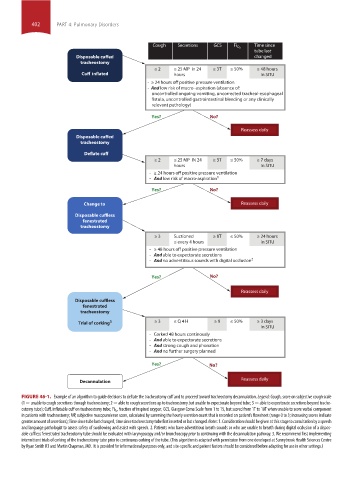
                 FIGURE 46-1.  Example of an algorithm to guide decisions to deflate the tracheostomy cuff and to proceed toward tracheostomy decannulation. Legend: Cough, score on subjective cough scale
                 (1 = unable to cough secretions through tracheostomy; 2 = able to cough secretions up to tracheostomy but unable to expectorate beyond tube; 3 = able to expectorate secretions beyond trache-
                                                  , fraction of inspired oxygen; GCS, Glasgow Coma Scale from 1 to 15, but scored from 1T to 10T when unable to score verbal component
                 ostomy tube); Cuff, inflatable cuff on tracheostomy tube; Fi O 2
                 in patients with tracheostomy; MP, subjective mucopurulence score, calculated by summing the hourly secretion count that is recorded on patient’s flowsheet (range 0 to 3; increasing scores indicate
                 greater amount of secretions); Time since tube last changed, time since tracheostomy tube first inserted or last changed. Notes: 1. Consideration should be given at this stage to consultation by a speech
                 and language pathologist to assess safety of swallowing and assist with speech. 2. Patients who have adventitious breath sounds or who are unable to breath during digital occlusion of a dispos-
                 able cuffless fenestrated tracheostomy tube should be evaluated with laryngoscopy and/or bronchoscopy prior to continuing with the decannulation pathway. 3. We recommend first implementing
                 intermittent trials of corking of the tracheostomy tube prior to continuous corking of the tube. (This algorithm is adapted with permission from one developed at Sunnybrook Health Sciences Centre
                 by Ryan Smith RT and Martin Chapman, MD.  It is provided for informational purposes only, and site-specific and patient factors should be considered before adapting for use in other settings.)


            section04.indd   402                                                                                       1/23/2015   2:18:59 PM

