


Page 669 - Hall et al (2015) Principles of Critical Care-McGraw-Hill
P. 669
488     PART 4: Pulmonary Disorders


                   Current guidelines recommend NIV as definitive and first-line     TABLE 54-2    Selection Criteria for NIV for ACRF
                 therapy for  COPD-related ACRF, 10,89,90  particularly in patients with
                 persistent hypercapnic ventilatory failure despite optimal medical   Selection Criteria
                 therapy. Most centers administer NIV via a full face  or nasal mask and   Inclusion Criteria  Exclusion Criteria (any may be present)
                                                      91
                 pressure-support ventilation, although helmet interfaces, poncho wraps,
                 and other ventilator modes can support NIV. For the dyspneic ACRF     A.  Appropriate diagnosis with potential     A.  Cardiorespiratory exclusions
                 patients who preferentially mouth breathe, a full-face mask is prefer-  reversibility (eg, AECOPD, acute left      a.  Respiratory arrest
                 able to minimize oral air leakage. The full-face mask also requires less     ventricular failure)     b.  Life-threatening hypoxemia
                 patient cooperation than the other interfaces. A tight-fitting mask allows     B.  Established need for ventilatory assistance    c.  Hemodynamically unstable requiring
                 substantial ventilatory assistance yet provides for brief periods off of the     a.  Moderate to severe respiratory distress  inotropes/pressors (unless in a critical
                 ventilator during which patients can speak, inhale nebulized medica-    b.   Accessory muscle use or abdominal   care unit)
                 tions, expectorate, and swallow liquids.                  paradox                  d.  Undrained pneumothorax
                   NIV has been systematically evaluated in several large studies. The out-    c.  Tachypnea >25 breaths/min   B.  Airway exclusions
                 comes from these studies have been synthesized by several groups. 92,93      d.   Blood gas derangement persistent      a.  Unable to protect airway
                 A Cochrane meta-analysis of 14 randomized controlled studies of   despite immediate maximum      b.  Vomiting, high aspiration risk
                 NIV versus usual medical care (UMC) included a total of 758 patients     standard medical treatment on      c.  Viscous or copious secretions
                 with ACRF.  Age ranged from 63 to 76 years, admission pH 7.26 to     controlled oxygen therapy for no      d.  Craniofacial trauma or fixed nasopha-
                          92
                                                          39 to 73 mm Hg   more than 1 hour          ryngeal abnormality
                 7.34, admission Pa CO 2  57 to 87 mm Hg, admission Pa O 2           >45 mm Hg or       e.  Recent facial, upper airway, or
                 and FEV  0.68 to 1.03 L. The eight largest studies enrolled 40 or more   pH <7.35, Pa CO 2
                        1
                 patients. Five studies were conducted in an ICU setting and the remain-  Pa O 2 /Fi O 2  <200    gastroesophageal surgery
                 der in medical wards or progressive care units. Mean duration of NIV     C.  Conscious and cooperative     f.  Facial burns
                 was 4.3 days (range, 3-10 days). The combined analysis demonstrated     a.  Able to protect airway     g.  Unable to fit mask
                 that: Treatment failure was less likely with NIV than UMC (RR 0.48;              C.  Neurocognitive exclusions
                 95% CI 0.37, 0.63) with an NNT of 5 (95% CI 4, 6) and mortality was                a.  Delirium/agitation/severe cognitive
                 reduced by 48% (RR for death 0.52; 95% CI 0.35, 0.76; NNT 10 (95%                   impairment
                 CI 7, 20). Notably, the mortality reduction was evident regardless of            D.  Other exclusions
                 whether ACRF was treated in an ICU or in a general ward. Additionally,             a.  Extreme obesity
                 there was a 60% reduction in requirement for intubation with NIV,                  b.  Patient moribund, comfort care goals
                                                       , and pH. Hospital                            in place
                 and rapid improvements in respiratory rate, Pa CO 2
                 length of stay was reduced by 3.24 days although the trend to reduced   Data from Zhu GF, Zhang W, Zong H, et al. Effectiveness and safety of noninvasive positive-pressure ven-
                 ICU  LOS  (4.71  fewer  days)  did  not  reach  significance.  Interestingly,   tilation for severe hypercapnic encephalopathy due to acute exacerbation of chronic obstructive pulmo-
                                     was heterogeneous between studies and was   nary disease: a prospective case-control study. Chin Med J (Engl). December 20, 2007;120(24):2204-2209.
                 the improvement in Pa O 2
                 not significantly different at 1 hour after initiation of treatment. The
                 finding of another meta-analysis revealed essentially similar findings   to achieve an EPAP of 2 to 5 cm H O (to counterbalance PEEPi) and
                                                                                                 2
                 for survival and clinical improvement, but subgroup analysis suggested   an IPAP can be increased by 2 to 5 cm H O every 10 minutes, to a target
                                                                                                    2
                 that the benefit was limited to patients with severe but not mild ACRF.   of 15 to 18 cm H O (equivalently, 2-5 cm H O PEEP with 13-16 cm H O
                                                                                   2
                                                                                                                         2
                                                                                                      2
                 This hypothesis has not been tested in a prospective, stratified fashion. 94  pressure support) to assist alveolar ventilation or patient tolerability has
                   NIV has been used for prolonged periods (more than 1 week) and has   been reached. 89,101  Higher pressures can sometimes be used, but they
                 been shown to relieve symptoms, reduce respiratory rate, increase tidal   tend to be limited by air leak or mask discomfort. The PEEP component
                 volume, improve gas exchange,  and lessen the amplitude of both the   of NIV is important  and does not usually cause incremental hyper-
                                                                                      102
                                        95
                 diaphragmatic electromyogram and the transdiaphragmatic pressure.    inflation.  Indeed, continuous positive airway pressure (CPAP) alone
                                                                              103
                                                                    96
                 Complications of the mask have been minor and few; local skin break-  (without ventilatory assistance) reduces the work of breathing, improves
                 down has been attributed to the tight-fitting mask but can be avoided   gas exchange, leads to subjective benefit, and sometimes can avert intuba-
                 by applying a patch of wound care dressing. Only a few patients can-  tion 104-106  when applied to patients with ACRF. When PEEP was added to
                 not tolerate face or nasal masks, and some of these patients respond   pressure-support ventilation in ventilated patients with COPD, inspira-
                 to judicious and carefully monitored use of anxiolytics. Aspiration of   tory effort fell another 17%, and patient-ventilator synchrony improved. 79
                 gastric contents has only rarely been noted in these patients, even when   The use of helium-oxygen mixtures as a driving gas for NIV has
                 a nasogastric tube is not routinely placed; however, impaired mentation   been considered attractive because of theoretically beneficial alterations
                 probably increases this risk. However, in selected patients with severe   in gas density and reduction in resistive pressure gradients across the
                 hypercapnic encephalopathy but stable hemodynamics, NIV may be as   inflamed and mucus impacted respiratory tree. However, in 204 patients
                 effective as in less cognitively impaired patients, although predictably,   with AECOPD requiring NIV for severe dyspnea and hypercarbia (Pa CO 2
                 those patients require higher levels of inspiratory pressure support and   >45 mm Hg), use of heliox (35% Fi O 2 ) as a driving gas was no less likely
                 prolonged ICU stays. 97                               to be associated with requirement for intubation than air:oxygen mix-
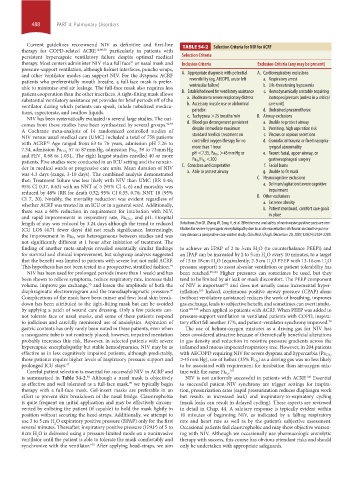
                   Careful patient selection is essential for successful NIV in ACRF and   ture with the same Fi O 2 . 107
                 is summarized in  Table  54-2.  Although a nasal mask is objectively   NIV is not uniformly successful in patients with ACRF.  Essential
                                       98
                                                                                                                  108
                 as effective and well tolerated as a full-face mask,  we typically begin   to successful patient-NIV synchrony are trigger settings for inspira-
                                                      99
                 therapy with a full-face mask. Gel-insert masks are preferable in an   tion, pressurization rates (rapid pressurization reduces diaphragm work
                 effort  to  prevent  skin  breakdown  of  the  nasal  bridge.  Claustrophobia   but results  in increased leak) and  inspiratory-to-expiratory cycling
                 is quite frequent on initial application and may be effectively circum-  (mask leaks can result in delayed cycling). These aspects are reviewed
                 vented by enlisting the patient (if capable) to hold the mask lightly in   in detail in Chap. 44. A salutary response is typically evident within
                 position without securing the head-straps. Additionally, we attempt to   10 minutes of beginning NIV, as indicated by a falling respiratory
                 use 3 to 5 cm H O expiratory positive pressure (EPAP) only for the first   rate and heart rate as well as by the patient’s subjective assessment.
                            2
                 several minutes. Thereafter, inspiratory positive pressure (IPAP) of 5 to   Occasional patients feel claustrophobic and may show objective worsen-
                 8 cm H O is delivered using a pressure limited mode on a noninvasive   ing with NIV. Although we occasionally use pharmacologic anxiolytic
                      2
                 ventilator until the patient is able to tolerate the mask comfortably and   therapy with success, this course has obvious attendant risks and should
                 synchronize with the ventilator.  After applying head-straps, we aim   only be undertaken with appropriate safeguards.
                                         100


            section04.indd   488                                                                                       1/23/2015   2:20:08 PM

