


Page 665 - Hall et al (2015) Principles of Critical Care-McGraw-Hill
P. 665
484     PART 4: Pulmonary Disorders


                                              b    c
                                                            Tidal volume

                                          Volume (L) 3.0  a  Tidal volume


                                           2.5
                                                          Dynamically determined FRC

                                                    True FRC


                                                  5                Pressure (cm H 2 O)
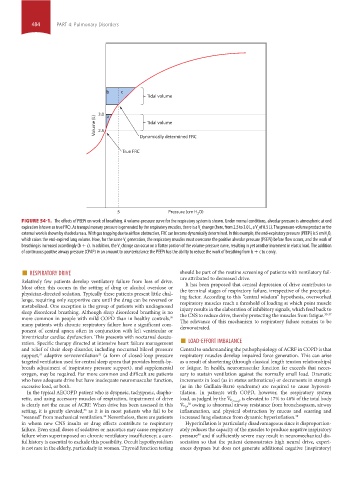
                 FIGURE 54-1.  The effects of PEEPi on work of breathing. A volume-pressure curve for the respiratory system is shown. Under normal conditions, alveolar pressure is atmospheric at end
                 expiration (shown as true FRC). As transpulmonary pressure is generated by the respiratory muscles, there is a V change (here, from 2.5 to 3.0 L, a V of 0.5 L). The pressure-volume product or the
                                                                                                  t
                                                                              t
                 external work is shown by shaded area a. With gas trapping due to airflow obstruction, FRC can become dynamically determined. In this example, the end-expiratory pressure (PEEPi) is 5 cm H O,
                                                                                                                         2
                 which raises the end-expired lung volume. Now, for the same V generation, the respiratory muscles must overcome the positive alveolar pressure (PEEPi) before flow occurs, and the work of
                                                     t
                 breathing is increased accordingly (b + c). In addition, the V change can occur on a flatter portion of the volume-pressure curve, resulting in yet another increment in elastic load. The addition
                                                   t
                 of continuous positive airway pressure (CPAP) in an amount to counterbalance the PEEPi has the ability to reduce the work of breathing from b + c to c only.
                     ■  RESPIRATORY DRIVE                              should be part of the routine screening of patients with ventilatory fail-
                 Relatively  few  patients  develop  ventilatory  failure  from  loss  of  drive.   ure attributed to decreased drive.
                                                                         It has been proposed that central depression of drive contributes to
                 Most often this occurs in the setting of drug or alcohol overdose or   the terminal stages of respiratory failure, irrespective of the precipitat-
                 physician-directed sedation. Typically these patients present little chal-
                 lenge, requiring only supportive care until the drug can be reversed or   ing factor. According to this “central wisdom” hypothesis, overworked
                                                                       respiratory muscles reach a threshold of loading at which point muscle
                 metabolized. One exception is the group of patients with undiagnosed
                 sleep disordered breathing. Although sleep disordered breathing is no   injury results in the elaboration of inhibitory signals, which feed back to
                                                                       the CNS to reduce drive, thereby protecting the muscles from fatigue.
                                                                                                                        35-37
                 more common in people with mild COPD than in healthy controls,
                                                                    30
                 many patients with chronic respiratory failure have a significant com-  The relevance of this mechanism to respiratory failure remains to be
                                                                       demonstrated.
                 ponent  of  central  apnea  often  in  conjunction  with  left  ventricular  or
                 ration. Specific therapy directed at intensive heart failure management   ■  LOAD-EFFORT IMBALANCE
                 biventricular cardiac dysfunction. This presents with nocturnal desatu-
                 and relief of their sleep disorder, including nocturnal bilevel pressure   Central to understanding the pathophysiology of ACRF in COPD is that
                 support,  adaptive servoventilation  (a form of closed-loop pressure   respiratory muscles develop impaired force generation. This can arise
                                           32
                       31
                 targeted ventilation used for central sleep apnea that provides breath-by-  as a result of shortening (through classical length tension relationships)
                 breath adjustment of inspiratory pressure support), and supplemental   or fatigue. In health, neuromuscular function far exceeds that neces-
                 oxygen, may be required. Far more common and difficult are patients   sary to sustain ventilation against the normally small load. Dramatic
                 who have adequate drive but have inadequate neuromuscular function,   increments in load (as in status asthmaticus) or decrements in strength
                 excessive load, or both.                              (as  in  the  Guillain-Barré  syndrome)  are  required  to  cause  hypoven-
                   In the typical AECOPD patient who is dyspneic, tachypneic, diapho-  tilation. In patients with COPD, however, the respiratory system
                 retic, and using accessory muscles of respiration, impairment of drive   load, as judged by the V ˙   , is elevated to 17% to 46% of the total body
                                                                                        O 2 resp
                 is clearly not the cause of ACRF. When drive has been assessed in this   V ˙ ,  owing to abnormal airway resistance from bronchospasm, airway
                                                                          38
                                                                        O 2
                 setting, it is greatly elevated,  as it is in most patients who fail to be   inflammation, and physical obstruction by mucus and scarring and
                                      33
                 “weaned” from mechanical ventilation.  Nevertheless, there are patients   increased lung elastance from dynamic hyperinflation. 39
                                             34
                 in whom new CNS insults or drug effects contribute to respiratory   Hyperinflation is particularly disadvantageous since it disproportion-
                 failure. Even small doses of sedatives or narcotics may cause respiratory   ately reduces the capacity of the muscles to produce negative inspiratory
                 failure when superimposed on chronic ventilatory insufficiency; a care-  pressure  and if sufficiently severe may result in neuromechanical dis-
                                                                             40
                 ful history is essential to exclude this possibility. Occult hypothyroidism   sociation so that the patient demonstrates high neural drive, experi-
                 is not rare in the elderly, particularly in women. Thyroid function  testing   ences dyspnea but does not generate additional negative (inspiratory)


            section04.indd   484                                                                                       1/23/2015   2:20:06 PM

