


Page 683 - Hall et al (2015) Principles of Critical Care-McGraw-Hill
P. 683
502     PART 4: Pulmonary Disorders


                        A         60                                 B        60
                           Ppk    50                   8    <0.001      Ppk   50
                                                                        (cm H 2 O)                           8  <0.02
                                  40                                          40
                           (cm H 2 O)                                         30
                                  30
                                                                        Pplat                                8  <0.01
                           Pplat  20                   8     <0.01      (cm H 2 O)  20                    2.5
                                                                              10
                                  10
                                  2.0                                                                     2.0
                                                       8     <0.01                                           8  <0.01
                                                                        V EI
                                                                        (L)                               1.5
                           V EI   1.5
                           (L)
                                                                                                          1.0
                                  1.0
                                                                V T           V T
                                                       V EI           V EI
                                                                              V EE
                                                                V EE                                      5
                                  0.5
                                                                                                          FRC
                                 FRC                                       V T  (L)  0.6    1.0    1.6
                             V I  (L/min)  100  40                         R (b/min)  27 ± 5  13 ± 3  7 ± 2
                             V T  (L)  1.0      1.0                        V E  (L/min)  16 ± 3  13 ± 3  11 ± 3
                             V E  (L/min)  13.3 ± 2.8  13.3 ± 2.8          V I  (L/min)  100  100  100
                                      157 ± 36  133 ± 34  8  <0.01          (mm Hg)                          7  NS
                             Pa O 2                                      Pa O 2   137 ± 41  157 ± 36  152 ± 25
                                      37 ± 8   37 ± 7  8     NS             (mm Hg)  38 ± 6  37 ± 8  38 ± 6  7  NS
                             Pa CO 2                                    Pa CO 2
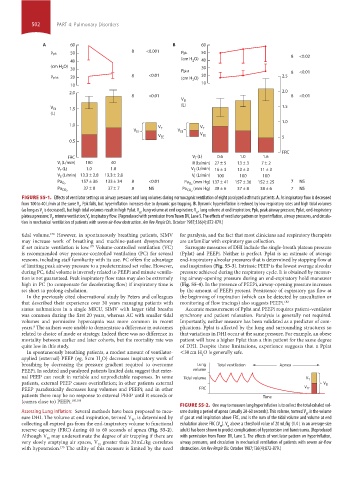
                 FIGURE 55-1.  Effects of ventilator settings on airway pressures and lung volumes during normocapnic ventilation of eight paralyzed asthmatic patients. A. As inspiratory flow is decreased
                 from 100 to 40 L/min at the same V , Ppk falls, but hyperinflation increases due to dynamic gas trapping. B. Dynamic hyperinflation is reduced by low respiratory rates and high tidal volumes
                                     E
                 (as long as V  is decreased), but high tidal volumes result in high Pplat. V , lung volume at end expiration; V , lung volume at end inspiration; Ppk, peak airway pressure; Pplat, end-inspiratory
                        E
                                                         EE
                                                                             EI
                 plateau pressure; V , minute ventilation; V, inspiratory flow. (Reproduced with permission from Tuxen DV, Lane S. The effects of ventilator pattern on hyperinflation, airway pressures, and circula-
                            E
                                        I
                 tion in mechanical ventilation of patients with severe air-flow obstruction. Am Rev Respir Dis. October 1987;136(4):872-879.)
                 tidal volume.  However, in spontaneously breathing patients, SIMV   for paralysis, and the fact that most clinicians and respiratory therapists
                           178
                 may increase work of breathing and machine-patient dyssynchrony   are unfamiliar with expiratory gas collection.
                 if set minute ventilation is low.  Volume-controlled ventilation (VC)   Surrogate measures of DHI include the single-breath plateau pressure
                                        179
                 is recommended over pressure-controlled ventilation (PC) for several   (Pplat) and PEEPi. Neither is perfect. Pplat is an estimate of average
                 reasons, including staff familiarity with its use. PC offers the advantage   end-inspiratory alveolar pressures that is determined by stopping flow at
                 of limiting peak airway pressure to a predetermined set value. However,   end inspiration (Fig. 55-3). Intrinsic PEEP is the lowest average alveolar
                 during PC, tidal volume is inversely related to PEEPi and minute ventila-  pressure achieved during the respiratory cycle. It is obtained by measur-
                 tion is not guaranteed. Peak inspiratory flow rates may also be extremely   ing airway-opening pressure during an end-expiratory hold maneuver
                 high in PC (to compensate for decelerating flow) if inspiratory time is   (Fig. 55-4). In the presence of PEEPi, airway-opening pressure increases
                 set short to prolong exhalation.                      by the amount of PEEPi present. Persistence of expiratory gas flow at
                   In the previously cited observational study by Peters and colleagues   the beginning of inspiration (which can be detected by auscultation or
                 that described their experience over 30 years managing patients with   monitoring of flow tracings) also suggests PEEPi. 182
                 status asthmaticus in a single MICU, SIMV with larger tidal breaths   Accurate measurement of Pplat and PEEPi requires patient-ventilator
                 was common during the first 20 years, whereas AC with smaller tidal   synchrony  and  patient  relaxation. Paralysis  is  generally  not  required.
                 volumes and permissive hypercapnia was more common in recent   Importantly, neither measure has been validated as a predictor of com-
                 years.  The authors were unable to demonstrate a difference in outcomes   plications. Pplat is affected by the lung and surrounding structures so
                     8
                 related to choice of mode or strategy. Indeed there was no difference in   that variations in DHI occur at the same pressure. For example, an obese
                 mortality between earlier and later cohorts, but the mortality rate was   patient will have a higher Pplat than a thin patient for the same degree
                 quite low in this study.                              of DHI. Despite these limitations, experience suggests that a Pplat
                   In spontaneously breathing patients, a modest amount of ventilator-  <30 cm H O is generally safe.
                 applied (external) PEEP (eg, 5 cm H O) decreases inspiratory work of   2
                                            2
                 breathing by decreasing the pressure gradient required to overcome   Lung  Total ventilation  Apnea
                 PEEPi. In sedated and paralyzed patients limited data suggest that exter-  volume
                 nal PEEP can result in variable and unpredictable responses. In some   Tidal volume              V T
                 patients, external PEEP causes overinflation; in other patients external                               V EI
                 PEEP  paradoxically  decreases  lung  volumes  and  PEEPi;  and  in  other   FRC                 V EE
                 patients there may be no response to external PEEP until it exceeds or            Time
                 (comes close to) PEEPi. 180,181
                                                                       FIGURE 55-2.  One way to measure lung hyperinflation is to collect the total exhaled vol-
                 Assessing Lung Inflation:  Several methods have been proposed to mea-  ume during a period of apnea (usually 20-60 seconds). This volume, termed V , is the volume
                                                                                                                  EI
                 sure DHI. The volume at end inspiration, termed V , is determined by   of gas at end inspiration above FRC, and is the sum of the tidal volume and volume at end
                                                       EI
                 collecting all expired gas from the end-inspiratory volume to functional   exhalation above FRC (V ). V  above a threshold value of 20 mL/kg (1.4 L in an average-size
                                                                                       EI
                                                                                     EE
                 reserve capacity (FRC) during 40 to 60 seconds of apnea (Fig. 55-2).   adult) has been shown to predict complications of hypotension and barotrauma. (Reproduced
                 Although V  may underestimate the degree of air trapping if there are   with permission from Tuxen DV, Lane S. The effects of ventilator pattern on hyperinflation,
                          EI
                 very slowly emptying air spaces, V  greater than 20 mL/kg correlates   airway pressures, and circulation in mechanical ventilation of patients with severe air-flow
                                           EI
                 with hypotension.  The utility of this measure is limited by the need   obstruction. Am Rev Respir Dis. October 1987;136(4):872-879.)
                              175


            section04.indd   502                                                                                       1/23/2015   2:20:15 PM

