


Page 684 - Hall et al (2015) Principles of Critical Care-McGraw-Hill
P. 684
CHAPTER 55: Status Asthmaticus  503


                                                                   Peak            Pause


                                           Pressure
                                                                          Inhalation  Exhalation


                                           Flow


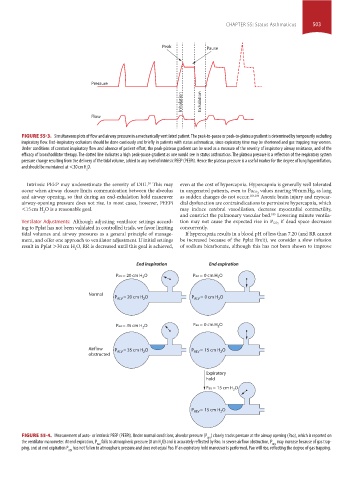
                    FIGURE 55-3.  Simultaneous plots of flow and airway pressure in a mechanically ventilated patient. The peak-to-pause or peak-to-plateau gradient is determined by temporarily occluding
                    inspiratory flow. End-inspiratory occlusions should be done cautiously and briefly in patients with status asthmaticus, since expiratory time may be shortened and gas trapping may worsen.
                    Under conditions of constant inspiratory flow and absence of patient effort, the peak-plateau gradient can be used as a measure of the severity of inspiratory airway resistance, and of the
                    efficacy of bronchodilator therapy. The dotted line indicates a high peak-pause gradient as one would see in status asthmaticus. The plateau pressure is a reflection of the respiratory system
                    pressure change resulting from the delivery of the tidal volume, added to any level of intrinsic PEEP (PEEPi). Hence the plateau pressure is a useful marker for the degree of lung hyperinflation,
                    and should be maintained at <30 cm H O.
                                          2

                     Intrinsic PEEP may underestimate the severity of DHI.  This may   even at the cost of hypercapnia. Hypercapnia is generally well tolerated
                                                               28
                    occur when airway closure limits communication between the alveolus   in oxygenated patients, even to Pa CO 2  values nearing 90 mm Hg, as long
                    and airway opening, so that during an end-exhalation hold maneuver   as sudden changes do not occur. 183,184  Anoxic brain injury and myocar-
                    airway-opening pressure does not rise. In most cases, however, PEEPi   dial dysfunction are contraindications to permissive hypercapnia, which
                    <15 cm H O is a reasonable goal.                      may  induce  cerebral vasodilation,  decrease  myocardial  contractility,
                           2
                                                                          and constrict the pulmonary vascular bed.  Lowering minute ventila-
                                                                                                         185
                    Ventilator Adjustments:  Although adjusting ventilator settings accord-  tion may not cause the expected rise in P CO 2  if dead space decreases
                    ing to Pplat has not been validated in controlled trials, we favor limiting   concurrently.
                    tidal volumes and airway pressures as a general principle of manage-  If hypercapnia results in a blood pH of less than 7.20 (and RR cannot
                    ment, and offer one approach to ventilator adjustment. If initial settings   be increased because of the Pplat limit), we consider a slow infusion
                    result in Pplat >30 cm H O, RR is decreased until this goal is achieved,   of sodium bicarbonate, although this has not been shown to improve
                                      2

                                                           End inspiration         End expiration

                                                    Pao   = 20 cm H O         Pao   = 0 cm H O
                                                             2
                                                                                      2
                                          Normal
                                                                                       2
                                                             2
                                                   P ALV  = 20 cm H O         P ALV  = 0 cm H O

                                                    Pao   = 35 cm H O         Pao   = 0 cm H O
                                                                                      2
                                                             2

                                          Airflow  P ALV  = 35 cm H O        P ALV  = 15 cm H O
                                                             2
                                                                                       2
                                          obstructed
                                                                                  Expiratory
                                                                                  hold
                                                                                  Pao   = 15 cm H O
                                                                                            2


                                                                             P ALV  = 15 cm H O
                                                                                       2


                    FIGURE 55-4.  Measurement of auto- or intrinsic PEEP (PEEPi). Under normal conditions, alveolar pressure (P ) closely tracks pressure at the airway opening (Pao), which is reported on
                                                                                   ALV
                    the ventilator manometer. At end expiration, P  falls to atmospheric pressure (0 cm H O) and is accurately reflected by Pao. In severe airflow obstruction, P  may increase because of gas trap-
                                                                                                         ALV
                                                                   2
                                             ALV
                    ping, and at end expiration P  has not fallen to atmospheric pressure and does not equal Pao. If an expiratory hold maneuver is performed, Pao will rise, reflecting the degree of gas trapping.
                                    ALV


            section04.indd   503                                                                                       1/23/2015   2:20:16 PM

