


Page 703 - Hall et al (2015) Principles of Critical Care-McGraw-Hill
P. 703
522     PART 4: Pulmonary Disorders


                 considerable financial burden imposed on the health care system by the   episodes of VAP, only three variables remained significant: duration of
                 development of VAP. 26,48,49,51-55                    mechanical ventilation of longer than 7 days before onset of VAP, prior
                     ■  ETIOLOGIC AGENTS                               antibiotic use, and prior use of broad-spectrum drugs (third-generation
                                                                       cephalosporins, fluoroquinolones  and/or imipenem).  Not all studies
                                                                                                              59
                 Microorganisms responsible for VAP differ according to the population   have confirmed this distribution pattern, and in some studies the most
                 of ICU patients, the durations of hospital and ICU stays, and the spe-  common pathogens associated with early-onset VAP were P. aeruginosa,
                 cific diagnostic method(s) used to establish the responsible pathogens.   MRSA and  Enterobacter spp, with similar pathogens associated with
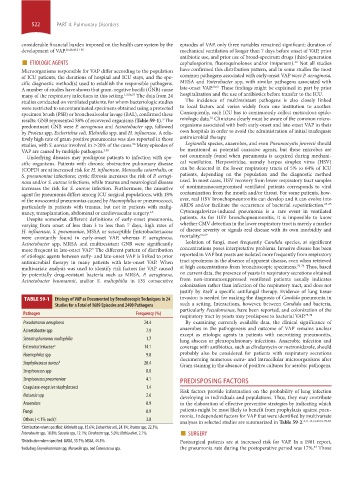
                 A number of studies have shown that gram-negative bacilli (GNB) cause   late-onset VAP. 60,61  These findings might be explained in part by prior
                 many of the respiratory infections in this setting. 1,3,56,57  The data from 24   hospitalization and the use of antibiotics before transfer to the ICU.
                 studies conducted on ventilated patients, for whom bacteriologic studies   The incidence of multiresistant pathogens is also closely linked
                 were restricted to uncontaminated specimens obtained using a protected   to local factors and varies  widely from one institution to another.
                 specimen brush (PSB) or bronchoalveolar lavage (BAL), confirmed these   Consequently, each ICU has to continuously collect meticulous epide-
                                                                                 62
                 results: GNB represented 58% of recovered organisms (Table 59-1).  The   miologic data.  Clinicians clearly must be aware of the common micro-
                                                                 3
                 predominant GNB were P. aeruginosa and Acinetobacter spp, followed   organisms associated with both early-onset and late-onset VAP in their
                 by Proteus spp, Escherichia coli, Klebsiella spp, and H. influenzae. A rela-  own hospitals in order to avoid the administration of initial inadequate
                 tively high rate of gram-positive pneumonias was also reported in those   antimicrobial therapy.
                 studies, with S. aureus involved in >20% of the cases.  Many episodes of   Legionella species, anaerobes, and even Pneumocystis jirovecii should
                                                       56
                 VAP are caused by multiple pathogens. 3,58            be mentioned as potential causative agents, but these microbes are
                   Underlying diseases may predispose patients to infection with spe-  not  commonly  found  when  pneumonia  is  acquired  during  mechani-
                 cific organisms. Patients with chronic obstructive pulmonary disease   cal  ventilation.  Herpesviridae,  namely  herpes  simplex  virus  (HSV)
                 (COPD) are at increased risk for H. influenzae, Moraxella catarrhalis, or     can be detected in the lower respiratory tracts of 5% to 64% of ICU
                 S. pneumoniae infections; cystic fibrosis increases the risk of P. aerugi-  patients, depending on the population and the diagnostic method
                 nosa and/or S. aureus infections, while trauma and neurological disease   used. In most cases, HSV recovery from lower respiratory tract samples
                 increases the risk for  S. aureus infection. Furthermore, the causative   of  nonimmunocompromised  ventilated  patients  corresponds  to  viral
                 agent for pneumonia differs among ICU surgical populations, with 18%   contamination from the mouth and/or throat. For some patients, how-
                 of the nosocomial pneumonias caused by Haemophilus or pneumococci,   ever, real HSV bronchopneumonitis can develop and it can evolve into
                 particularly  in  patients  with  trauma,  but  not  in  patients  with  malig-  ARDS and/or facilitate the occurrence of bacterial superinfection. 63-65
                 nancy, transplantation, abdominal or cardiovascular surgery. 1,3  Cytomegalovirus-induced pneumonia is a rare event in ventilated
                   Despite somewhat different definitions of early-onset pneumonia,   patients. As  for HSV  bronchopneumonitis, it  is  impossible  to know
                 varying from onset of less than 3 to less than 7 days, high rates of   whether CMV detection in the lower respiratory tract is merely a marker
                 H. influenzae, S. pneumoniae, MSSA or susceptible Enterobacteriaceae   of disease severity or signals real disease with its own morbidity and
                 were constantly found in early-onset VAP, whereas  P. aeruginosa,   mortality. 66-69
                 Acinetobacter spp, MRSA and multiresistant GNB were significantly   Isolation of fungi, most frequently  Candida species, at significant
                 more frequent in late-onset VAP.  The different pattern of distribution   concentrations poses interpretative problems. Invasive disease has been
                                         3
                 of etiologic agents between early- and late-onset VAP is linked to prior   reported in VAP but yeasts are isolated more frequently from respiratory
                 antimicrobial therapy in many patients with late-onset VAP. When   tract specimens in the absence of apparent disease, even when retrieved
                 multivariate analysis was used to identify risk factors for VAP caused   at high concentrations from bronchoscopic specimens. 70-74  Thus, based
                 by potentially drug-resistant bacteria such as MRSA,  P.  aeruginosa,   on current data, the presence of yeasts in respiratory secretions obtained
                 Acinetobacter baumannii, and/or  S. maltophilia in 135 consecutive   from non-immunosuppressed ventilated patients usually indicates
                                                                       colonization rather than infection of the respiratory tract, and does not
                                                                       justify by itself  a specific  antifungal therapy. Evidence of lung tissue
                   TABLE 59-1     Etiology of VAP as Documented by Bronchoscopic Techniques in 24   invasion is needed for making the diagnosis of Candida pneumonia in
                             Studies for a Total of 1689 Episodes and 2490 Pathogens  such a setting. Interactions, however, between  Candida and bacteria,
                                                                       particularly Pseudomonas, have been reported, and colonization of the
                  Pathogen                              Frequency (%)  respiratory tract by yeasts may predispose to bacterial VAP. 75-78
                  Pseudomonas aeruginosa                   24.4          By examining currently available data, the clinical significance of
                                                                       anaerobes in the pathogenesis and outcome of VAP remains unclear
                  Acinetobacter spp                         7.9
                                                                       except as etiologic agents in patients with necrotizing pneumonitis,
                  Stenotrophomonas maltophilia              1.7        lung abscess or pleuropulmonary infections. Anaerobic infection and
                  Enterobacteriaceae a                     14.1        coverage with antibiotics, such as clindamycin or metronidazole, should
                  Haemophilus spp                           9.8        probably also be considered for patients with respiratory secretions
                                                                       documenting numerous extra- and intracellular microorganisms after
                  Staphylococcus aureus b                  20.4        Gram staining in the absence of positive cultures for aerobic pathogens.
                  Streptococcus spp                         8.0
                  Streptococcus pneumoniae                  4.1        PREDISPOSING FACTORS
                  Coagulase-negative staphylococci          1.4
                                                                       Risk factors provide information on the probability of lung infection
                  Neisseria spp                             2.6        developing in individuals and populations. Thus, they may contribute
                  Anaerobes                                 0.9        to the elaboration of effective preventive strategies by indicating which
                  Fungi                                     0.9        patients might be most likely to benefit from prophylaxis against pneu-
                                                                       monia. Independent factors for VAP that were identified by multivariate
                  Others (<1% each) c                       3.8
                                                                       analyses in selected studies are summarized in Table 59-2. 2,11,13,14,29,51,79-83
                 a Distribution when specified: Klebsiella spp, 15.6%; Escherichia coli, 24.1%; Proteus spp, 22.3%;
                 Enterobacter spp, 18.8%; Serratia spp, 12.1%; Citrobacter spp, 5.0%; Hafnia alvei, 2.1%.    ■  SURGERY
                 b Distribution when specified: MRSA, 55.7%; MSSA, 44.3%.  Postsurgical patients are at increased risk for VAP. In a 1981 report,
                                                                                                                     84
                 c Including Corynebacterium spp, Moraxella spp, and Enterococcus spp.  the pneumonia rate during the postoperative period was 17%.  Those


            section04.indd   522                                                                                       1/23/2015   2:20:32 PM

